
Understanding Why "Stainless" Doesn't Mean "Rust-Proof" and How to Protect Everyday Kitchenware
Part 1 — The Science Behind Stainless Steel and Why Rust Can Still Appear
Introduction: "I Thought Stainless Steel Couldn't Rust..."
It often starts with a small orange spot.
Perhaps you notice it inside your favorite insulated water bottle after months of daily use. Maybe it appears on the edge of a kitchen knife, the bottom of a stainless steel pot, or near the drain of your sink.
Your first reaction is usually the same:
"How can stainless steel be rusting? Isn't it supposed to be stainless?"
It's a reasonable question—and one of the most common misconceptions about stainless steel.
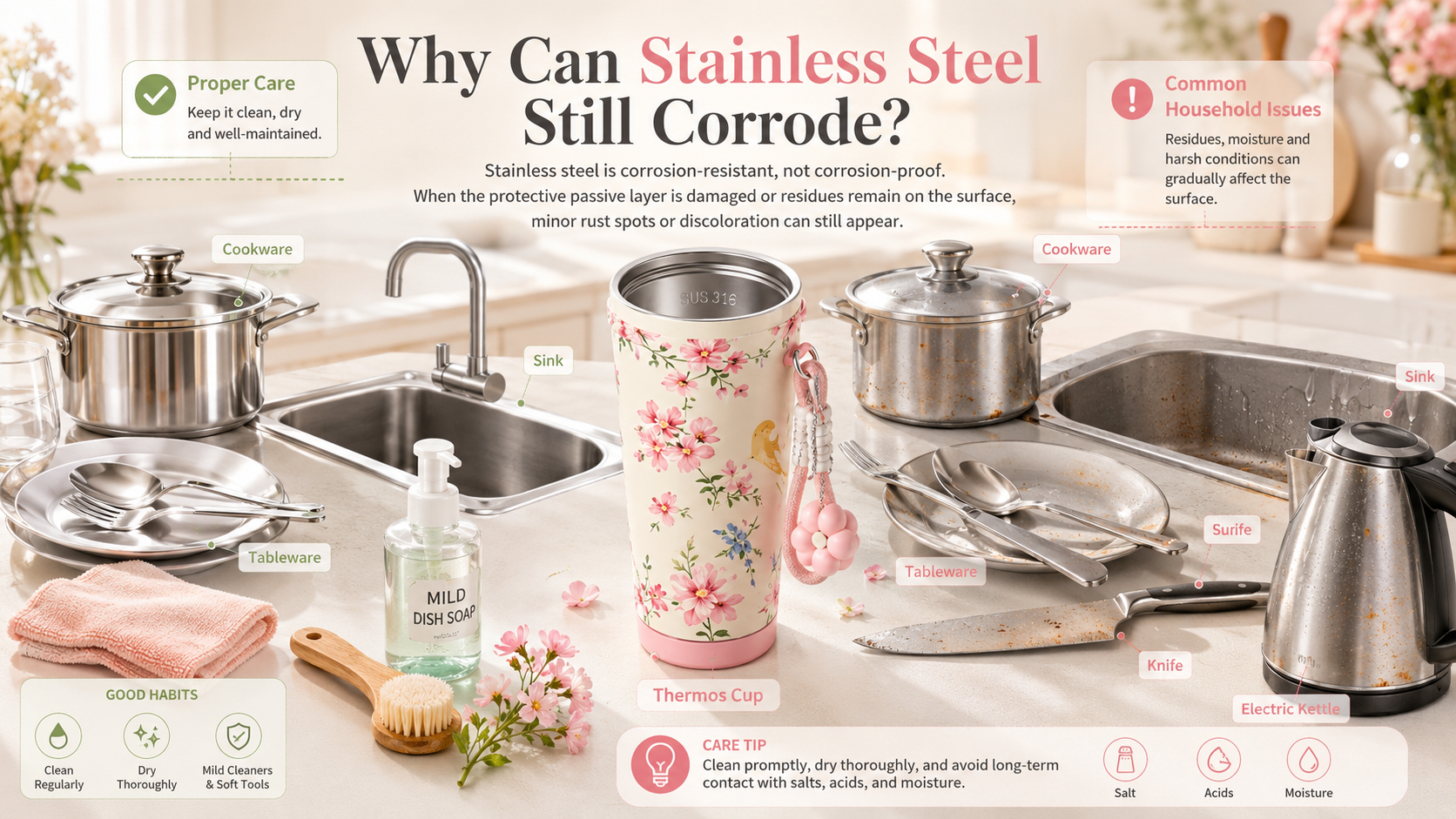
The word stainless naturally suggests that the material will never rust, stain, or corrode. In reality, stainless steel is designed to resist rust much better than ordinary steel, but it is not completely immune to it.
Under the right conditions, even high-quality stainless steel can develop small rust spots or surface discoloration.
The good news is that these issues are often preventable.
Understanding why stainless steel behaves this way helps you care for everything from reusable water bottles and cookware to kitchen utensils and sinks without unnecessary worry.
Rather than seeing rust as a sign of poor quality, it's more accurate to view it as a signal that the material has been exposed to conditions beyond what its protective surface was designed to handle.
What Does "Stainless Steel" Actually Mean?
The name "stainless steel" can be a little misleading.
It does not mean the material can never stain or rust.
Instead, it describes a family of steel alloys that contain enough chromium to create a natural protective barrier against corrosion.
That protective barrier is what makes stainless steel so valuable in kitchens around the world.
Unlike ordinary carbon steel, stainless steel actively protects itself every day.
The Secret Is Chromium
The key ingredient is chromium.
Most food-grade stainless steels contain at least around 10.5% chromium.
When chromium comes into contact with oxygen in the air—or even oxygen dissolved in water—it forms an incredibly thin, invisible layer of chromium oxide across the surface.
This layer is often called the passive layer.
Although it measures only a few nanometers thick, it plays a remarkable role.
It acts like an invisible shield, preventing oxygen and moisture from reaching the iron beneath the surface.
Without access to iron, rust cannot easily develop.
One of the most fascinating characteristics of this passive layer is its ability to repair itself.
If the surface receives a small scratch but still has access to oxygen, the chromium reacts again and forms a new protective film.
This process happens continuously throughout the life of the product.
It's one of the reasons stainless steel has become a preferred material for cookware, drinkware, kitchen appliances, and food preparation equipment.
Why Can Rust Still Appear?
If stainless steel can protect itself, why do rust spots sometimes appear?
Because the protective layer isn't indestructible.
When the passive film becomes damaged faster than it can repair itself, tiny areas of exposed iron may react with moisture and oxygen.
That is when rust begins to form.
Importantly, rust on stainless steel often starts on the surface.
It does not necessarily mean the entire product has failed.
Many cases involve only localized corrosion that can be addressed through proper cleaning and better maintenance habits.
Understanding the causes helps prevent those situations from occurring in the first place.
Common Household Causes of Rust
Contrary to popular belief, most rust problems don't originate in factories.
They develop gradually through everyday habits inside the home.
Salt: The Everyday Ingredient That Challenges Stainless Steel
Salt is one of the biggest enemies of stainless steel.
Whether it comes from cooking, salty foods, sweat, or ocean air, salt introduces chloride ions that can weaken the passive layer protecting the metal.
Examples include:
- Leaving salty soup inside a travel mug overnight.
- Allowing soy sauce or salty sauces to dry on utensils.
- Forgetting to rinse cookware after boiling salted water.
- Using bottles at the beach without washing away sea spray.
Over time, chloride exposure can create tiny weak points where corrosion begins.
Acidic Foods
Acidic foods don't automatically damage stainless steel, but prolonged contact isn't ideal.
Common examples include:
- Tomato sauce
- Lemon juice
- Vinegar-based dressings
- Citrus drinks
- Pickled vegetables
These foods are perfectly safe to prepare or consume using stainless steel cookware and drinkware.
The issue arises when they remain in prolonged contact with the surface without cleaning.
For example, storing lemon water inside an insulated bottle for several consecutive days is very different from drinking it during an afternoon hike.
Constant Moisture
Water itself is usually not a problem.
Moisture that remains trapped for long periods can be.
This is especially true when moisture combines with minerals or food residue.
Common situations include:
- Bottles stored while still wet.
- Wet dishcloths left inside sinks.
- Cookware stacked before drying.
- Lids closed immediately after washing.
Allowing products to dry thoroughly helps preserve the passive layer while reducing opportunities for residue to accumulate.
Hard Water Deposits
In many regions, tap water contains dissolved calcium and magnesium.
As water evaporates, these minerals remain behind.
Although mineral deposits themselves are not rust, they may trap moisture against the surface and make routine cleaning more difficult.
Over time, heavy scale can hide developing corrosion underneath.
Regular cleaning prevents this gradual buildup.
Surface Scratches
Minor scratches are part of everyday use.
Most are harmless because the passive layer reforms naturally.
However, repeated abrasion from aggressive cleaning tools can make recovery more difficult.
Using steel wool, metal brushes, or highly abrasive scouring pads may create unnecessary wear.
Soft cloths, bottle brushes, and non-abrasive sponges remain the safer choice for long-term maintenance.
Harsh Cleaning Chemicals
Some household cleaning products are simply stronger than stainless steel requires.
Chlorine bleach deserves particular attention.
Although effective as a disinfectant in many situations, prolonged contact with stainless steel can increase the likelihood of corrosion.
Whenever possible, choose cleaning methods recommended by the product manufacturer.
Warm water, mild dish soap, baking soda, and occasional diluted white vinegar are sufficient for most household maintenance.
Does Every Type of Stainless Steel Perform the Same?
Another common misunderstanding is that all stainless steel products are identical.
In reality, several food-grade stainless steel alloys are commonly used in kitchens.
The most familiar include:
304 Stainless Steel
Often described as 18/8 stainless steel, this material offers an excellent balance between corrosion resistance, durability, and affordability.
It is widely used in reusable water bottles, cookware, kitchen sinks, and utensils.
For most households, it provides excellent long-term performance when properly maintained.
316 Stainless Steel
316 stainless steel contains a small amount of molybdenum, which improves resistance to chloride exposure.
Because of this, it is often chosen for premium insulated bottles and products intended for coastal environments.
People living near the ocean or frequently using bottles outdoors may appreciate its additional corrosion resistance.
18/10 Stainless Steel
Frequently found in premium cookware and cutlery, 18/10 stainless steel contains slightly more nickel than 18/8.
This contributes to improved shine and corrosion resistance while maintaining excellent food safety.
For everyday kitchen use, all three materials perform exceptionally well.
The differences become more noticeable only under demanding environments such as prolonged salt exposure or coastal climates.
Rust Isn't Always Rust
One reason many people worry unnecessarily is because several common stains resemble rust.
For example:
A brown mark inside a tea bottle may simply be tea tannins.
A white ring near the bottom of a kettle may be hard water scale.
Rainbow-colored discoloration on cookware often results from harmless heat tint rather than corrosion.
Learning to distinguish these surface changes helps avoid unnecessary concern.
Not every discoloration means your cookware or bottle is damaged.
Sometimes, it's simply evidence of everyday use.
Understanding the Material Changes the Way We Care for It
Once you understand how stainless steel protects itself, the name "stainless" begins to make much more sense.
The material is remarkably durable—but not invincible.
Its performance depends on a delicate protective layer that quietly repairs itself every day.
Most rust problems begin not because the stainless steel is defective, but because everyday conditions—salt, moisture, harsh cleaners, or neglected residue—temporarily overwhelm that protective system.
The encouraging news is that these conditions are largely within our control.
Part 2 — Identifying Rust, Preventing Corrosion, and Helping Stainless Steel Last for Years
Is It Really Rust? Learning to Tell the Difference
One of the biggest reasons people become concerned about stainless steel is that not every stain looks the same.
A small orange spot inside a bottle may indeed be surface rust.
A brown film inside a tea flask may simply be tea tannins.
A white chalky ring near the bottom of a kettle could be mineral deposits from hard water.
Because these marks often appear similar at first glance, they are frequently mistaken for one another.
Learning the difference can save unnecessary cleaning, prevent accidental damage, and help you know when a product truly needs attention.
Surface Rust
Surface rust usually appears as small orange or reddish-brown spots.
It often develops around scratches, welded joints, or areas where moisture has remained for extended periods.
Unlike severe corrosion found on untreated steel, surface rust on quality stainless steel is often limited to a small area and can frequently be removed if addressed early.
Tea Tannin Stains
Tea stains tend to form a smooth brown or amber-colored film rather than isolated rust spots.
They are caused by natural plant compounds known as tannins rather than corrosion.
Unlike rust, tannin stains are generally uniform and commonly appear inside reusable bottles used for black tea or other dark teas.
These stains are cosmetic and usually respond well to routine cleaning.
Hard Water Deposits
Mineral deposits usually appear white, gray, or chalky.
They often collect along the water line or at the bottom of kettles and bottles.
Although they are not harmful to stainless steel by themselves, heavy buildup can trap moisture and make routine maintenance more difficult.
Heat Tint
People who cook frequently sometimes notice blue, purple, or rainbow-colored areas on stainless steel cookware.
This discoloration is known as heat tint.
It results from changes in the thickness of the protective oxide layer caused by high cooking temperatures.
Heat tint is not rust and generally does not affect the safety or performance of the cookware.
Everyday Habits That Can Shorten the Life of Stainless Steel
Most stainless steel products are designed to last for many years.
In many cases, premature corrosion is linked not to manufacturing defects but to everyday habits that gradually challenge the material's protective surface.
Fortunately, these habits are easy to improve.
Leaving Salty Foods for Too Long
Salt is one of the most common contributors to localized corrosion.
While stainless steel is perfectly suitable for cooking salty foods, it is not intended for storing them indefinitely.
For example:
- Leaving soup in a pot overnight.
- Storing soy-based sauces in containers for several days.
- Forgetting seafood residue on kitchen utensils.
- Leaving sports drinks inside bottles after exercise.
Rinsing and washing promptly after use significantly reduces unnecessary exposure.
Closing Bottles Before They Are Dry
Many people wash a bottle and immediately tighten the lid before putting it away.
While this seems harmless, trapped moisture creates an environment where residue can remain longer than necessary.
Allowing bottles to air dry with the lid removed helps maintain freshness while supporting long-term care.
Using Abrasive Cleaning Tools
A clean bottle should not require excessive force.
Steel wool, coarse scouring pads, and metal brushes can gradually roughen polished stainless steel surfaces.
These microscopic scratches increase the likelihood that future residue will cling to the surface.
Soft bottle brushes, microfiber cloths, and non-abrasive sponges are generally sufficient for household cleaning.
Ignoring Small Rust Spots
Tiny rust spots rarely improve on their own.
Addressing them early is much easier than waiting until they become more noticeable.
Routine inspection during regular cleaning allows small issues to be corrected before they spread.
Living Near the Coast: Why Location Matters
One factor that many people overlook is geography.
If you live near the ocean, stainless steel experiences different environmental conditions than it would inland.
Sea air contains microscopic salt particles carried by the wind.
Even if you never place your bottle in seawater, these airborne chlorides can settle on outdoor furniture, kitchen windows, bicycles, and reusable drinkware.
Countries throughout Southeast Asia and South America provide excellent examples.
Coastal communities in the Philippines, Indonesia, Malaysia, Thailand, Vietnam, Brazil, Chile, Peru, and Uruguay often experience warm, humid climates combined with salt-laden air.
For households in these regions, simple maintenance habits become even more valuable.
Regular rinsing, thorough drying, and avoiding prolonged salt exposure can noticeably extend the appearance and performance of stainless steel products.
For users who frequently spend time near the ocean, premium 316 stainless steel may also provide additional peace of mind because of its improved resistance to chloride-rich environments.
A Simple Maintenance Routine for Everyday Kitchenware
Good maintenance doesn't require expensive products.
Consistency is usually more important than complexity.
After Every Use
- Empty beverages promptly.
- Rinse with clean water.
- Wash with warm water and mild dish soap whenever possible.
Once Each Week
- Clean bottle lids thoroughly.
- Remove silicone seals if the design allows.
- Inspect threads and narrow openings for hidden residue.
Once Each Month
- Deep clean according to the type of residue.
- Use baking soda to help reduce lingering odors.
- Use diluted white vinegar to remove mineral deposits if necessary.
- Check for unusual discoloration or early signs of surface rust.
Long-Term Care
Store bottles, cookware, and utensils in clean, dry environments.
Avoid leaving food or beverages inside containers for extended periods.
Simple habits performed consistently are often the most effective form of corrosion prevention.
Can Surface Rust Be Removed?
In many household situations, yes.
Small areas of surface rust can often be removed without replacing the product.
The appropriate cleaning method depends on the manufacturer's recommendations, but many homeowners successfully remove light surface rust using gentle stainless steel cleaners or a soft paste made from baking soda and water.
After cleaning, rinse thoroughly and dry completely.
If rust continues to reappear in the same location despite proper care, or if corrosion becomes deep or widespread, replacing the product may be the safer choice.
Fortunately, such situations are uncommon for quality food-grade stainless steel that receives regular maintenance.
Choosing Stainless Steel Products That Are Easier to Maintain
Good design makes maintenance easier from the very beginning.
When selecting reusable bottles, cookware, or kitchen accessories, consider features such as:
- Food-grade 304 or 316 stainless steel.
- Smooth interior finishes that reduce residue buildup.
- Wide openings for easier cleaning.
- Removable silicone seals.
- Durable construction with minimal hidden crevices.
- Clear manufacturer care instructions.
These features not only simplify cleaning but also help preserve the protective passive layer over years of everyday use.
Stainless Steel Is Built for Daily Life
One of the reasons stainless steel remains so popular is its remarkable balance of durability, hygiene, and ease of care.
It performs reliably in busy kitchens, daily commutes, family meals, outdoor adventures, and countless refills throughout the day.
Like any material, however, it performs best when used as intended.
Understanding why rust occasionally appears helps replace unnecessary concern with practical knowledge.
Instead of assuming that every stain signals failure, we learn to recognize the difference between normal signs of use and conditions that require attention.
Conclusion
Despite its name, stainless steel was never designed to be completely immune to rust.
It was designed to resist corrosion through an invisible chromium-rich passive layer that continually protects the surface under normal conditions.
Most household rust problems arise not because the material is poor, but because everyday factors—such as salt, trapped moisture, harsh cleaners, or neglected residue—temporarily overwhelm that protective layer.
Fortunately, preventing corrosion is usually straightforward.
Routine washing, proper drying, gentle cleaning tools, and avoiding prolonged exposure to salt and moisture can significantly extend the life of reusable bottles, cookware, sinks, and kitchen utensils.
In the end, stainless steel doesn't demand complicated care.
It simply rewards consistent care.
With a little attention and an understanding of how the material works, high-quality stainless steel products can remain attractive, functional, and dependable for many years—making them one of the most practical and sustainable choices for modern kitchens.
References
The following references provide authoritative background information on stainless steel, corrosion resistance, food-contact materials, and household maintenance:
- World Stainless Association. Educational resources on stainless steel composition, corrosion resistance, passive layers, and everyday applications.
- British Stainless Steel Association (BSSA). Technical guidance on stainless steel grades, cleaning, maintenance, and corrosion prevention in domestic environments.
- Specialty Steel Industry of North America (SSINA). Care and Cleaning of Stainless Steel—practical recommendations for maintaining stainless steel surfaces in homes and commercial settings.
- International Stainless Steel Forum (ISSF). Publications explaining the science of stainless steel, durability, sustainability, and corrosion mechanisms.
- American Iron and Steel Institute (AISI). Reference information on stainless steel grades and material properties commonly used in consumer products.
- ASM International. Resources on corrosion science, passive oxide films, and stainless steel metallurgy.
- International Organization for Standardization (ISO). Standards related to stainless steel materials, food-contact applications, and quality management systems.
- U.S. Food & Drug Administration (FDA). Guidance on food-contact materials and safe use of food preparation equipment.
- Davis, J. R. (Ed.). Stainless Steels. ASM International. A comprehensive reference on stainless steel metallurgy, corrosion behavior, and maintenance.
- Sedriks, A. J. Corrosion of Stainless Steels. Wiley-Interscience. A foundational text on the mechanisms of stainless steel corrosion and passive film protection.
Note: Care recommendations may vary depending on the specific manufacturer and product design. For insulated bottles, cookware, and kitchen tools, always follow the cleaning and maintenance instructions provided by the manufacturer in addition to general best practices.