
The Science Behind Tea Stains, Bottle Discoloration, and Smarter Drinkware Care
Part 1 — Understanding Tea Tannins and Why Bottles Change Color
Introduction: Your Bottle Isn't Dirty—It's Telling the Story of Your Tea
You make a fresh cup of black tea before heading to work.
It stays warm in your insulated bottle for hours, tasting just as comforting as it did when you first poured it. At the end of the day, you empty the bottle, give it a quick rinse, and place it on the drying rack.
The next morning, you notice something different.
The inside of the bottle no longer looks as bright as it once did.
Instead, a faint golden-brown ring has appeared around the bottom. A few weeks later, the stain has become darker. Even after washing with dish soap, a light brown tint remains.
If you've ever wondered why this happens, you're not alone.
Tea lovers around the world ask the same questions:
- Why does my reusable bottle turn brown?
- Is the stain caused by bacteria?
- Does tea damage stainless steel?
- Should I replace my bottle?
- Is there something wrong with the tea?
Fortunately, the answer is reassuring.
In most cases, the brown color is not a sign of poor hygiene or a damaged bottle. It is the natural result of compounds found in tea called tannins gradually bonding to the bottle's surface.
Understanding how tannins behave can help you clean more effectively, choose the right drinkware, and enjoy your favorite teas without worrying about permanent damage.
The bottle isn't becoming dirty.
It's simply carrying the fingerprints of every cup you've enjoyed.
What Are Tea Tannins?
To understand why tea leaves stains, we first need to understand tannins.
Tannins are naturally occurring polyphenols, a large family of plant compounds found in many fruits, vegetables, seeds, bark, wine, cocoa, and, of course, tea leaves.
In nature, tannins serve several purposes.
They help protect plants against insects and environmental stress while also contributing to the plant's structure and longevity.
For tea drinkers, tannins are responsible for several familiar characteristics:
- The rich amber or reddish-brown color of brewed tea.
- The slight dryness or astringency you feel on your tongue.
- Part of the tea's depth and complexity.
- Some of the antioxidants associated with tea consumption.
Rather than being unwanted chemicals, tannins are an essential part of what makes tea taste and look the way it does.
Without tannins, black tea would lose much of its distinctive character.
Why Do Tannins Turn Bottles Brown?
The simple answer is that tannins naturally like to attach themselves to surfaces.
The scientific explanation is slightly more interesting.
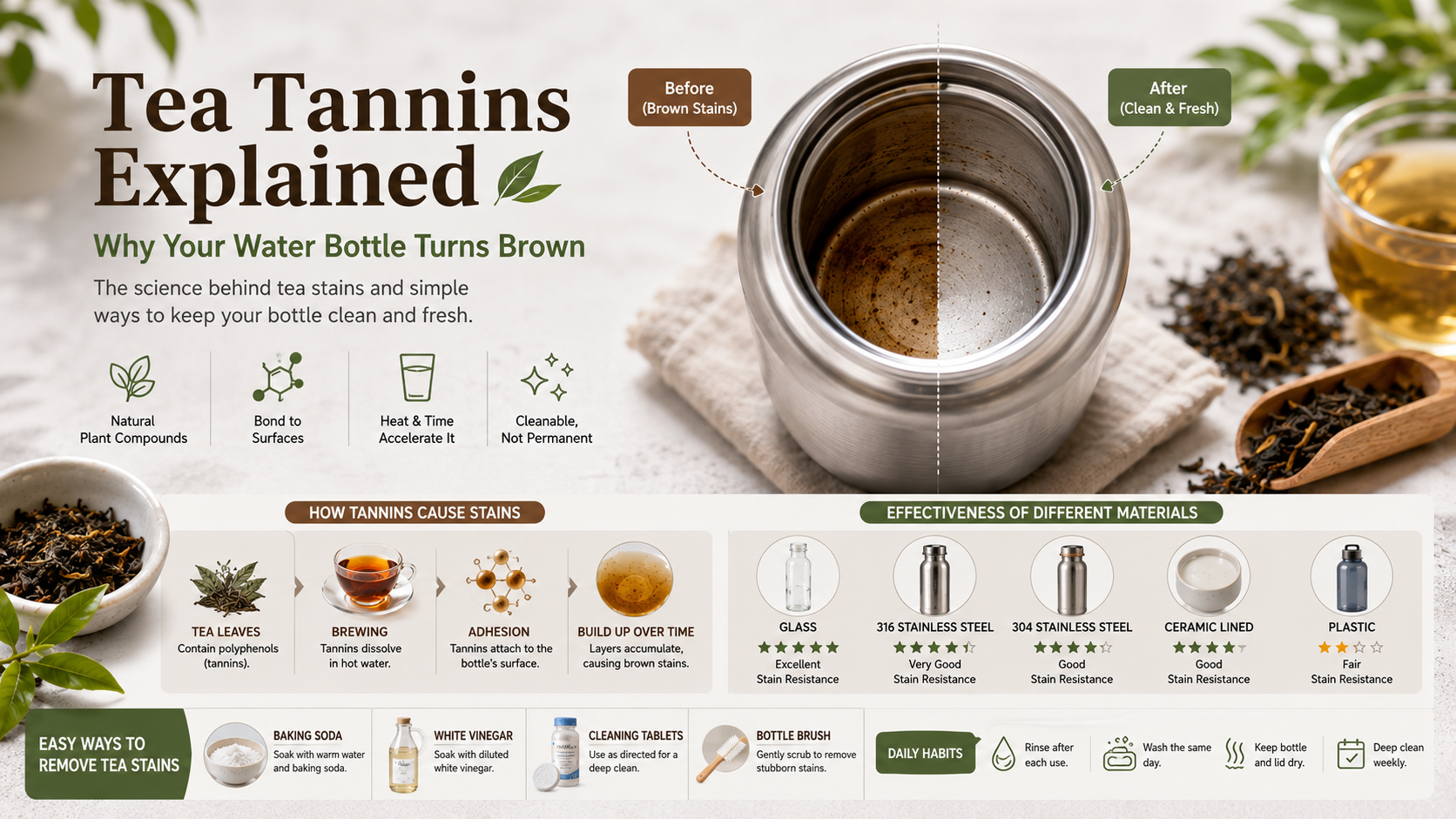
When tea is brewed with hot water, tannins dissolve into the liquid.
As the tea sits inside a bottle, these dissolved compounds come into contact with the bottle's interior.
Over time, tiny amounts begin attaching to the surface through a process known as adsorption.
Unlike absorption, where a substance moves into a material, adsorption occurs when molecules cling to the outer surface.
Each cup leaves behind only a microscopic layer.
By itself, that layer is almost invisible.
After hundreds of cups, however, those layers gradually build upon one another.
The result is the familiar golden or brown discoloration seen inside many reusable bottles.
The stain develops slowly enough that many people don't notice it until months later.
Heat Makes the Process Faster
Temperature plays an important role in stain formation.
Most tea is enjoyed hot, often between 70°C and 100°C (158–212°F), depending on the variety.
Higher temperatures increase molecular movement.
This allows tannins to interact more actively with the bottle's surface.
At the same time, as hot tea gradually cools inside the bottle, small amounts of dissolved compounds remain behind after the liquid is emptied.
Repeated heating and cooling cycles encourage these microscopic layers to accumulate.
This explains why bottles used exclusively for hot tea often discolor more quickly than those used for iced tea.
Tea Stains Are Different from Coffee Residue
Although tea and coffee are often grouped together, they leave behind very different types of residue.
Coffee is primarily an oil-based challenge.
Natural coffee oils contain aromatic compounds that cling to lids, silicone seals, and drinking spouts, often leaving behind lingering odors even after washing.
Tea behaves differently.
Instead of oils, tea contains higher concentrations of tannins and plant pigments.
These compounds rarely create strong lingering smells.
Instead, they gradually produce visible staining.
A useful way to remember the difference is this:
Coffee usually affects flavor and aroma.
Tea usually affects appearance.
Neither is necessarily harder to clean—they simply require different approaches.
Not Every Tea Leaves the Same Amount of Staining
One of the biggest misconceptions about tea stains is that every variety behaves the same way.
In reality, different teas contain different concentrations of tannins and pigments.
Some leave visible stains surprisingly quickly.
Others leave almost none.
Black Tea
Black tea undergoes the highest degree of oxidation during processing.
This creates the rich color and bold flavor many people enjoy.
It also makes black tea one of the most likely varieties to produce noticeable bottle stains.
For daily drinkers, gradual discoloration is completely normal.
Oolong Tea
Oolong teas vary considerably depending on their level of oxidation.
Heavily oxidized oolongs behave similarly to black tea, while lighter styles leave fewer visible marks.
Pu-erh Tea
Pu-erh develops its own distinctive characteristics through fermentation and aging.
Its deep color may contribute to gradual staining over time, especially with frequent use.
Green Tea
Green tea experiences minimal oxidation during processing.
As a result, it generally leaves lighter stains than black tea.
However, long-term daily use can still produce noticeable discoloration.
White Tea
White tea contains relatively low levels of oxidized pigments.
Its delicate appearance is usually reflected in lighter staining.
Herbal Infusions
Technically, many herbal teas are not true teas because they are not made from Camellia sinensis leaves.
Nevertheless, some herbal ingredients can stain surprisingly well.
Hibiscus, butterfly pea flower, turmeric, and berry blends all contain powerful natural pigments capable of leaving colorful residue.
Water Quality Also Matters
Tea itself is only one part of the equation.
The water used to brew it also influences stain formation.
Hard water contains higher concentrations of minerals such as calcium and magnesium.
These minerals can interact with tea compounds, encouraging additional deposits inside kettles, mugs, and reusable bottles.
In regions with particularly hard water, tea stains may appear sooner even when cleaning habits remain unchanged.
Soft water generally produces fewer mineral deposits, although tannins alone can still gradually stain bottle surfaces.
This subtle interaction explains why two people drinking the same tea may notice different staining patterns.
Why Bottle Materials React Differently
The material inside your bottle influences how easily tannins attach and how simple they are to remove.
Stainless Steel
Food-grade stainless steel offers excellent resistance to corrosion and remains one of the best materials for tea drinkers.
Its smooth surface slows tannin buildup compared with rougher materials.
When stains do appear, they are usually superficial rather than permanent.
Glass
Glass is naturally non-porous and highly resistant to flavor transfer.
Tea stains are generally easier to remove because tannins struggle to bond strongly to its smooth surface.
For people who enjoy observing the color of their tea, glass remains one of the cleanest options.
Ceramic
Ceramic interiors also resist staining well when the glaze remains intact.
Small cracks or worn coatings, however, may gradually collect more residue.
Plastic
Plastic bottles often develop tiny surface scratches through everyday use.
Although these scratches are usually harmless, they create additional microscopic spaces where tannins can settle.
As a result, discoloration may become more noticeable over time.
Silicone Components
Silicone seals and gaskets deserve special attention.
While they are less likely to become visibly brown than bottle walls, they can still trap tea residue in narrow grooves if not cleaned regularly.
Is the Brown Color Actually Harmful?
One of the most common concerns among tea drinkers is whether brown stains indicate bacteria or mold.
In most cases, the answer is no.
Tea stains themselves are primarily composed of natural plant compounds rather than harmful microorganisms.
A clean bottle may still develop visible discoloration simply because tannins gradually accumulate over time.
However, this does not mean cleaning can be ignored.
If tea residue combines with leftover milk, sugar, fruit, or prolonged moisture, microbial growth becomes more likely.
Regular washing remains essential—not because tannins are dangerous, but because every reusable bottle benefits from good hygiene.
Understanding the Difference Changes Everything
The moment you understand what tannins actually are, tea stains become much less mysterious.
Your bottle is not turning brown because it is defective.
It is not becoming unsafe simply because a light stain has appeared.
Instead, it is responding naturally to one of tea's defining characteristics.
Every cup leaves behind an almost invisible layer of plant compounds.
Over weeks and months, those layers slowly become visible.
The good news is that most of these stains are manageable, preventable, and rarely permanent.
In Part 2, we'll compare how different bottle materials handle tea stains, explore the safest and most effective ways to remove tannin buildup, explain whether dedicated tea bottles are worth considering, and share simple daily habits that keep reusable drinkware looking clean for years.
Part 2 — Removing Tea Stains, Choosing Better Drinkware, and Building Smarter Tea Habits
Which Bottle Material Resists Tea Stains Best?
Now that we understand why tannins gradually attach themselves to bottle surfaces, an important question naturally follows:
Does the material of your bottle make a difference?
The answer is yes—but perhaps not as dramatically as many people expect.
No reusable bottle is completely immune to tea stains. However, different materials influence how quickly stains develop and how easily they can be removed.
Food-Grade Stainless Steel
High-quality 18/8 (304) and 316 stainless steel remain among the best choices for everyday tea drinkers.
Their polished, non-porous surfaces slow tannin adhesion and allow stains to be removed relatively easily with routine cleaning.
When brown discoloration appears, it is usually a thin surface layer rather than permanent damage to the metal.
For commuters, travelers, and office workers, stainless steel continues to offer one of the best balances between durability, insulation, hygiene, and ease of maintenance.
Glass
Glass is widely regarded as one of the most chemically stable drinkware materials.
Because its surface is exceptionally smooth, tannins struggle to establish a strong bond.
Visible stains generally remove easily with ordinary washing or occasional deep cleaning.
Glass also offers an additional benefit for tea enthusiasts: it allows the natural color of different teas to be appreciated while brewing or drinking.
Its primary limitation remains durability during travel.
Ceramic-Lined Drinkware
Ceramic-coated bottles have become increasingly popular among tea and coffee drinkers because they preserve flavor exceptionally well.
As long as the ceramic coating remains intact and free from chips, it offers excellent resistance to flavor transfer and moderate resistance to tannin staining.
Many tea lovers appreciate ceramic interiors because they maintain a neutral taste profile across different tea varieties.
Plastic
Modern food-grade plastics are safe for everyday use when manufactured correctly, but they generally require more attentive maintenance.
Small scratches created during years of daily use can increase the available surface area where tannins gradually accumulate.
This does not mean plastic bottles are unsuitable for tea, only that regular cleaning becomes more important over time.
Silicone Components
Bottle seals deserve special attention.
Although silicone itself rarely develops dramatic brown staining, narrow grooves surrounding removable gaskets often trap tiny amounts of tea residue.
Routine cleaning of these hidden areas prevents gradual buildup and keeps bottles performing at their best.
How to Remove Tea Tannin Stains Safely
The good news is that most tea stains are surprisingly easy to remove if addressed before they become heavily layered.
Aggressive chemicals are rarely necessary.
Instead, gentle, consistent cleaning usually produces the best results.
Method 1: Warm Water and Mild Dish Soap
For daily maintenance, nothing replaces simple soap and warm water.
Dish soap helps lift tea residue before it has time to accumulate into visible stains.
Using a bottle brush allows the cleaning solution to reach the entire interior surface, including the bottom where tea often settles.
Daily cleaning remains the single most effective way to prevent long-term discoloration.
Method 2: Baking Soda
Baking soda remains one of the most trusted household cleaning agents for reusable drinkware.
Its gentle alkalinity helps loosen tannin deposits without damaging stainless steel, glass, or ceramic interiors.
A practical method includes:
- Add one or two teaspoons of baking soda.
- Fill with warm water.
- Allow the mixture to soak for several hours.
- Gently scrub using a bottle brush.
- Rinse thoroughly.
This method works particularly well for stains that have developed gradually over several weeks.
Method 3: Diluted White Vinegar
When tea stains combine with mineral deposits from hard water, diluted white vinegar becomes especially useful.
Its mild acidity helps dissolve mineral buildup while loosening tannin deposits.
After soaking, always wash the bottle with mild dish soap to remove any remaining vinegar odor.
Because vinegar is acidic, it is best reserved for occasional deep cleaning rather than everyday use.
Method 4: Bottle-Cleaning Tablets
Purpose-made cleaning tablets offer a convenient alternative for people who use insulated bottles every day.
Many are formulated to dissolve organic residue throughout the bottle, including difficult-to-reach areas inside lids and drinking channels.
While not essential, they provide a practical option for travelers and people with limited time.
Method 5: Soft Brushes Instead of Abrasive Pads
One of the most common mistakes is attempting to scrub away stains with steel wool or harsh scouring pads.
Although these tools may remove discoloration quickly, they can also create microscopic scratches.
Those scratches increase future tannin buildup by providing additional surfaces for compounds to attach.
A soft bottle brush is almost always the better long-term solution.
Daily Habits That Prevent Tea Stains
Removing stains is useful.
Preventing them is even better.
Fortunately, maintaining a reusable bottle requires only a few simple habits.
Rinse Soon After Finishing
Fresh tea residue removes much more easily than dried deposits.
Even a quick rinse significantly reduces future buildup.
Avoid Leaving Tea Overnight
Allowing brewed tea to remain inside the bottle for many hours gives tannins additional time to settle.
Whenever practical, empty the bottle after finishing your drink.
Wash the Bottle the Same Day
Routine cleaning is always easier than intensive restoration.
Daily washing minimizes both staining and odor accumulation.
Remove Silicone Seals Regularly
Many people clean the bottle but overlook removable seals.
These components should occasionally be removed, washed separately, and allowed to dry completely before reassembly.
Store Bottles Dry
After washing, allow every component to air dry thoroughly.
Moisture trapped inside lids or beneath silicone seals can encourage unwanted residue from other beverages, even though tannins themselves are harmless.
Should Tea Lovers Have a Dedicated Tea Bottle?
For many people, one reusable bottle serves every purpose throughout the day.
Morning coffee.
Afternoon tea.
Evening water.
There is nothing inherently wrong with this approach.
However, dedicated tea drinkers often prefer a bottle reserved specifically for tea.
There are several practical advantages.
Using one bottle primarily for tea reduces flavor transfer between beverages, minimizes interactions between coffee oils and tea tannins, and allows cleaning routines to focus on the specific type of residue most likely to develop.
On the other hand, maintaining separate bottles is not essential.
A well-designed reusable bottle that receives consistent care can comfortably handle multiple beverages throughout its lifetime.
Ultimately, the decision depends more on personal preference than on technical necessity.
Choosing Better Drinkware for Daily Tea Drinking
If tea is your preferred beverage, certain design features can make everyday maintenance noticeably easier.
Look for bottles that include:
- Food-grade 18/8 or 316 stainless steel interiors
- Wide-mouth openings for easy brushing
- Smooth interior walls with minimal crevices
- Removable silicone gaskets
- Leakproof lids that can be fully disassembled
- Available replacement seals
- Durable exterior coatings suitable for everyday use
These characteristics simplify cleaning while extending the bottle's useful lifespan.
Tea Stains Are a Sign of Use—Not Failure
Perhaps the most important lesson is that tea stains should not automatically be viewed as damage.
Every reusable bottle develops signs of use.
Scratches on the outside.
Polished areas where your hand naturally grips the bottle.
Tiny marks created by years of daily travel.
Tea stains belong to this same category.
They reflect repeated enjoyment of one of the world's oldest and most beloved beverages.
What matters is not achieving a permanently spotless interior.
What matters is maintaining a bottle that remains hygienic, functions properly, and continues delivering fresh, enjoyable drinks.
Conclusion: Understanding Tea Makes Bottle Care Simpler
Tea has accompanied human civilization for thousands of years, connecting cultures through daily rituals, hospitality, and quiet moments of reflection.
The same natural compounds that create tea's beautiful color, pleasant astringency, and remarkable complexity also leave subtle traces behind inside reusable bottles.
These traces are not defects.
They are simply the result of chemistry.
Understanding the role of tannins changes how we approach bottle care.
Instead of worrying about every brown mark, we learn to recognize the difference between harmless discoloration and poor maintenance.
Regular cleaning, thoughtful material selection, and simple daily habits are usually all that's required to keep reusable drinkware performing well for years.
A quality bottle is meant to accompany thousands of cups of tea throughout its lifetime.
A little knowledge—and a little routine care—ensures every cup tastes as fresh as the first.
References
- Tea & Herbal Association of Canada. Tea Fact Sheets – Overview of tea processing, polyphenols, and tannins.
- UK Tea & Infusions Association. Educational resources on tea chemistry, oxidation, and brewing.
- Food and Agriculture Organization of the United Nations. Reports on global tea production, processing, and quality.
- International Organization for Standardization. Standards relating to food-contact materials and reusable drinkware.
- World Health Organization. Guidance on safe drinking-water practices and food-contact hygiene.
- European Food Safety Authority. Scientific opinions on food-contact materials and consumer safety.
- Liang, Y., Lu, J., Zhang, L., Wu, S., & Wu, Y. Research on tea polyphenols, catechins, oxidation, and beverage quality published in peer-reviewed food science journals.
- Hilal, Y., & Engelhardt, U. Characterisation of White Tea – Comparison to Green and Black Tea. Published in food chemistry literature examining tea processing and polyphenol composition.
- Additional background information referenced from peer-reviewed publications in Food Chemistry, Journal of Agricultural and Food Chemistry, and Critical Reviews in Food Science and Nutrition concerning tea polyphenols, tannins, oxidation, and food-contact surface interactions.