
Analisis Kejuruteraan Praktikal Mengapa Botol Bertebat Hilang Prestasi
Pengenalan: Penebat Vakum Jarang “Gagal Secara Tiba-tiba”
Penebat vakum sering dianggap sebagai ciri binari: sama ada botol “mengekalkan kepanasan” atau tidak. Walau bagaimanapun, dalam penggunaan dunia sebenar, penebat vakum hampir tidak pernah gagal secara tiba-tiba. Sebaliknya, prestasinya merosot secara beransur-ansur, mengikut laluan fizikal dan mekanikal yang boleh diramalkan.
Banyak pengguna menyedari ini sebagai perubahan perlahan: botol yang pernah mengekalkan minuman panas selama dua belas jam kini sukar untuk mencapai lapan jam; pemeluwapan muncul di mana ia tidak pernah berlaku sebelum ini; dinding luar terasa lebih panas daripada yang dijangkakan. Ini bukan kecacatan rawak atau penurunan kualiti misteri. Ini adalah simptom tekanan tertentu yang bertindak pada sistem vakum tertutup dari semasa ke semasa.
Artikel ini mengkaji penebat vakum dari perspektif kejuruteraan. Daripada menumpukan pada jenama atau waranti, ia menerangkan mekanisme sebenar yang melemahkan atau memusnahkan penebat vakum, mengapa mekanisme tersebut wujud, dan bagaimana masa, fizik, dan corak penggunaan berinteraksi untuk menentukan jangka hayat produk.
Fokus adalah pada botol keluli tahan karat bertebat vakum berdinding dua, yang mendominasi pasaran botol boleh guna semula moden.
Bagaimana Penebat Vakum Berfungsi: Asas Teknikal Ringkas
Untuk memahami bagaimana penebat vakum gagal, adalah membantu untuk menyatakan semula apa yang direka untuk mencegahnya.
Haba dipindahkan melalui tiga mekanisme asas:
- Konduksi – haba bergerak melalui bahan pepejal
- Perolakan – haba dibawa oleh cecair yang bergerak (udara atau cecair)
- Sinaran – haba yang dipancarkan sebagai gelombang elektromagnetik
Botol bertebat vakum menyasarkan dua mekanisme pertama.
Dalam reka bentuk tipikal, botol terdiri daripada:
- Dinding dalam keluli tahan karat yang menampung cecair
- Dinding luar keluli tahan karat yang bersentuhan dengan tangan pengguna
- Lapisan vakum tertutup di antara keduanya
Dengan mengeluarkan udara dari ruang antara dinding, perolakan dihapuskan, dan pemindahan haba konduktif dikurangkan kepada hanya titik sentuhan kecil pada leher dan pangkal. Sinaran masih berlaku, tetapi sumbangannya secara perbandingan kecil dan sering dikurangkan dengan permukaan dalaman yang reflektif.
Perkara utama ialah ini:
Penebat vakum hanya berfungsi selagi vakum kekal utuh.
Setelah vakum itu terjejas—walaupun sedikit—rintangan haba sistem menurun dengan mendadak.
Kehilangan Vakum: Mod Kegagalan Utama
Inti setiap kegagalan penebat adalah kejadian yang sama: kehilangan integriti vakum.
Ini biasanya tidak bermakna vakum runtuh sepenuhnya dalam satu saat. Lebih kerap, ia berlaku sebagai kebocoran progresif, di mana sejumlah kecil udara perlahan-lahan memasuki ruang tertutup.
Walaupun sedikit udara mengubah fizik secara dramatik:
- Molekul udara memperkenalkan semula laluan perolakan
- Konduksi gas meningkatkan aliran haba
- Kecerunan suhu menjadi kurang stabil
Dari perspektif pengguna, ini kelihatan seperti "penebat yang lebih lemah," bukan kegagalan total. Botol itu masih berfungsi, tetapi tidak lagi pada kecekapan asalnya.
Oleh kerana perubahan itu beransur-ansur, pengguna sering mengaitkannya dengan faktor luaran—cuaca, jenis cecair, atau imaginasi—apabila ia sebenarnya adalah kemerosotan fizikal yang boleh diukur.
Tekanan Mekanikal: Impak, Jatuh, dan Deformasi Tersembunyi
Salah satu penyebab paling umum kemerosotan vakum ialah tekanan mekanikal, terutamanya daripada impak.
Apabila botol terjatuh atau terhantuk pada permukaan keras, cangkerang keluli tahan karat luaran mungkin tidak menunjukkan kerosakan yang kelihatan. Keluli tahan karat adalah mulur dan tahan lasak, yang boleh mengelirukan. Walau bagaimanapun, di bawah permukaan, tenaga impak mesti pergi ke suatu tempat.
Tenaga itu boleh menyebabkan:
- Mikro-deformasi dinding dalam
- Konsentrasi tegangan pada kimpalan
- Herotan kecil pada pangkal atau leher botol
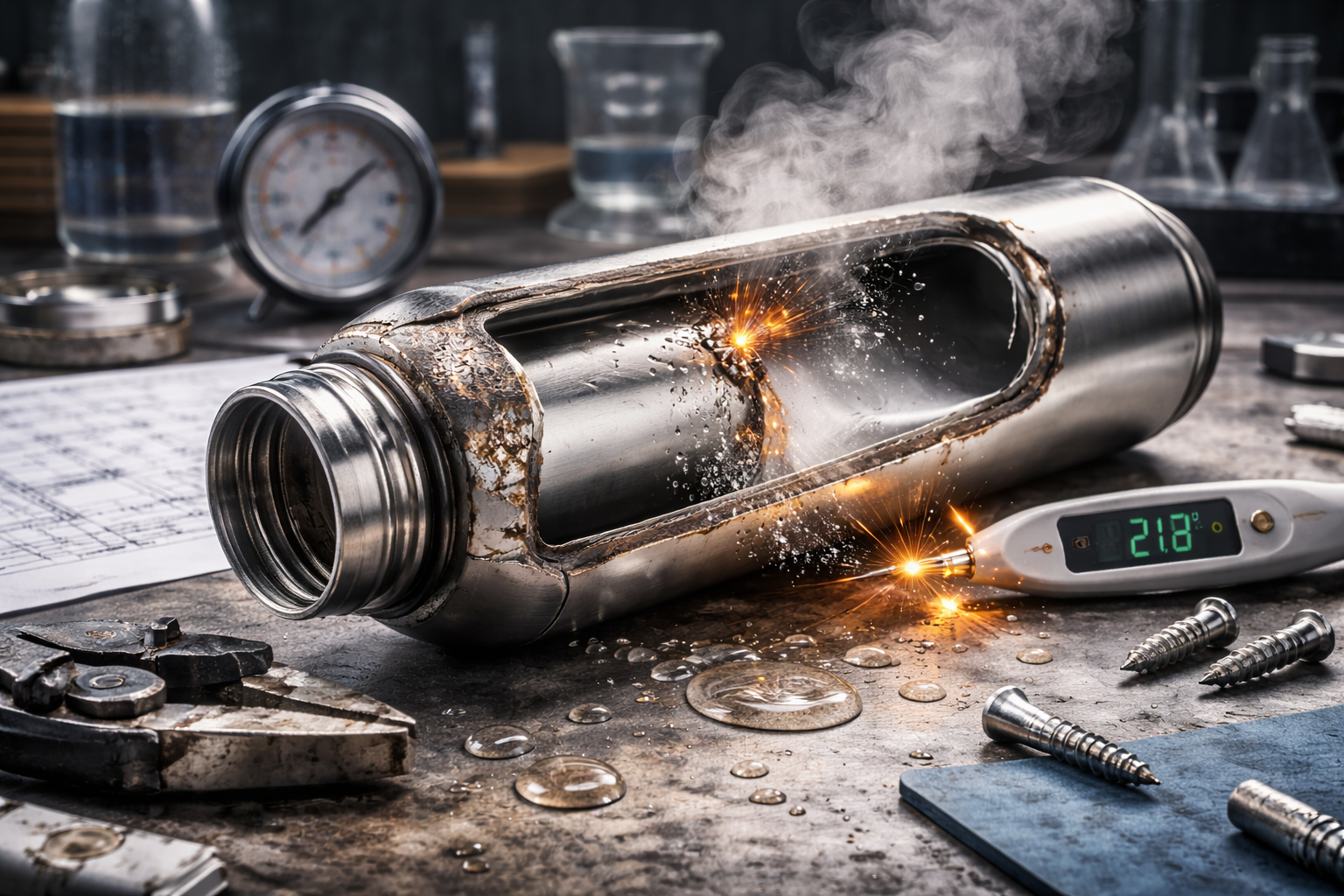
Penebat vakum bergantung pada ketepatan. Kimpalan yang menutup ruang vakum adalah nipis dan berterusan. Walaupun retakan atau herotan mikroskopik pada titik-titik ini boleh menjadi tempat permulaan kebocoran.
Yang penting, kehilangan vakum daripada impak tidak memerlukan retakan yang cukup besar untuk membocorkan cecair. Kecacatan yang tidak kelihatan dengan mata kasar sudah cukup untuk membenarkan kemasukan gas perlahan selama berbulan-bulan atau bertahun-tahun.
Inilah sebabnya botol boleh kelihatan "sempurna" namun masih kehilangan prestasi penebat.
Kelesuan Termal: Kerosakan Akibat Kitaran Haba Berulang
Kelesuan termal kurang jelas berbanding kerosakan impak, tetapi sering lebih berpengaruh dalam jangka masa panjang.
Setiap kali botol diisi dengan cecair panas, dinding dalaman mengembang sedikit. Apabila botol menyejuk, ia mengecut. Dinding luaran, terdedah kepada suhu ambien, mengikuti profil terma yang berbeza. Ini mewujudkan pengembangan pembezaan kitaran antara komponen.
Lama-kelamaan, kitaran berulang menyebabkan:
- Kelesuan logam pada sambungan kimpalan
- Pergerakan mikro pada sambungan struktur
- Pelemahan secara beransur-ansur pada kedap vakum
Kesan ini amat ketara apabila:
- Botol kerap diisi dengan cecair hampir mendidih
- Ayunan suhu yang besar berlaku (cth., cecair panas diikuti dengan bilasan sejuk)
- Penggunaan harian dan jangka panjang
Kelesuan termal tidak membayangkan salah guna. Ia adalah hasil yang boleh diramalkan daripada bahan-bahan yang beroperasi dalam kecerunan haba dunia sebenar. Toleransi pembuatan yang lebih baik dan teknik kimpalan melambatkan proses, tetapi ia tidak dapat menghapuskannya sepenuhnya.
Kualiti Pembuatan: Mengapa Sesetengah Botol Tahan Lebih Lama daripada Yang Lain
Dua botol dengan bahan yang serupa boleh mempunyai jangka hayat penebat yang sangat berbeza. Perbezaannya sering terletak pada ketepatan pembuatan, bukan pilihan bahan.
Faktor utama termasuk:
Teknologi Kimpalan
Botol berkualiti tinggi biasanya menggunakan kimpalan laser untuk mengedap ruang vakum. Kimpalan laser adalah sempit, seragam, dan menyebabkan herotan terma yang minimum. Kimpalan berkualiti rendah mungkin lebih tebal, kurang konsisten, dan lebih cenderung kepada kecacatan mikro.
Tahap Vakum dan Proses Pengedapan
Mewujudkan vakum yang stabil memerlukan pengosongan terkawal dan pengedapan segera. Tekanan vakum yang tidak konsisten atau pencemaran semasa pengedapan meningkatkan risiko kebocoran jangka panjang.
Kawalan Kualiti dan Ujian
Sesetengah pengeluar menguji tekanan atau menguji terma ruang vakum sebelum pemasangan. Yang lain bergantung pada pensampelan. Kecacatan yang terlepas pada peringkat ini menjadi kegagalan bertahun-tahun kemudian, bukan serta-merta.
Pembolehubah ini menjelaskan mengapa jangka hayat penebat tidak rawak. Ia direkayasa.
Kakisan dan Interaksi Kimia: Kerosakan Perlahan, Tidak Langsung
Keluli tahan karat adalah tahan kakisan, bukan kalis kakisan.
Lama-kelamaan, pendedahan kepada keadaan tertentu boleh menjejaskan integriti struktur:
- Cecair sisa yang tertinggal di dalam untuk tempoh yang lama
- Minuman manis atau berasid yang tidak dibersihkan sepenuhnya
- Pembersih kimia yang keras atau rendaman berpanjangan
Kakisan jarang menyerang ruang vakum secara langsung. Sebaliknya, ia melemahkan logam di sekeliling kimpalan atau titik tekanan. Apabila kekuatan bahan berkurangan, tekanan termal atau mekanikal yang sebelum ini tidak berbahaya menjadi merosakkan.
Dengan cara ini, kakisan bertindak sebagai pengganda, mempercepatkan mekanisme degradasi lain dan bukannya menyebabkan kegagalan langsung.
Apa yang Tidak Merosakkan Penebat Vakum: Menjelaskan Mitos Umum
Ramai pengguna bimbang tentang tindakan yang sebahagian besarnya tidak relevan dengan integriti vakum.
Pencucian tangan biasa tidak menjejaskan lapisan vakum.
Kesan calar permukaan adalah kosmetik dan tidak berkaitan dengan prestasi penebat.
Bertukar antara minuman panas dan sejuk tidak "mengejutkan" botol sehingga gagal.
Mitos ini berterusan kerana penebat vakum tidak kelihatan. Tanpa petunjuk yang kelihatan, pengguna menganggap hubungan sebab-akibat yang tidak wujud.
Memahami apa yang tidak menyebabkan kerosakan adalah sama pentingnya dengan mengetahui apa yang menyebabkannya.
Petunjuk Awal Kemerosotan Vakum
Walaupun kegagalan vakum adalah beransur-ansur, terdapat tanda-tanda amaran yang boleh dikenali:
- Dinding luar menjadi ketara panas dengan cecair panas
- Pemeluwapan terbentuk di bahagian luar semasa penggunaan sejuk
- Masa pengekalan haba memendek secara konsisten, bukan secara sporadis
Petunjuk ini menunjukkan kehilangan vakum separa, bukan kegagalan total. Pada peringkat ini, penurunan prestasi tidak dapat dipulihkan, tetapi dapat diramalkan.
Kebolehdibaiki: Mengapa Penebat Vakum Tidak Boleh Dipulihkan
Setelah integriti vakum hilang, pembaikan peringkat pengguna tidak dapat dilakukan.
Mencipta semula vakum memerlukan:
- Pembongkaran komponen logam tertutup
- Peralatan vakum industri
- Pengedapan semula yang tepat tanpa memperkenalkan bahan cemar
Secara praktiknya, kos dan kerumitan melebihi nilai produk. Inilah sebabnya mengapa penebat vakum direka sebagai sistem tertutup seumur hidup, bukan sistem yang boleh diservis.
Memanjangkan Jangka Hayat Penebat Vakum: Logik Kejuruteraan Praktikal
Walaupun degradasi tidak dapat dihentikan, ia boleh diperlahankan.
Elakkan hentakan yang tidak perlu, terutamanya di bahagian bawah dan leher.
Jangan dedahkan botol kepada kejutan terma melampau berulang kali.
Bersihkan dengan teliti tetapi perlahan-lahan, elakkan bahan kimia agresif.
Biarkan cecair panas menyejuk sedikit sebelum menutup apabila praktikal.
Amalan ini tidak mengekalkan "kesempurnaan," tetapi ia mengurangkan pengumpulan tekanan.
Kesimpulan: Penebat Vakum Gagal Mengikut Fizik, Bukan Kemalangan
Penebat vakum tidak gagal kerana nasib malang atau kecacatan tiba-tiba. Ia gagal kerana sistem tertutup tertakluk kepada tekanan mekanikal, kitaran terma, kelesuan bahan, dan masa.
Memahami mekanisme ini mengubah jangkaan. Botol bertebat vakum bukanlah peranti terma kekal; ia adalah sistem kecekapan tinggi dengan jangka hayat yang boleh diukur yang dibentuk oleh pilihan kejuruteraan dan corak penggunaan.
Dilihat dari sudut ini, kemerosotan penebat bukanlah kecacatan—ia adalah fizik yang melakukan apa yang selalu dilakukan oleh fizik.