
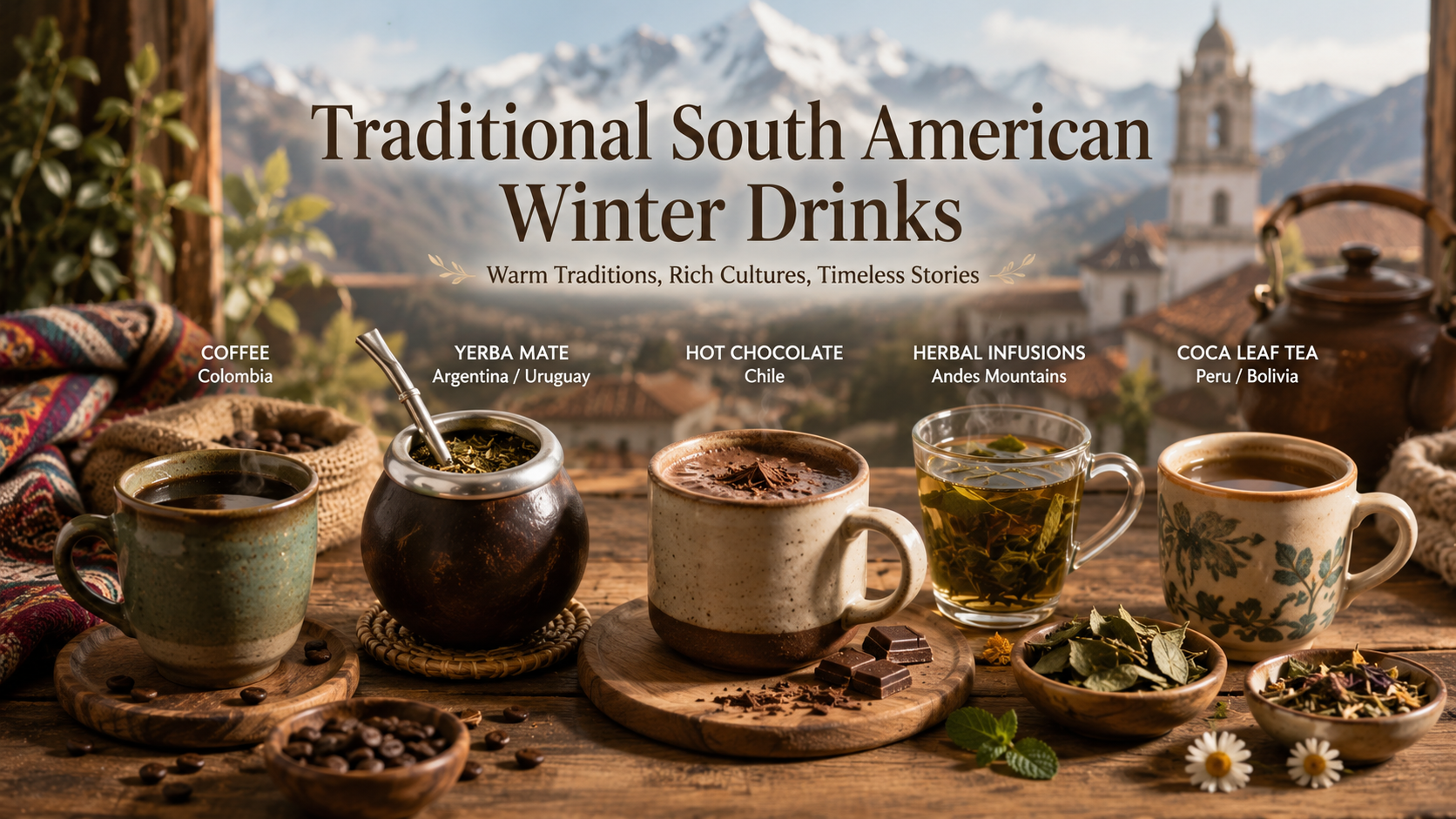
A Journey Through Culture, Climate, and the Everyday Rituals That Warm the Southern Hemisphere
Part 1 — Every Winter Drink Tells a Story
Introduction: Winter Begins with a Warm Cup
While much of the Northern Hemisphere is enjoying sunshine and summer holidays, winter quietly settles across South America.
In July and August, the seasons shift. Snow blankets parts of Patagonia, chilly mornings arrive in Buenos Aires and Santiago, mist rolls across the Andean highlands, and families throughout the continent naturally reach for something warm to drink.
Listen closely on a winter morning, and you'll hear familiar sounds repeated in countless homes.
The kettle begins to boil.
Fresh coffee fills the kitchen with its rich aroma.
Someone carefully pours hot water into a mate gourd.
A grandmother prepares herbal tea using recipes passed down through generations.
Children wait patiently for steaming mugs of hot chocolate after coming home from school.
These small moments may seem ordinary, yet they reveal something much larger.
Across South America, winter drinks are not simply beverages.
They are expressions of hospitality, family traditions, regional identity, and the comforting rhythm of everyday life.
Every cup tells a story.
More Than a Drink: Why Warm Beverages Matter During Winter
Every culture has foods and drinks that become closely connected with certain seasons.
In South America, winter beverages often serve purposes that go far beyond quenching thirst.
They slow conversations.
They encourage families to gather around the table.
They provide comfort after a long day outdoors.
They accompany celebrations, quiet mornings, road trips, and evenings spent with friends.
In today's fast-paced world, drinks are often consumed while walking, driving, or working.
Winter invites something different.
It encourages people to pause.
Preparing loose-leaf tea takes time.
Brewing coffee asks for patience.
Sharing a traditional mate is impossible to rush.
These rituals naturally create moments of presence that modern lifestyles often overlook.
Perhaps this explains why so many cherished childhood memories include the smell of coffee, the steam rising from a mug, or the warmth of holding a cup between cold hands.
Sometimes the drink itself is only part of the experience.
The real comfort comes from the people and moments surrounding it.
Climate Shapes Every Cup
South America stretches nearly 7,500 kilometers (about 4,660 miles) from north to south.
Because of its remarkable geography, winter looks very different depending on where you are.
In the high Andes, cold mornings encourage warming herbal infusions.
Along the Atlantic coast, windy weather makes coffee shops especially inviting.
In Patagonia, hot chocolate becomes a familiar companion after outdoor adventures.
Meanwhile, tropical regions experience cooler evenings without the harsh winters found farther south.
These regional differences have shaped drinking traditions for centuries.
Communities naturally adapted local ingredients to suit local climates.
Mountain herbs became teas.
Coffee flourished where ideal growing conditions existed.
Native plants were transformed into traditional infusions.
Over time, these practical choices evolved into cultural traditions.
Today, they remain part of everyday life.
Yerba Mate: The Drink That Brings People Together
No discussion of South American winter drinks would be complete without yerba mate.
Popular throughout Argentina, Uruguay, Paraguay, and parts of southern Brazil, mate is unlike almost any other beverage tradition in the world.
To an outsider, it may simply appear to be herbal tea served in a distinctive cup.
For those who grow up with it, however, mate represents something much deeper.
Sharing.
Conversation.
Friendship.
Community.
Unlike coffee, which is often enjoyed individually, mate is traditionally prepared in one gourd and passed from person to person.
Each participant drinks before returning the cup to be refilled and shared again.
The ritual creates a natural rhythm.
Nobody rushes.
Conversations unfold slowly.
Silence feels comfortable.
Time seems less important.
For many South Americans, mate is woven into daily life.
It accompanies early mornings before work, long drives across open landscapes, afternoons in city parks, university study sessions, family gatherings, and weekends spent outdoors.
The drink itself contains naturally occurring caffeine, but its greatest value may be the conversations it quietly encourages.
Coffee: A Morning Tradition Across the Continent
Coffee tells a different story.
South America produces some of the world's most celebrated coffee, with Brazil and Colombia recognized internationally for their rich coffee-growing traditions.
Yet for local residents, coffee is rarely just an export.
It is part of everyday life.
Morning routines often begin with freshly brewed coffee enjoyed at home before work or school.
Neighborhood cafés become gathering places where people discuss local news, meet friends, or simply watch the city wake up.
In Colombia's mountain cities, cool mornings naturally invite a warm cup before heading outdoors.
In Brazil, coffee appears throughout the day, accompanying breakfast, business meetings, and afternoon conversations.
Peru's coffee-growing regions have also gained international recognition, while local cafés increasingly celebrate beans sourced from nearby farms.
Although preparation styles vary from country to country, coffee consistently represents familiarity, hospitality, and the beginning of a new day.
Herbal Infusions Rooted in Nature
Long before modern cafés became common, Indigenous communities across the Andes relied on local plants to prepare warming herbal infusions.
Many of these traditions continue today.
Chamomile remains a popular evening tea throughout the continent.
Lemongrass is appreciated for its refreshing aroma.
Mint is commonly enjoyed after meals.
In Peru and Bolivia, mountain herbs have been brewed for generations as comforting hot beverages during cold mornings and evenings.
These herbal drinks reflect an important aspect of South American culture: a close relationship with the natural environment.
Rather than importing ingredients from distant places, communities often made use of plants growing nearby.
The result is an extraordinary diversity of regional teas and infusions that continue to connect people with local landscapes.
Today, many younger generations are rediscovering these traditional beverages as part of a broader interest in sustainability, natural ingredients, and slower lifestyles.
Hot Chocolate: A Taste of Comfort
For many families, no winter beverage feels quite as comforting as hot chocolate.
Although recipes differ across countries, the emotional connection is remarkably similar.
It is the drink children look forward to after playing outside.
It accompanies rainy afternoons, winter holidays, and evenings spent under blankets watching movies together.
In cooler regions such as southern Chile and Patagonia, cafés often serve rich hot chocolate alongside freshly baked pastries.
Mountain lodges welcome travelers with steaming mugs after long hikes or snowy adventures.
Unlike drinks associated with energy or productivity, hot chocolate is closely linked with relaxation.
It invites people to slow down.
To stay a little longer.
To enjoy the moment instead of rushing toward the next task.
Perhaps that is why, for so many people, the taste of hot chocolate carries memories that last far beyond childhood.
Every Region Has Its Own Winter Story
One of the most beautiful aspects of South America's winter drink culture is that there is no single tradition.
Instead, each region has developed its own rituals based on climate, geography, history, and local ingredients.
The Andes celebrate mountain herbs.
The Pampas celebrate mate.
Brazil celebrates coffee.
Patagonia embraces rich hot chocolate.
Throughout the continent, families adapt recipes to local tastes while preserving traditions that connect generations.
These drinks remind us that culture is often experienced not through famous landmarks, but through ordinary moments repeated every day.
Sometimes understanding a place begins not with visiting its monuments, but with accepting an invitation to share a warm drink at someone's table.
Looking Beyond the Beverage
If we only focus on ingredients, we miss the deeper story.
South America's traditional winter drinks are not remarkable because they are rare.
They are remarkable because they have become part of daily life.
They accompany work and rest.
Celebrations and ordinary afternoons.
Family traditions and quiet personal rituals.
Part 2 — From Local Traditions to Modern Living: Why These Winter Drinks Still Matter Today
Hospitality Begins with a Warm Cup
Across South America, offering someone a warm drink is rarely just a practical gesture.
It is a quiet way of saying, "Welcome. Stay a while."
Whether you are visiting a family home in Argentina, stopping at a small café in Colombia, or spending a rainy afternoon in southern Chile, you'll often discover that the first thing offered isn't a menu or even a conversation—it's something warm to drink.
Unlike cultures where beverages are frequently consumed on the go, many South American traditions encourage people to pause.
A cup of coffee becomes the beginning of a conversation.
A pot of tea stays on the table long after the meal has ended.
A shared mate circle has no strict schedule or finishing time.
These customs remind us that hospitality is measured less by extravagance and more by generosity, presence, and time.
In many ways, the drink is simply an invitation to slow down together.
The Best Way to Experience South America Is Through Its Cafés and Kitchens
Travel guides often focus on famous landmarks, museums, or scenic viewpoints.
Yet some of the most memorable experiences happen in far more ordinary places.
A neighborhood bakery opening before sunrise.
A mountain café where hikers gather after a long walk.
A small market stall serving freshly brewed coffee.
A family kitchen filled with the comforting aroma of herbs and simmering chocolate.
These places rarely appear on lists of "must-see attractions," but they often reveal the everyday rhythm of local life more authentically than any monument.
For travelers, choosing to spend an hour in a local café instead of rushing to the next attraction offers something increasingly rare: the chance to observe daily life without an itinerary.
Watching regular customers greet one another by name, seeing grandparents sharing breakfast with grandchildren, or noticing office workers pausing for afternoon coffee provides a deeper understanding of a place than photographs alone ever could.
Sometimes, travel is less about seeing more and more about noticing more.
Winter Drinks Tell the Story of the Seasons
Every traditional winter beverage reflects the environment in which it developed.
Communities adapted to local climates long before modern heating systems, insulated travel mugs, or coffee chains became common.
Mountain villages relied on herbs that grew nearby.
Coffee-producing regions naturally celebrated freshly harvested beans.
Areas with colder winters embraced richer, more comforting drinks.
Rather than importing distant traditions, people created beverages using what the landscape provided.
This close relationship between climate and cuisine still exists today.
Walking through South America during winter means experiencing regional differences not only through changing scenery, but also through changing flavors.
One region welcomes visitors with aromatic herbal infusions.
Another with strong coffee.
Another with mate shared among friends.
Another with thick hot chocolate enjoyed beside a fireplace.
Together, they form a map of culture that is written not in borders, but in cups.
Why These Traditions Continue to Matter
Modern life has changed dramatically.
Coffee can be ordered from a smartphone.
Instant drinks are available almost everywhere.
People often eat lunch while answering emails and drink coffee during meetings.
Yet despite these conveniences, traditional winter drink rituals continue to thrive.
Why?
Because they satisfy needs that technology cannot.
People still seek connection.
Families still enjoy gathering around the kitchen table.
Friends still appreciate long conversations without distractions.
Communities still celebrate seasonal traditions.
In fact, many younger South Americans are rediscovering these customs as part of a broader interest in local heritage, sustainable living, and mindful lifestyles.
Preparing loose-leaf tea instead of instant drinks.
Buying coffee from local roasters.
Learning family recipes that nearly disappeared.
Sharing mate in public parks.
These habits represent something larger than nostalgia.
They reflect a desire to reconnect with slower, more intentional ways of living.
What the World Can Learn from South American Winter Drink Culture
Perhaps the greatest lesson isn't about a specific beverage.
It's about the pace at which we enjoy it.
In many parts of the world, drinks have become fuel.
Coffee helps people work longer.
Energy drinks promise greater productivity.
Bottled beverages are consumed between appointments.
South American winter traditions quietly suggest another perspective.
A drink can also become a pause.
A conversation.
A daily ritual.
A reason to gather.
An opportunity to appreciate the present moment.
The value isn't measured by how quickly it's finished.
It's measured by the experience it creates.
This philosophy aligns closely with the growing global interest in slow living, a lifestyle that encourages people to replace constant urgency with greater awareness of everyday moments.
Winter naturally supports this mindset.
Its shorter days invite people indoors.
Its cooler weather encourages warm meals.
Its quieter atmosphere reminds us that not every hour needs to be filled with activity.
Bringing South American Winter Traditions into Everyday Life
You don't need to live in the Andes or Patagonia to appreciate these customs.
Many of their underlying principles can be incorporated into daily routines wherever you are.
For example:
Start your morning by preparing coffee or tea without immediately checking your phone.
Invite a friend to share an afternoon drink rather than meeting only for business.
Explore herbal infusions made from locally available ingredients.
Visit neighborhood cafés instead of always choosing familiar international chains.
Carry a reusable bottle filled with your favorite warm drink when commuting or traveling.
Create a small tea or coffee corner at home where preparing a drink becomes an enjoyable ritual instead of another task.
These habits don't attempt to recreate South America.
Instead, they borrow its appreciation for slowing down and finding comfort in ordinary moments.
Sustainability in Every Cup
Many traditional South American drinking habits also reflect ideas that have become increasingly important today.
Preparing beverages at home reduces disposable packaging.
Choosing locally grown ingredients supports nearby communities.
Using reusable drinkware helps minimize single-use waste.
Buying loose-leaf tea or freshly roasted coffee often requires less packaging than heavily processed alternatives.
These choices are not new.
In many cases, they have been practiced for generations.
Modern sustainability sometimes means rediscovering habits that previous generations considered perfectly ordinary.
The most environmentally friendly routine is often the one that values quality, longevity, and thoughtful consumption over convenience.
Every Drink Carries a Memory
Ask someone about their favorite winter drink, and they rarely begin by describing the ingredients.
Instead, they remember a person.
A grandmother making tea after school.
Parents preparing coffee before sunrise.
Friends sharing mate in the park.
A mountain café visited during a memorable road trip.
The first snowfall seen through a café window.
A rainy afternoon spent reading with hot chocolate nearby.
Memory gives these drinks their greatest meaning.
Long after the last sip has been taken, the moment remains.
That is why recipes are passed from one generation to the next.
They preserve not only flavors, but relationships.
Conclusion: The Stories Hidden in Every Cup
South America's traditional winter drinks are wonderfully diverse.
Some are rich and sweet.
Others are simple and earthy.
Some are shared among many people.
Others accompany quiet moments alone.
Yet despite their differences, they share a common purpose.
They help people feel connected—to family, to friends, to local landscapes, and to the changing rhythm of the seasons.
In today's increasingly fast-moving world, perhaps these traditions matter more than ever.
They remind us that comfort doesn't always come from buying something new.
Sometimes it comes from slowing down long enough to prepare a familiar drink, sit beside someone we care about, and enjoy an ordinary conversation without watching the clock.
Every cup tells a story.
Not because of what's inside it, but because of the moments it quietly creates.
References
The cultural background and regional information presented in this article are informed by publicly available resources from the following organizations and publications:
- UN Tourism (United Nations World Tourism Organization) – Resources on cultural tourism, gastronomy, and sustainable travel.
- UNESCO – Intangible Cultural Heritage and traditional food and beverage practices.
- Food and Agriculture Organization of the United Nations (FAO) – Information on regional agricultural products, traditional crops, and sustainable food systems.
- World Coffee Research – Educational resources on coffee origins, cultivation, and producing regions in South America.
- Specialty Coffee Association (SCA) – Coffee culture, brewing practices, and sustainability initiatives.
- Yerba Mate Association and regional cultural publications – Historical and cultural background of yerba mate traditions in Argentina, Uruguay, Paraguay, and southern Brazil.
- National Geographic Travel – Features exploring South American food traditions, regional cultures, and travel experiences.
- BBC Travel – Articles examining how local food and drink reflect culture, identity, and community.
- Journal of Ethnic Foods – Academic research on traditional foods, beverages, and culinary heritage.
- International Journal of Gastronomy and Food Science – Studies on regional food culture, sustainability, and consumer behavior.
-
Editor's Note: Recipes, preparation methods, and regional customs vary across South America. This article focuses on broad cultural traditions and everyday lifestyle practices rather than prescribing specific preparation techniques or making health-related claims.