
Practical Bottle Care Tips for Tropical Rainforests, Coastal Cities, Mountains, and Temperate Regions
Part 1 — Why Climate Matters More Than You Think
Introduction: One Reusable Bottle, Many Different Environments
A reusable water bottle often becomes one of the most frequently used items in everyday life.
It travels to the office in the morning, accompanies weekend hikes, sits beside gym equipment, and joins road trips across cities and landscapes. Many people choose a bottle based on insulation, size, or appearance, but far fewer consider another factor that quietly affects its performance every single day—climate.
South America is one of the world's most geographically diverse continents.
Within a single journey, a reusable bottle could experience the humid rainforest climate of northern Brazil, the cool mountain air of the Andes, the dry conditions of Patagonia, or the salty breeze along the Pacific and Atlantic coasts.
Although the bottle remains the same, the environment around it changes dramatically.
These differences influence far more than the temperature of your drink.
They affect how quickly moisture evaporates, how easily bacteria and mold can develop, how mineral deposits form, how often bottles should be cleaned, and even how long silicone seals remain fresh.
In other words, bottle care is not only about what you drink—it is also about where you use your bottle.
Understanding how different climates influence reusable drinkware helps extend its lifespan, improve hygiene, and create a better everyday drinking experience.
South America's Extraordinary Climate Diversity
Unlike continents dominated by one or two major climate zones, South America contains nearly every major climate type.
These include:
- Tropical rainforest climates in the Amazon Basin.
- Humid subtropical regions in southern Brazil, Paraguay, and northern Argentina.
- Mediterranean climates in central Chile.
- High-altitude mountain climates throughout the Andes.
- Temperate regions in Uruguay and central Argentina.
- Semi-arid and desert landscapes, including the Atacama Desert.
- Cool southern regions extending into Patagonia.
Each environment presents different challenges for reusable drinkware.
For example:
High humidity slows evaporation, allowing moisture to remain inside bottle lids longer.
Dry climates increase water consumption but often reduce mold growth.
Coastal environments expose bottles to salt particles carried by sea air.
Mountain regions encourage greater use of hot beverages, which may increase coffee and tea residue inside insulated bottles.
Recognizing these differences allows users to develop cleaning routines that better match their environment rather than relying on a single approach throughout the year.
Why Climate Changes the Way Bottles Should Be Cleaned
Many people believe that if they wash their bottle every few days, that's enough.
In reality, cleaning frequency should depend on three major environmental factors:
Temperature
Warm environments accelerate microbial growth.
According to food safety guidance from the World Health Organization (WHO) and the U.S. Food and Drug Administration (FDA), microorganisms generally reproduce more rapidly under warm and moist conditions when nutrients are available.
Although drinking water alone presents relatively low risk, beverages containing sugars, proteins, or natural plant compounds create conditions where residue can support bacterial growth if bottles are left unwashed.
This is particularly relevant for reusable bottles used for coffee, fruit juice, milk-based drinks, smoothies, or traditional herbal beverages.
Humidity
Humidity affects bottles differently than temperature.
A bottle that appears clean after washing may still retain invisible moisture inside:
- Silicone gaskets
- Straw assemblies
- Flip-top lids
- Bottle threads
- Hidden cap cavities
When moisture remains trapped, these areas dry more slowly.
Over time, this can contribute to unpleasant odors and, in some cases, mold development—especially if bottles are stored with their lids tightly closed.
High humidity does not automatically create bacteria or mold, but it can create conditions where moisture persists longer, making regular drying especially important.
Minerals and Water Quality
Cleaning is also influenced by local water characteristics.
Some regions have harder water than others.
Hard water contains naturally occurring minerals such as calcium and magnesium.
These minerals are harmless for most people to drink, but they may gradually leave white deposits inside bottles, particularly around drinking spouts and threaded openings.
Unlike beverage stains, mineral buildup usually requires occasional descaling rather than stronger detergents.
Understanding the difference between residue and mineral deposits helps prevent unnecessary scrubbing that could damage bottle surfaces.
Climate Zone 1: Caring for Bottles in Tropical Rainforest Regions
The Amazon Basin experiences one of the world's most humid environments.
Cities such as Manaus, Belém, Iquitos, and parts of the Guianas often combine:
- High temperatures
- High humidity
- Frequent rainfall
- Limited indoor drying conditions
These factors make moisture management especially important.
A bottle that dries quickly in a dry climate may remain damp for hours in tropical conditions.
The bottle body itself—particularly stainless steel—is generally not the issue.
Instead, attention should focus on removable components.
Silicone seals.
Straw lids.
Bottle caps.
Rubber valves.
These areas trap tiny amounts of water after washing.
If bottles are immediately closed and stored, moisture remains trapped inside.
Practical Care Tips
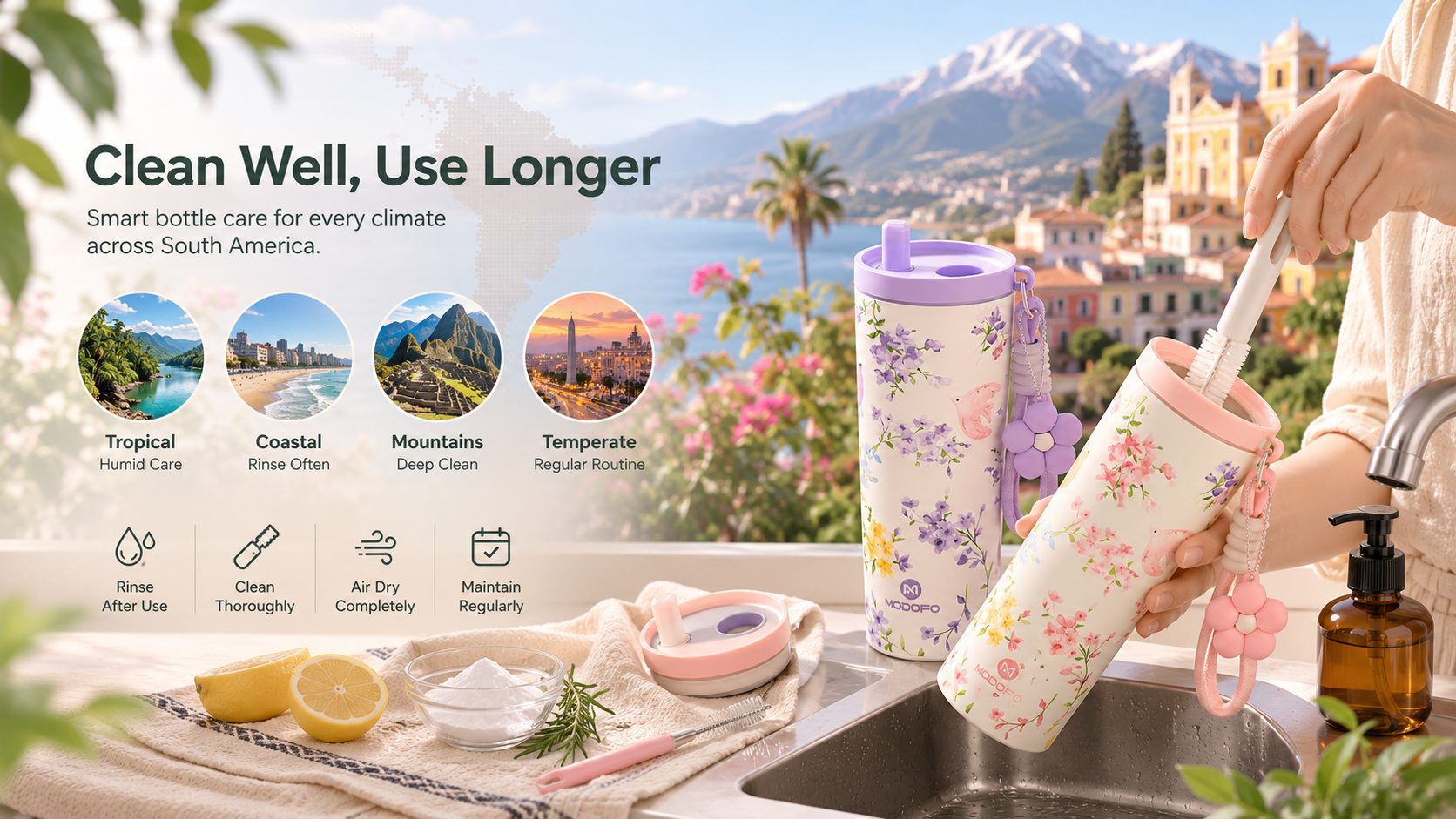
- Wash bottles daily if using flavored drinks.
- Leave lids open until completely dry.
- Remove silicone seals periodically according to manufacturer instructions.
- Store bottles uncapped whenever possible.
- Deep clean lids weekly rather than waiting for odors to appear.
Preventive care is usually easier than removing persistent smells later.
Climate Zone 2: Coastal Cities and Salt Air
South America's coastlines stretch for thousands of kilometers along both the Pacific and Atlantic Oceans.
Cities including:
- Rio de Janeiro
- Santos
- Montevideo
- Lima
- Valparaíso
- Mar del Plata
offer beautiful outdoor lifestyles that naturally encourage reusable bottle use.
Beach walks.
Cycling.
Outdoor cafés.
Parks.
Weekend travel.
These activities increase bottle usage, but coastal environments also introduce unique maintenance considerations.
Sea salt suspended in the air can gradually settle on bottle exteriors, particularly when bottles are carried in backpacks or beach bags.
Combined with sunscreen, sand, and perspiration, the outside of a bottle often becomes dirtier than the inside.
Fortunately, high-quality stainless steel used in food-grade drinkware is highly resistant to normal environmental exposure.
Routine rinsing of the bottle's exterior with fresh water after beach visits is generally sufficient to remove salt residue before it accumulates.
Cleaning should also include bottle handles, carrying straps, and textured lids, where fine sand particles can become trapped.
Different Drinks Become More Popular in Different Climates
Climate influences not only how bottles should be cleaned, but also what people choose to drink.
In tropical regions, bottles are often filled with:
- Cold water
- Fruit-infused water
- Coconut water
- Fresh juices
- Electrolyte drinks
These beverages frequently contain natural sugars or fruit acids that benefit from prompt rinsing after use.
In coastal cities, sparkling water and citrus drinks become common choices during outdoor activities.
Although sparkling water leaves little residue, citrus juices may leave sticky films if allowed to dry inside the bottle.
Understanding both climate and beverage chemistry helps create cleaning habits that match real-world use instead of following a single universal routine.
Good Bottle Care Begins with Observation
Perhaps the most important lesson is that no cleaning schedule fits every environment.
Someone living in Bogotá, Brazil's Amazon region, Buenos Aires, and Patagonia may own the same insulated bottle, yet their maintenance needs will differ significantly.
Rather than cleaning according to the calendar, experienced reusable bottle users often learn to observe their surroundings.
Is the bottle drying slowly?
Has humidity increased?
Are you drinking more coffee this week?
Have you been hiking near the ocean?
These everyday observations often provide better guidance than rigid cleaning rules.
Part 2 — Climate-Smart Bottle Care for Everyday Life
Climate Zone 3: High-Altitude Mountain Regions
The Andes Mountains stretch for more than 7,000 kilometers, passing through Venezuela, Colombia, Ecuador, Peru, Bolivia, Chile, and Argentina. Millions of people live and work at elevations above 2,500 meters (8,200 feet), where daily routines are shaped by cooler temperatures, stronger sunlight, and lower humidity than many lowland regions.
Cities such as Cusco, La Paz, Quito, and parts of Bogotá often experience cool mornings and evenings even when daytime sunshine feels warm.
These conditions influence both hydration habits and bottle maintenance.
At higher elevations, the body generally loses more water through respiration because the air is drier. Combined with increased ultraviolet exposure and physical activity, many people naturally consume more hot beverages throughout the day, including:
- Coffee
- Black tea
- Herbal infusions
- Yerba mate
- Hot chocolate
Unlike plain water, these drinks leave behind compounds such as coffee oils, tea tannins, natural plant pigments, and minerals.
Over time, these substances may gradually accumulate inside bottles if regular cleaning is postponed.
Practical Care Tips
- Rinse bottles soon after finishing coffee or tea.
- Deep clean insulated bottles every 5–7 days if used daily for hot beverages.
- Pay extra attention to bottle lids and drinking spouts where residue tends to collect.
- Use a bottle brush that reaches the bottom without scratching the interior.
- Allow bottles to dry completely before storing overnight.
The goal isn't constant deep cleaning—it is preventing residue from becoming difficult to remove.
Climate Zone 4: Temperate Cities and Everyday Routines
Many of South America's largest cities enjoy relatively moderate climates.
Buenos Aires.
Montevideo.
Córdoba.
Santiago.
Porto Alegre.
These regions experience more noticeable seasonal changes, making them ideal places for establishing consistent bottle care routines throughout the year.
Unlike tropical climates, humidity is generally less persistent.
Unlike mountain regions, daily temperature swings are often smaller.
For most households, the biggest challenge is not the environment—it's simply remembering to clean bottles regularly.
Developing a simple weekly routine is often more effective than waiting until a bottle develops stains or odors.
A practical schedule might include:
Daily
- Empty bottles before bedtime.
- Rinse with warm water after each use.
- Wash bottles used for flavored beverages with mild dish soap.
Weekly
- Clean lids, straws, and silicone seals separately.
- Inspect bottle threads for hidden residue.
- Wash reusable straws with an appropriate cleaning brush.
Monthly
- Perform a deep cleaning using a bottle-safe cleaning method.
- Check seals for wear or discoloration.
- Inspect the bottle for dents or damaged insulation that could affect long-term performance.
Preventive maintenance generally requires less effort than removing stubborn buildup later.
Different Drinks Require Different Cleaning Habits
One of the biggest misconceptions about reusable bottles is that every beverage affects the bottle in the same way.
In reality, different drinks leave behind different types of residue.
| Beverage | Main Residue | Suggested Cleaning Habit |
|---|---|---|
| Plain Water | Minerals (occasionally) | Regular rinsing |
| Coffee | Natural oils | Wash with mild soap after use |
| Black Tea | Tannins | Clean before stains develop |
| Green Tea | Light tannins | Daily rinse and regular washing |
| Fruit Juice | Natural sugars | Wash immediately after use |
| Smoothies | Protein and fiber | Clean thoroughly after each use |
| Milk | Protein and fat | Never leave overnight |
| Sports Drinks | Sugars and electrolytes | Wash daily |
| Yerba Mate | Plant particles and tannins | Rinse thoroughly and deep clean weekly |
Notice that many cleaning challenges come from ingredients rather than the drinks themselves.
Understanding these differences helps prevent unnecessary staining, lingering odors, and flavor transfer.
Choosing Bottle Materials for Different Environments
Material selection also influences long-term maintenance.
Stainless Steel
Food-grade stainless steel remains one of the most versatile choices because it:
- Resists flavor absorption.
- Handles both hot and cold beverages.
- Offers excellent durability.
- Cleans relatively easily with proper care.
High-quality stainless steel performs well across humid tropical climates, coastal regions, and mountain environments.
Glass
Glass bottles are naturally resistant to staining and odor retention.
They're excellent for fruit-infused water, tea, and juices.
However, they require greater care during travel and outdoor activities because they are more fragile.
Tritan™ Plastic
Modern Tritan bottles are lightweight and impact-resistant, making them popular for sports and travel.
However, prompt cleaning is still recommended after sugary beverages to minimize lingering odors and surface films.
Silicone Components
Bottle seals, gaskets, and drinking straws often require more attention than the bottle body itself.
Because silicone is slightly porous at a microscopic level, it may temporarily retain aromas from strongly flavored drinks.
Regular removal and cleaning—following the manufacturer's instructions—helps maintain freshness and prevent odor buildup.
A Climate-Based Bottle Care Schedule
Different environments call for slightly different maintenance routines.
| Climate | Quick Rinse | Full Wash | Deep Cleaning |
|---|---|---|---|
| Tropical Rainforest | After every use | Daily | Weekly |
| Coastal Regions | After every outdoor activity | Daily | Every 1–2 weeks |
| Mountain Regions | After coffee or tea | Daily | Weekly |
| Temperate Cities | Daily | Every 1–2 days | Every 2 weeks |
| Frequent Travelers | After every refill | Daily | Before and after each trip |
These recommendations are not strict rules.
Instead, they provide a practical starting point that can be adjusted according to personal habits and the beverages most frequently consumed.
Five Small Habits That Extend Bottle Life
Keeping a reusable bottle in excellent condition doesn't require expensive products.
Consistency matters far more than complexity.
Simple habits include:
-
Empty bottles before going to bed instead of leaving drinks inside overnight.
-
Allow bottles and lids to air dry separately before reassembling.
-
Clean lids, threads, and silicone seals as carefully as the bottle interior.
-
Avoid storing bottles with the lid tightly closed while moisture remains inside.
-
Wash bottles promptly after coffee, tea, juice, smoothies, or dairy-based drinks.
These habits take only a few minutes but can significantly reduce staining, odors, and unnecessary wear.
Reusable Bottles and Sustainable Living in South America
Across South America, reusable drinkware is becoming increasingly common in offices, universities, outdoor markets, hiking trails, beaches, and public parks.
This shift reflects more than convenience.
It aligns with broader efforts to reduce single-use plastic waste and encourage everyday sustainability.
Organizations including the United Nations Environment Programme (UNEP) and the Pan American Health Organization (PAHO) continue to promote practical actions that reduce disposable plastic consumption and support healthier communities.
A well-maintained reusable bottle contributes to these efforts by remaining functional for years rather than months.
Regular cleaning is therefore not only about hygiene.
It also helps maximize the environmental value of choosing reusable products in the first place.
Conclusion: Let Your Environment Shape Your Care Routine
Reusable water bottles are designed to accompany us through everyday life.
Yet everyday life looks very different across South America.
A bottle carried through the Amazon rainforest faces different conditions from one used in Patagonia.
A commuter in Buenos Aires develops different habits from a hiker in the Andes or a cyclist along Brazil's coastline.
Rather than following a single universal cleaning schedule, the most effective approach is to let your environment guide your routine.
Pay attention to humidity.
Notice what you drink most often.
Consider how frequently your bottle is used outdoors.
Observe how quickly it dries after washing.
These small observations make bottle care more practical, more effective, and easier to maintain over time.
Just as climates vary across the continent, good bottle care adapts to where life takes you.
References
The recommendations in this article are based on publicly available research, food safety guidance, and environmental information, including:
- World Health Organization (WHO). Guidelines for Drinking-water Quality.
- U.S. Food and Drug Administration (FDA). Food Safety and Consumer Guidance on cleaning food-contact containers.
- Centers for Disease Control and Prevention (CDC). Guidance on cleaning reusable food and beverage containers.
- Pan American Health Organization (PAHO). Resources on healthy hydration and public health across the Americas.
- United Nations Environment Programme (UNEP). Reports on reducing single-use plastics and promoting reusable alternatives.
- International Bottled Water Association (IBWA). Consumer guidance on reusable bottle hygiene.
- International Journal of Environmental Research and Public Health. Studies on hydration behaviors, environmental conditions, and public health.
- National Sanitation Foundation (NSF). Best practices for cleaning reusable food-contact products.
Editor's Note: South America includes a wide range of climates and water conditions. Cleaning frequency should always be adapted to your local environment, how often you use your bottle, and the types of beverages you regularly enjoy. Following your bottle manufacturer's care instructions is also recommended for the best long-term performance.