
Why Home Has Become a Feeling Rather Than Just a Place
Introduction: Home Means Something Different Today
Not long ago, home was often defined by practical things.
Its location.
Its size.
The number of rooms.
The furniture inside.
For many people, home was simply where the day began and ended.
A place to sleep before leaving for work again.
But over the past few years, that definition has quietly changed.
As the pace of life shifted and more time was spent at home, people began to see their living spaces differently.
Home became an office.
A café.
A reading corner.
A place for family dinners.
A creative studio.
A movie theater.
A quiet retreat.
Today, across Europe and North America, many people no longer describe home as a building.
They describe it as a feeling.
A place where they can slow down.
Feel comfortable.
Reconnect with themselves.
And enjoy the people who matter most.
Perhaps the greatest luxury today isn't owning a bigger house.
It's creating a home that supports a better life.
Home Is No Longer Just a Place to Live
A house provides shelter.
A home provides comfort.
The difference isn't measured in square meters or interior design.
It's measured in how a space makes us feel.
A small apartment filled with sunlight, books, plants, and laughter can feel far richer than a large house with little warmth.
Home isn't created by expensive furniture.
It's created by everyday life.
The smell of fresh coffee in the morning.
Music playing while dinner is being prepared.
A favorite chair by the window.
The familiar rhythm of ordinary days.
These are the details that quietly transform a place into something meaningful.
One Space, Many Purposes
Modern homes have become more flexible than ever before.
The dining table hosts breakfast in the morning.
Video meetings in the afternoon.
Family dinners in the evening.
Board games on weekends.
A quiet corner becomes a workspace during the day.
Later, it becomes the perfect place to read.
The kitchen is no longer simply where meals are prepared.
It's where conversations begin.
The balcony becomes a coffee shop.
The living room becomes a movie theater.
The bedroom becomes a peaceful retreat.
Instead of separating work, rest, creativity, and family into different places, today's home often brings them together under one roof.
The Morning Sets the Tone
Many people have discovered that the way a morning begins often shapes the entire day.
Opening the curtains to let in natural light.
Brewing fresh coffee.
Filling a reusable bottle with water before work.
Watering indoor plants.
Writing a few thoughts in a journal.
Stretching for ten quiet minutes.
Reading a chapter before opening a laptop.
These rituals don't require extra time.
They simply require intention.
Rather than rushing immediately into responsibilities, people are creating mornings that feel calmer and more personal.
Home becomes the place where balance begins.
The Kitchen Is Becoming the Heart of the Home Again
For generations, kitchens have brought people together.
Today, that role feels more important than ever.
Families cook together.
Friends gather around the island while meals are prepared.
Fresh bread cools on the counter.
Coffee brews slowly on weekend mornings.
Tea is shared during long conversations.
The kitchen has become more than a functional room.
It's a place where stories are exchanged.
Recipes are passed down.
New traditions begin.
Some of life's most meaningful conversations still happen while preparing dinner together.
Everyday Rituals Create Extraordinary Memories
Most people don't remember every ordinary Tuesday.
They remember the rituals.
Sunday pancakes.
Movie nights with popcorn.
Fresh flowers on the dining table.
Reading before bed.
Coffee on the balcony while the city slowly wakes.
Watching rain through the kitchen window.
Seasonal baking in autumn.
Hot tea beside the fireplace during winter.
These routines seem small while they're happening.
Yet over time, they become the memories people treasure most.
Home is where these rituals quietly grow.
Designing a Home That Supports Well-Being
Home is no longer designed only to look beautiful.
Increasingly, it's designed to help people feel better.
Natural light fills the room.
Indoor plants soften the space.
Books remain within easy reach.
Comfortable furniture encourages people to stay longer.
Warm textures create calm.
Open shelves display objects that hold meaning rather than simply decoration.
People are choosing quality over quantity.
Thoughtful spaces over perfect ones.
The goal isn't creating a showroom.
It's creating an environment where everyday life feels easier, healthier, and more enjoyable.
Home Extends Beyond Four Walls
Sometimes home isn't limited to the address on a mailbox.
It includes the neighborhood café where mornings begin.
The local bakery where fresh bread is bought every Saturday.
The bookstore visited every month.
The park where evening walks become a daily habit.
The nearby farmers' market filled with familiar faces.
These places become natural extensions of home.
They create a sense of belonging that stretches beyond the front door.
A welcoming neighborhood often makes a home feel even warmer.
The Everyday Objects That Quietly Support Home
Every home contains objects that gradually become part of daily life.
A favorite coffee mug.
A reusable insulated tumbler.
A teapot waiting on the kitchen shelf.
A notebook filled with ideas.
A reading lamp beside the sofa.
Fresh flowers in a simple vase.
A comfortable blanket.
These everyday essentials aren't memorable because they're expensive.
They're memorable because they're present.
Morning after morning.
Season after season.
They quietly support the routines that make a house feel lived in.
Home Is Built Through Shared Moments
What people remember most about home rarely involves furniture or decoration.
They remember conversations around the dinner table.
Laughter during movie nights.
Cooking together.
Coffee shared on quiet mornings.
Friends staying longer than expected.
Children drawing at the kitchen table.
Parents reading bedtime stories.
Home becomes meaningful because life happens there.
Not because everything looks perfect.
The strongest homes are not the most carefully designed.
They are the ones most fully lived in.
The MODOFO GLOBAL Philosophy
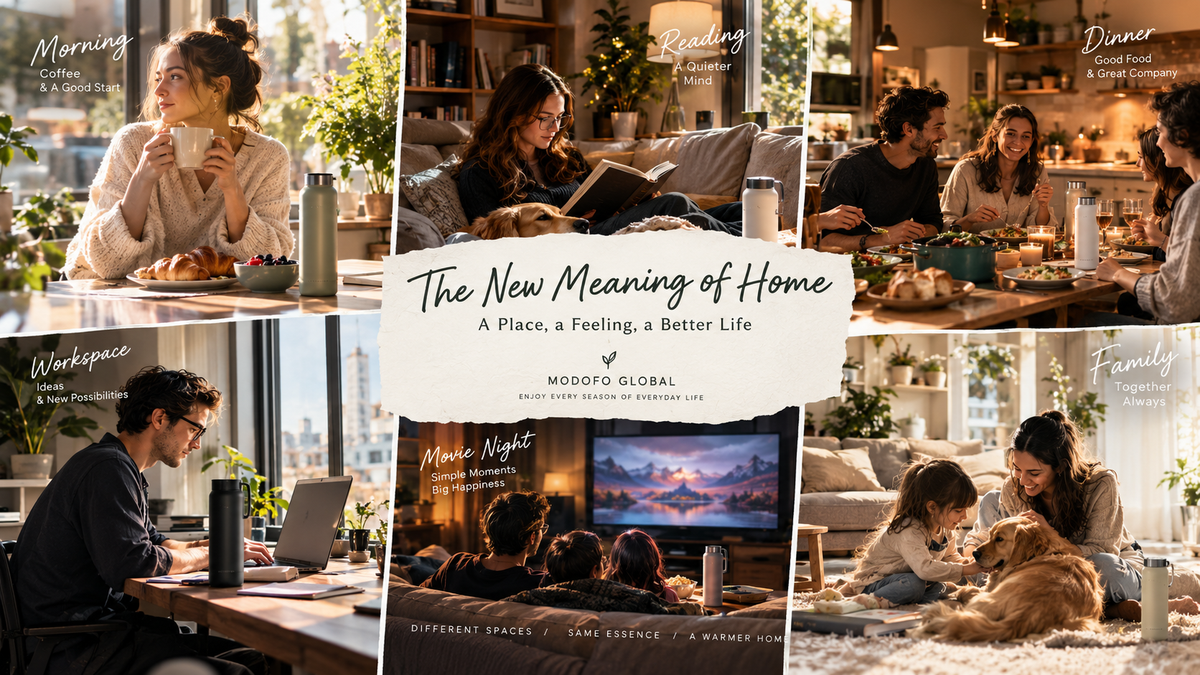
At MODOFO GLOBAL, we believe home is where everyday moments become lasting memories.
It's where the first cup of coffee welcomes a new morning.
Where fresh tea slows a busy afternoon.
Where dinner brings family together after a long day.
Where creativity begins at a comfortable workspace.
Where weekends are filled with books, conversations, films, and quiet moments of rest.
Our everyday essentials are designed to move naturally through these experiences—not to become the center of attention, but to quietly support the rhythm of home.
Because great products don't create meaningful lives on their own.
They simply become trusted companions to the moments that do.
Conclusion: Home Is a Feeling We Create Every Day
The meaning of home will continue to evolve.
Homes may become smarter.
More sustainable.
More flexible.
Designed for changing ways of living.
But one thing is unlikely to change.
People will always seek places where they feel welcomed.
Safe.
Comfortable.
Connected.
Perhaps home has never been defined by walls.
It has always been defined by what happens within them.
The morning coffee enjoyed without rushing.
The shared meals that last longer than expected.
The books waiting to be finished.
The conversations that continue long after dinner.
The routines that slowly become family traditions.
Because in the end, home isn't simply where we return after a busy day.
It's the place where we learn to live well.
Where ordinary moments become extraordinary memories.
And where, day after day, we create the feeling that we simply call home.
A house gives us a place to live. A home gives us a place to belong.