
Finding the Perfect Bottle for Work, Exercise, Travel, Family Life, and Everyday Comfort
Most people think choosing a water bottle is simple.
You pick a size, check the color, compare prices, and make a purchase.
Yet many water bottles end up forgotten in kitchen cabinets, sitting unused on office desks, or collecting dust in the back of a closet.
Why?
Because the best water bottle is rarely the one with the most features.
The best water bottle is the one that naturally fits into your daily life.
A bottle that feels comfortable to carry, easy to drink from, visually appealing, and suitable for your routine is far more likely to become part of your everyday habits.
In recent years, lifestyle researchers, consumer behavior reports, and even countless discussions across online communities have shown that people increasingly view everyday products as extensions of their routines and identities.
A water bottle is no longer just a container.
It is something that accompanies us through work, exercise, travel, study, parenting, hobbies, and moments of rest.
Choosing the right bottle is often less about specifications and more about understanding how you live.
Why Lifestyle Matters More Than Specifications
When shopping for drinkware, consumers often focus on technical details:
- Capacity
- Insulation performance
- Material
- Leak resistance
- Weight
These factors are important.
However, they do not always determine whether a bottle will actually be used.
Many people purchase large insulated bottles because they seem practical, only to discover they are too heavy for daily commuting.
Others buy trendy sports bottles but spend most of their day sitting at a desk.
The mismatch between product and lifestyle often creates dissatisfaction.
Consumer behavior studies consistently show that convenience is one of the strongest predictors of repeated product use.
In simple terms:
A bottle that matches your routine is often more valuable than a bottle with the highest specifications.
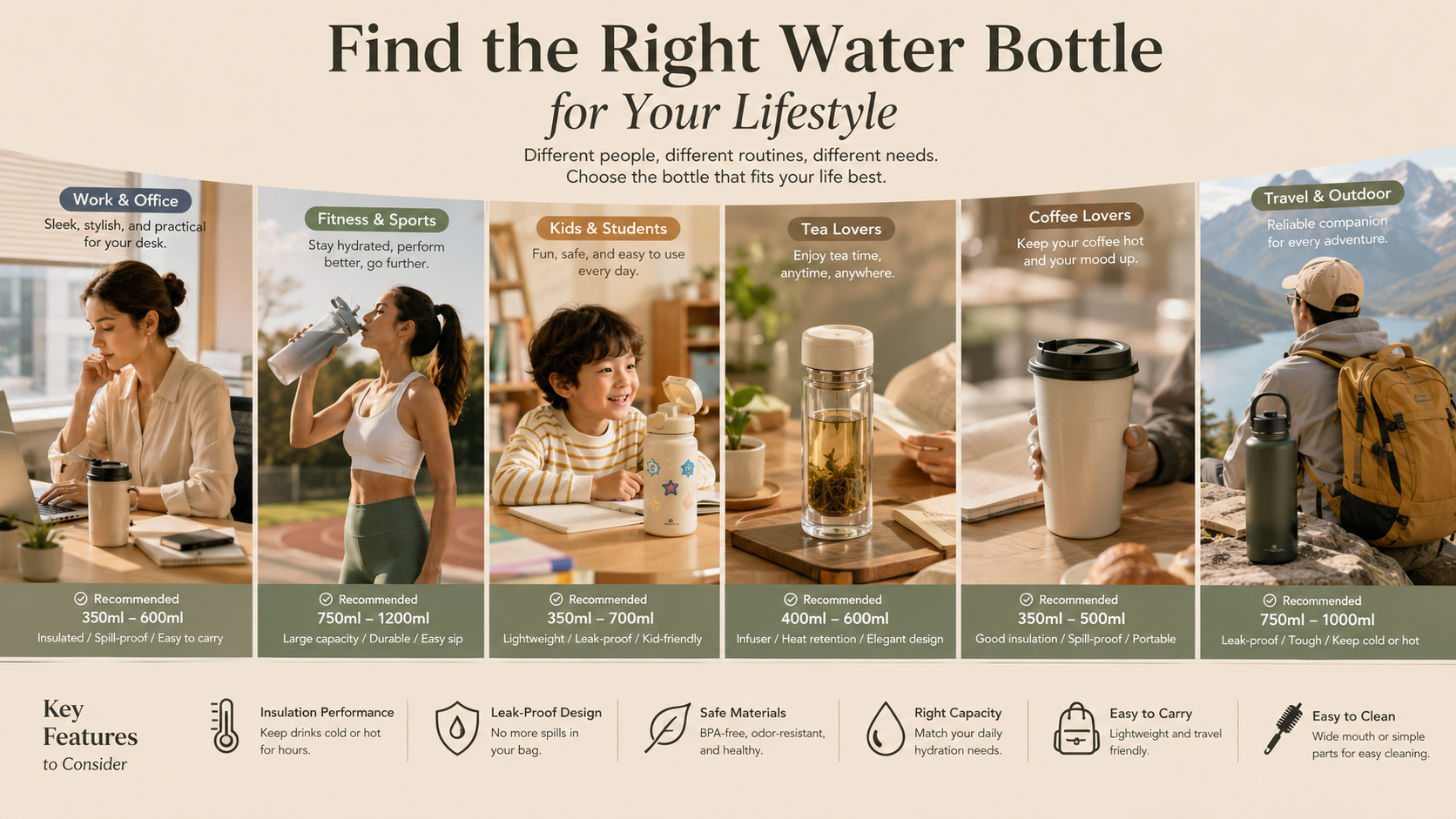
For Active People: Bigger Capacity Means Greater Convenience
Fitness enthusiasts, runners, cyclists, hikers, and outdoor adventurers typically have one major concern:
staying hydrated without constantly searching for water.
Physical activity increases fluid loss through sweating.
As a result, larger-capacity bottles often become more practical.
Recommended Features
- 800ml–1200ml capacity
- Integrated carrying handle
- Leak-proof lid
- Straw or quick-sip design
- Durable stainless steel construction
Many gym-goers in fitness communities report that larger bottles encourage more consistent hydration simply because fewer refills are required.
The less effort it takes to drink water, the more likely people are to do it.
This highlights an important principle:
Good design supports good habits.
For Office Workers: Function Meets Personal Style
Office environments create entirely different needs.
Unlike athletes, office workers typically remain seated for long periods.
Their bottle often stays visible on a desk for eight or more hours every day.
In this environment, appearance becomes surprisingly important.
Many professionals prefer bottles that are:
- Elegant
- Minimalist
- Lightweight
- Easy to clean
- Suitable for coffee, tea, or water
A growing number of workplace lifestyle discussions suggest that people increasingly treat desk accessories as part of their personal workspace identity.
Just as someone chooses a notebook, keyboard, or desk lamp, they may also choose a bottle that reflects their personality.
After all, the objects we see every day subtly influence how we feel about our environment.
A thoughtfully designed bottle can make a workspace feel more organized, pleasant, and personal.
For Students: Durability and Convenience Come First
Students often move between classrooms, libraries, sports facilities, and public transportation.
Their needs tend to prioritize practicality.
Ideal Features
- Lightweight construction
- Durable materials
- Comfortable carry handle
- Leak-proof lid
- Medium to large capacity
Students also benefit from bottles that are easy to refill and maintain.
Online discussions among university students frequently mention that convenience plays a larger role than aesthetics when managing busy schedules.
A bottle that survives daily use without becoming a burden is often the best choice.
For Children: Fun Designs Encourage Healthy Habits
Children represent one of the most interesting drinkware categories.
Unlike adults, children are heavily influenced by visual appeal.
Parents often notice that kids willingly use products featuring:
- Animals
- Cartoon characters
- Bright colors
- Interactive designs
This observation aligns with research in child behavior and habit formation.
Children are more likely to repeat behaviors that feel enjoyable and rewarding.
Helpful Features for Kids
- Lightweight design
- Straw drinking system
- Comfortable grip
- Spill-resistant lids
- Attractive graphics
In many cases, a child who loves their water bottle naturally drinks more water throughout the day.
The design itself becomes part of habit formation.
For Tea Lovers: Choosing a Bottle That Supports Slower Moments
For tea enthusiasts, hydration is often connected to ritual rather than necessity.
Tea drinking encourages people to slow down.
It creates intentional pauses during otherwise busy days.
Tea lovers may appreciate:
- Tea infusers
- Ceramic-lined interiors
- Dedicated tea pots
- Heat retention
- Elegant serving designs
Unlike sports hydration, tea drinking focuses on experience.
The vessel becomes part of the ritual.
A thoughtfully designed tea bottle or insulated tea pot supports moments of reflection, conversation, reading, or relaxation.
Many tea communities emphasize that the enjoyment of tea comes not only from flavor but also from the process surrounding it.
For Coffee Drinkers: Temperature Retention Matters
Coffee drinkers often face a common challenge:
keeping beverages at enjoyable temperatures throughout busy mornings.
This is especially important for:
- Commuters
- Remote workers
- Office professionals
- Travelers
Key priorities often include:
- Heat retention
- Spill resistance
- Comfortable drinking experience
- Portability
Coffee enthusiasts frequently discuss how temperature directly influences flavor perception.
A well-insulated mug or tumbler can help preserve both taste and enjoyment over extended periods.
For many people, a morning coffee is not merely caffeine consumption.
It is part of a daily routine that provides structure and comfort.
For Travelers: Versatility Is Essential
Travel introduces unique challenges.
People may encounter:
- Airports
- Long drives
- Hotels
- Tourist attractions
- Outdoor excursions
A travel bottle should balance:
- Capacity
- Weight
- Durability
- Leak protection
Many experienced travelers recommend bottles between 600ml and 1000ml as a practical middle ground.
Too small and frequent refills become inconvenient.
Too large and carrying becomes cumbersome.
Versatility becomes more valuable than specialization.
How Water Bottle Needs Change Throughout Life
One of the most overlooked aspects of drinkware is that our preferences evolve over time.
Childhood
Fun and engagement matter most.
Teenage Years
Durability and portability become important.
University Years
Convenience and practicality dominate.
Early Career
Aesthetic design and workplace suitability gain importance.
Family Life
Versatility and shared use become priorities.
Later Adulthood
Comfort, insulation, and long-term usability often become more valuable.
Retirement
Tea rituals, slow living, and leisure activities may shape drinkware preferences.
Just as our lifestyles evolve, the products we use evolve alongside them.
Why Design Influences Hydration More Than Many People Realize
An interesting trend appears repeatedly in both consumer research and community discussions:
people drink more water when drinking feels easier.
Factors that may encourage hydration include:
- Comfortable handles
- Easy-open lids
- Attractive appearance
- Convenient size
- Preferred drinking methods
Behavioral psychology often highlights the importance of reducing friction.
The easier a behavior becomes, the more likely people are to repeat it.
Hydration habits are no exception.
A thoughtfully designed bottle may encourage more consistent water intake simply by making drinking more enjoyable.
A Water Bottle Is More Than Just a Container
At first glance, a bottle seems like a simple object.
Yet it often accompanies us through:
- Morning commutes
- Gym sessions
- Study hours
- Family outings
- Travel adventures
- Quiet evenings at home
Over time, everyday objects become integrated into routines.
They support habits, influence convenience, and shape daily experiences.
This is why choosing the right bottle is ultimately not about finding the "best" bottle.
It is about finding the bottle that best supports your lifestyle.
Conclusion: The Best Water Bottle Is the One You Enjoy Using
There is no universal perfect water bottle.
Different lifestyles require different solutions.
A student may need something entirely different from a traveler.
A tea enthusiast may value qualities that matter little to a runner.
The most successful bottle is not necessarily the most advanced.
It is the one that naturally fits into your life.
When a bottle aligns with your routine, preferences, and daily habits, it becomes something you reach for automatically.
And often, that is the true mark of good design.
Not complexity.
Not specifications.
But usefulness, comfort, and everyday enjoyment.
References and Sources
This article combines publicly available information, consumer behavior observations, community discussions, and lifestyle research to provide general educational insights.
Reference categories include:
Hydration and Health Resources
- World Health Organization (WHO)
- U.S. Centers for Disease Control and Prevention (CDC)
- National Health Service (NHS)
- Harvard T.H. Chan School of Public Health
Consumer and Lifestyle Research
- Statista Consumer Goods Reports
- Euromonitor International Lifestyle Trends
- McKinsey Consumer Behavior Studies
- Deloitte Consumer Insights Reports
Community and User Experience Discussions
- Reddit hydration communities
- Reddit fitness and running communities
- Reddit tea and coffee enthusiast communities
- Outdoor recreation forums
- Travel and backpacking discussion groups
Product Design and Behavioral Psychology Concepts
- Habit formation research
- Behavioral economics studies
- User experience (UX) design principles
- Consumer convenience behavior studies
Disclaimer: This article is intended for informational and lifestyle discussion purposes only. It does not constitute medical advice, health advice, or professional recommendations. Individual hydration needs may vary depending on age, health status, climate, activity level, and other factors. Readers should consult qualified healthcare professionals regarding specific health concerns.