
A cup that feels perfectly fine when empty can suddenly feel clumsy, unstable, or tiring once it’s filled with liquid. This experience is so common that many people assume it’s just a matter of cup size or personal grip strength. In reality, the discomfort comes from a much deeper interaction between physics, design, materials, and human ergonomics.
Understanding why some cups feel awkward to hold when full requires looking beyond capacity numbers and into how weight, balance, shape, and usage context work together. The issue is not user error. It is a predictable outcome of design trade-offs.
The Moment a Cup Stops Feeling Comfortable
Most users notice the problem at a specific moment: the cup is filled to near its labeled capacity, lifted with one hand, and suddenly feels heavier than expected or harder to control. The wrist compensates. The grip tightens. Sometimes the cup tilts slightly forward or backward, even without movement.
This discomfort tends to appear in everyday situations: walking with a drink, lifting it from a car cup holder, or holding it for extended periods at a desk. The same cup might feel fine for a quick sip but unpleasant over time.
The key insight is that comfort is not determined by total weight alone. It is determined by how that weight behaves once the cup is in motion.
Weight Distribution Matters More Than Weight
The most important factor behind awkward handling is weight distribution, not absolute mass.
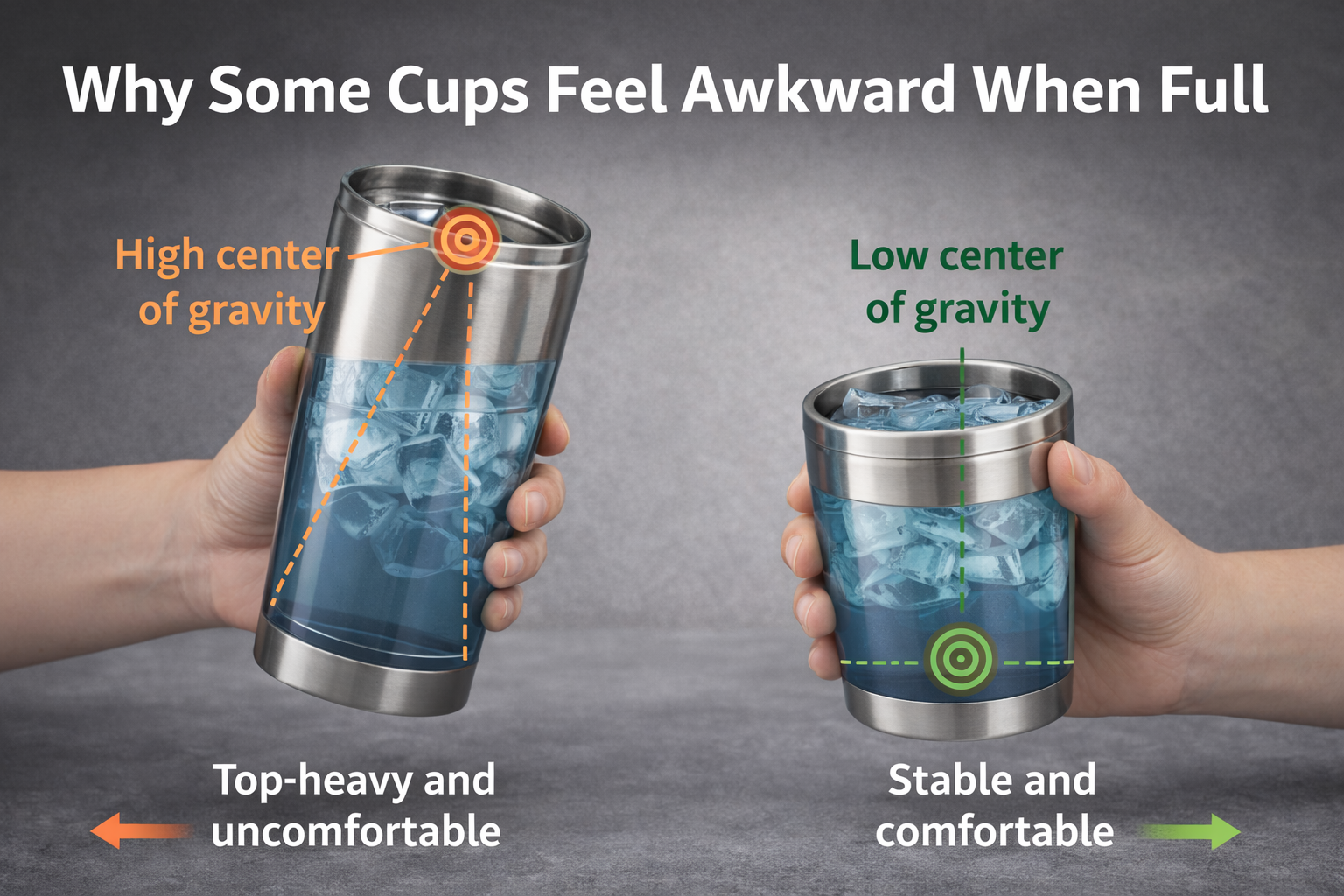
When a cup is empty, most of its weight is concentrated in the walls and base. Once filled, the liquid becomes the dominant contributor to total weight. Because liquid is free to move, it shifts the center of gravity upward and outward.
A higher center of gravity increases the torque placed on the wrist. Even small changes in height or shape can dramatically change how stable a cup feels. This is why taller cups often feel more awkward than shorter cups, even when they hold the same volume.
The effect becomes more pronounced when ice is added. Ice displaces liquid unevenly, creating localized mass concentrations that move independently. This internal movement forces the hand to constantly correct balance, increasing fatigue.
Why Tall Cups Feel Less Stable When Full
Cup height plays a critical role in perceived awkwardness.
A tall cup increases the vertical distance between the grip point and the center of mass. This distance acts as a lever. The longer the lever, the more effort the wrist must apply to keep the cup upright.
This is why a slim, tall 20oz cup often feels less stable than a wider, shorter cup of the same capacity. The liquid weight is not only heavier but positioned farther from the hand.
Designers often favor tall silhouettes because they fit cup holders and look sleek. The trade-off is stability. From a physics standpoint, tall cups are inherently less forgiving when full.
Shape and Ergonomics: When Geometry Fights the Hand
Cup shape strongly influences how the hand interacts with weight.
Straight-walled cups distribute pressure evenly but offer little tactile guidance for grip placement. Tapered cups guide the hand naturally toward a narrower grip zone, improving control. However, excessive tapering can reduce internal volume efficiency and complicate manufacturing.
Diameter is another critical factor. If the cup is too wide, smaller hands struggle to maintain a secure grip. If it is too narrow, pressure concentrates on fewer contact points, increasing strain.
Smooth cylindrical shapes, while visually clean, often lack ergonomic feedback. Without contours, grooves, or texture, the hand receives limited information about orientation and balance. This forces the user to rely more on grip force rather than natural hand positioning.
Material Choice Changes How Weight Is Felt
Material selection directly affects how awkward a cup feels when full.
Stainless steel, especially in double-wall insulated designs, adds significant base weight before liquid is introduced. When filled, the combined mass can exceed what users intuitively expect for a drink container.
Plastic cups are lighter but often require thicker walls for rigidity, which can widen the grip diameter. Glass offers a balanced feel but introduces fragility concerns and heat transfer issues.
Surface finish also matters. A matte or rubberized surface increases friction, reducing the grip force needed to maintain control. Polished metal surfaces, while premium-looking, can feel slippery, especially with condensation.
The material does not just add weight. It changes how confidently the hand can manage that weight.
Double-Wall Insulation: Comfort vs Performance
Double-wall insulation is a major contributor to awkward handling in modern cups.
Insulation improves temperature retention but requires additional material thickness. This reduces internal volume relative to external size and increases overall mass. More importantly, it moves the grip point farther from the liquid, increasing leverage effects.
Insulated cups often feel “heavier than expected” because users mentally associate them with standard mugs or bottles of similar size. The mismatch between expectation and physical reality amplifies perceived awkwardness.
From a design perspective, insulation is a deliberate trade-off. Thermal performance improves at the cost of handling comfort, especially at larger capacities.
Handles Are Not a Universal Solution
Adding a handle seems like an obvious fix, but handles introduce their own problems.
A handle shifts the grip away from the cup’s centerline, creating asymmetric loading. This can feel stable when stationary but awkward during movement. Handles also increase the moment arm, putting more stress on the wrist when the cup is full.
Small handles may not accommodate all hand sizes, while large handles can interfere with storage and cup holders. Some designs add detachable handles, which help flexibility but increase complexity and cost.
Handles solve some problems but rarely eliminate awkwardness entirely.
Lid Design and Top-Heavy Effects
Lids contribute more to imbalance than most users realize.
Complex lids with locking mechanisms, straw assemblies, or rotating components add weight near the top of the cup. This shifts the center of gravity upward, increasing instability.
Straw systems are particularly impactful. A straw filled with liquid acts as a vertical column of weight that amplifies top-heavy behavior. When the cup tilts, the straw lags slightly, creating additional movement.
Spill-prevention features improve safety but often worsen balance. This is another example of functional priorities competing with ergonomic comfort.
Real-World Use Makes the Problem Worse
Cups are rarely used in ideal conditions.
Walking, driving, or multitasking introduces motion that magnifies instability. A cup that feels manageable at a desk may feel awkward during a commute. One-handed use increases strain, especially when the wrist must compensate for shifting liquid.
Fatigue compounds the issue. Holding a heavy or unbalanced cup for extended periods leads to muscle strain, even if the initial grip feels acceptable.
These real-world factors explain why user dissatisfaction often appears after prolonged use rather than immediately.
Human Factors Designers Can’t Ignore
Hands vary widely in size, strength, and grip style. A cup that feels fine for one user may feel awkward for another.
Many designs implicitly assume an average hand size that does not represent global users. Grip strength also varies by age and daily activity. Left-handed users often encounter additional awkwardness due to asymmetric features.
Ignoring these human factors leads to designs that look good on paper but feel uncomfortable in practice.
Why Popular Cups Still Feel Awkward
If awkward handling is so predictable, why do many popular cups still suffer from it?
The answer lies in competing priorities. Capacity, insulation, aesthetics, and branding often take precedence over ergonomics. Consumers tend to shop visually and compare capacity numbers, not handling comfort.
Design teams must balance cost, manufacturability, and market expectations. Improving ergonomics often requires subtle changes that are hard to communicate in marketing.
As a result, discomfort becomes an accepted compromise rather than a solved problem.
How to Choose a Cup That Feels Better When Full
Consumers can reduce awkwardness by looking beyond capacity labels.
Shorter cups with wider bases generally feel more stable. Tapered shapes improve grip control. Textured surfaces reduce strain. Simpler lids usually improve balance.
Matching cup design to actual usage is crucial. A desk cup does not need the same ergonomics as a travel cup. Larger capacities are not always better if comfort suffers.
Understanding these factors leads to better long-term satisfaction.
The Future of Ergonomic Cup Design
Design trends are slowly shifting toward ergonomics.
Some brands experiment with redistributed mass, integrated grip zones, or modular handles. Others reduce height while maintaining capacity through wider profiles. These changes reflect a growing recognition that comfort matters.
As competition increases, handling comfort may become a clearer differentiator. Cups that feel good when full are more likely to be used daily, not just admired on a shelf.
Conclusion: Awkwardness Is a Design Outcome
When a cup feels awkward to hold when full, it is not a personal failing. It is the predictable result of design decisions involving weight distribution, shape, materials, and use context.
Capacity numbers alone cannot explain comfort. Understanding the mechanics behind handling reveals why some cups fatigue the wrist while others feel effortless.
In drinkware design, comfort is not accidental. It is engineered, compromised, or ignored. The cups that feel best when full are the ones where ergonomics were treated as a priority, not an afterthought.
Design Principles and Data Behind Cup Handling Comfort
From an engineering standpoint, cup handling comfort is closely tied to measurable physical principles rather than subjective perception alone. Studies in ergonomics and product design consistently show that center of gravity height, object mass, and grip diameter have a direct impact on wrist torque and muscular load. According to biomechanical research on hand-held objects, increasing the center of mass even by a few centimeters significantly raises rotational force on the wrist during one-handed lifting, especially when the object exceeds 500 grams in total weight. Industrial design guidelines further indicate that cylindrical objects with diameters exceeding 75–80 mm begin to reduce grip efficiency for average adult hands, increasing fatigue over sustained use. In drinkware design, double-wall stainless steel construction typically adds 20–35% additional mass compared to single-wall designs, while insulated lids and straw mechanisms shift weight upward, increasing top-heavy behavior. Laboratory measurements of liquid-filled containers also show that internal fluid movement introduces dynamic load variation, which requires continuous micro-adjustments by the hand and forearm. These findings explain why taller, insulated cups with complex lids often feel unstable when full, even when their labeled capacity and total volume appear reasonable on paper.
-
Pheasant, S. & Haslegrave, C.
Bodyspace: Anthropometry, Ergonomics and the Design of Work - Chaffin, D. B., Andersson, G., & Martin, B.
Occupational Biomechanics - ISO 9241-210: Human-Centred Design for Interactive Systems
- McGorry, R. W.
Effect of Load Height and Mass on Upper Extremity Biomechanics - Industrial Design Society of America (IDSA)
- Fluid Dynamics in Containers – Journal of Applied Mechanics