
From 12oz to 40oz and Beyond
Capacity labels look definitive. A cup says 20oz, so it should hold 20oz of liquid. Yet many users eventually notice something feels off. Ice fills it too quickly. The lid displaces more space than expected. The drink reaches the brim sooner than the number suggests.
This confusion is not limited to 20oz cups. It appears across the entire range of drinkware—from small mugs to oversized insulated tumblers. The reason is simple but rarely explained: capacity labels describe a reference point, not a real-world guarantee.
Understanding why this gap exists helps users choose better cups and helps brands communicate more clearly.
Capacity Confusion Is Bigger Than One Cup Size
The “20oz problem” is often discussed because 20oz sits at the center of modern drinkware. It is large enough to be insulated, portable enough for daily use, and common across global brands. But the same logic applies to nearly every labeled size.
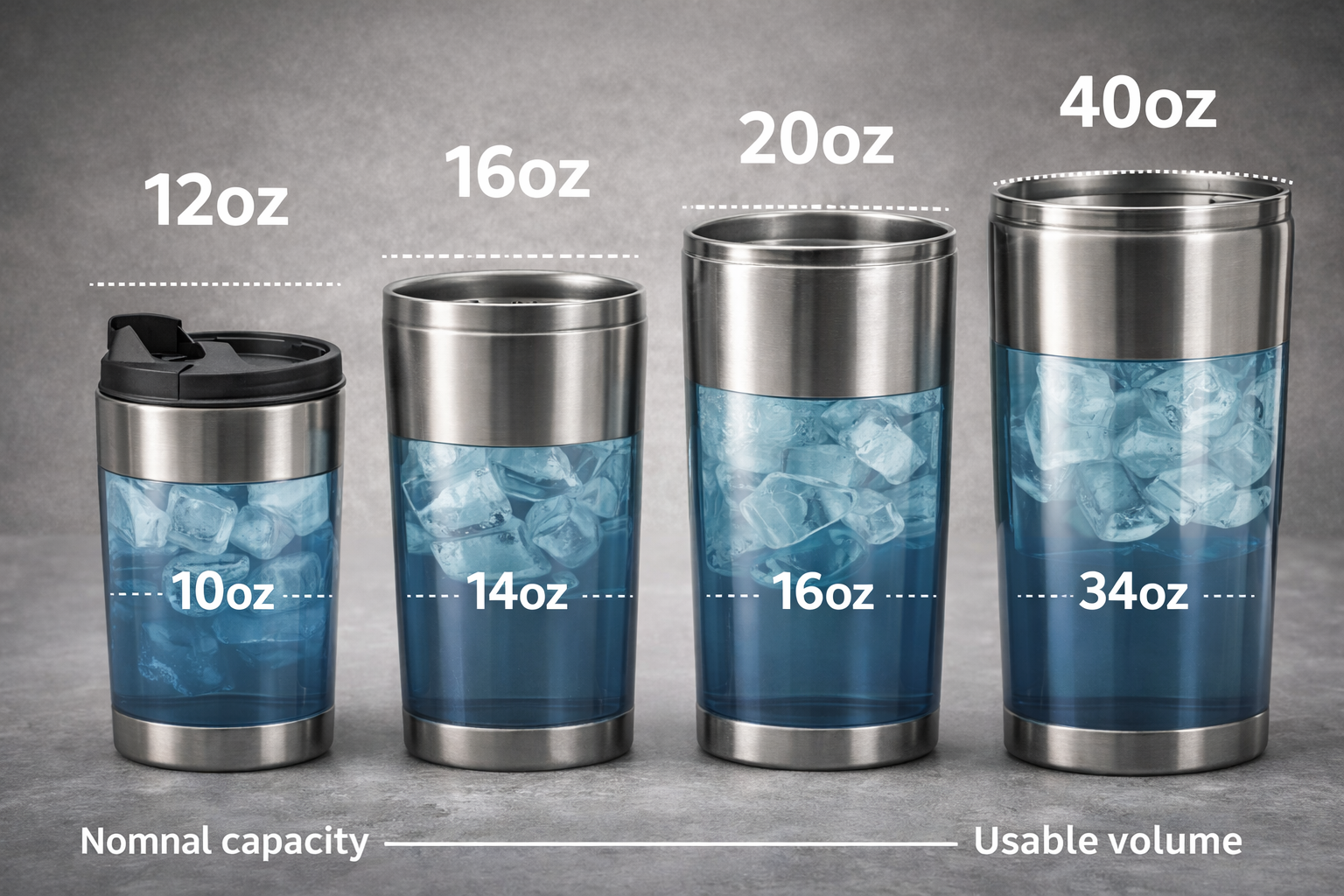
An 12oz cup may feel slightly smaller than expected.
A 30oz tumbler may feel much smaller than expected.
A 40oz cup may feel large but still not hold what users imagine.
The confusion grows with size, insulation, and accessories. Capacity mismatch is not a flaw—it is a design outcome.
What Cup Capacity Labels Actually Represent
In drinkware, capacity is typically defined as nominal capacity.
Nominal capacity refers to the maximum internal volume of the cup body under ideal conditions:
- No lid
- No ice
- No headspace
- Filled to the internal brim
This measurement is useful for categorization and comparison, but it does not reflect daily use.
Unlike measuring cups or laboratory containers, drinkware is designed to be used comfortably, carried safely, and sealed reliably. That requires compromises that reduce usable liquid volume.
Capacity labels help users compare products. They are not intended to function as precision instruments.
How Capacity Behavior Changes Across Cup Sizes
Small Cups: 8oz–12oz
Smaller cups often feel closer to their labeled capacity. They typically:
- Have thinner walls
- Use simpler lids or no lids
- Require less structural reinforcement
However, even small cups include headspace to prevent spills and allow comfortable sipping. That headspace slightly reduces usable volume, especially when filled with hot liquids.
The difference is subtle, which is why it often goes unnoticed.
Medium Cups: 16oz–24oz
This range is where most confusion begins.
Medium-sized cups are frequently insulated and often paired with lids designed for mobility. These features introduce multiple volume-reducing factors:
- Thicker walls
- Curved internal bases
- Lid mechanisms that occupy internal space
Ice usage is also common at this size, further reducing how much liquid the cup can actually hold.
A 20oz cup in this category may technically meet its labeled capacity, yet rarely does so in practice.
Large Cups: 30oz–40oz and Above
Large cups exaggerate the gap between labeled and usable volume.
As size increases:
- Insulation layers become thicker
- Structural reinforcement increases
- Lid complexity grows
These changes are necessary for durability and performance, but they consume internal space. A 40oz cup often feels significantly smaller once ice, lid displacement, and spill headspace are accounted for.
The larger the cup, the more noticeable the difference becomes.
Design Factors That Reduce Usable Volume at Any Size
Double-Wall Insulation
Insulation is one of the biggest contributors to volume loss.
Double-wall construction improves temperature retention, but it reduces internal diameter. The thicker the insulation, the more volume is lost. This trade-off applies across all insulated cup sizes.
Better insulation almost always means less usable volume.
Cup Shape and Internal Geometry
Cups are rarely straight cylinders internally.
Tapered bottoms improve stability and compatibility with cup holders. Rounded internal bases strengthen structure and reduce stress points. These shapes enhance usability but reduce fillable space.
The volume lost may seem small on paper, but it becomes noticeable when users expect exact capacity.
Lid Types and Internal Components
Lids are rarely volume-neutral.
Straw mechanisms, flip spouts, and internal seals displace liquid space. Most users intuitively ignore this factor when thinking about capacity, even though it plays a major role in daily use.
A cup with a complex lid may hold significantly less liquid than the same cup without one.
Real-World Use Changes Everything
Capacity labels assume liquid-only filling. Real life does not.
Ice
Ice dramatically reduces usable liquid volume. Large cubes, crushed ice, or ice-filled cups may reduce liquid capacity by 20–50%, depending on usage.
Brands do not account for ice because ice usage varies widely.
Foam and Headspace
Carbonated drinks, milk-based beverages, and hot liquids require headspace to prevent overflow. This headspace is functional, not wasted, but it reduces perceived capacity.
Spill Prevention
Cups are designed to be moved. Leaving space at the top prevents spills during walking, driving, or sudden stops. That space is intentional and necessary.
Manufacturing Tolerances and Scale
In mass production, no two cups are identical.
Small variations in wall thickness, internal curvature, and assembly tolerances affect internal volume. These variations increase with size.
Rather than labeling exact fill lines, brands work within acceptable ranges. Capacity labels represent the design target, not the measured outcome of each unit.
OZ and ML Across the Full Capacity Spectrum
Exact conversion between OZ and ML produces awkward numbers. Brands rarely use them.
For example, converting 20oz to ML yields a number that feels technical rather than intuitive. Clean numbers are easier to understand, compare, and remember.
Rounding improves usability but sacrifices precision. Across larger sizes, rounding differences become more noticeable, reinforcing the perception gap.
Why Brands Use Consistent Capacity Labels
Capacity labels are part of a product system.
Brands aim for consistency across product lines so users can easily compare sizes. Changing a 20oz label to a more precise number would introduce confusion, not clarity.
Capacity functions as a category signal. It tells users roughly where a cup sits in the size spectrum.
Choosing the Right Cup Size Beyond the Number
Smarter cup selection starts with scenarios, not labels.
Questions that matter more than the number:
- Will ice be used daily?
- Is portability a priority?
- Will the cup be used with a lid?
- Is temperature retention more important than volume?
In many cases, sizing up provides a better experience than expecting exact capacity from a smaller cup.
Rethinking Capacity the Right Way
Capacity labels are not lies. They are abstractions.
They help users compare products across brands and regions. They do not describe how much liquid will fit in every real-world situation.
Understanding this distinction turns frustration into informed choice.
Conclusion: Capacity Labels Are Scales, Not Guarantees
From 12oz mugs to 40oz tumblers, labeled capacity rarely matches daily liquid volume exactly. This gap exists because drinkware is designed for usability, safety, and performance—not measurement accuracy.
Once users understand how insulation, lids, shape, and real-world habits affect volume, capacity labels become useful guides rather than misleading promises.
The best cup is not the one that measures perfectly.
It is the one that fits how you actually drink.