
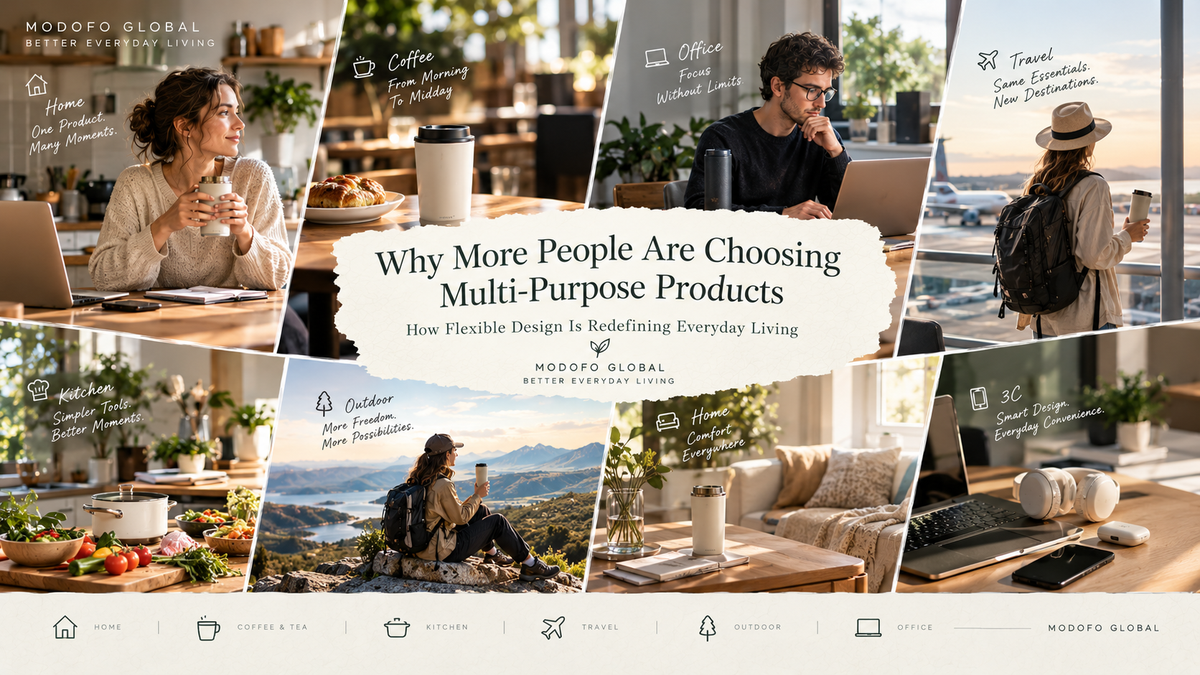
How Flexible Design Is Redefining Everyday Living
Introduction: Modern Life No Longer Fits Into One Category
There was a time when life felt neatly divided.
Home was for relaxing.
The office was for working.
The kitchen was for cooking.
Weekends were for traveling.
Each place had its own purpose, and every product was designed to do just one thing.
Today's lifestyle looks very different.
Many people begin their morning at home, answer emails from a neighborhood café, take meetings while traveling, exercise in the park, work remotely in the afternoon, and spend the evening preparing dinner with friends.
The boundaries between work, leisure, travel, and home have become increasingly fluid.
As life becomes more flexible, the products we rely on are changing too.
Instead of filling our homes with separate items for every situation, we are beginning to value products that naturally move with us throughout the day.
Not because they do everything.
But because they fit wherever life happens.
The future of everyday living isn't about owning more.
It's about choosing things that stay useful, meaningful, and adaptable as life evolves.
Life Is Becoming More Flexible
One of the defining characteristics of modern living is flexibility.
Remote work has changed where people work.
Hybrid schedules have changed when people work.
Compact homes encourage smarter organization.
Weekend travel has become more spontaneous.
Outdoor activities are blending into daily routines.
Coffee shops have become workspaces.
Dining tables become meeting rooms.
Living rooms transform into yoga studios.
Balconies become reading corners.
Life no longer fits into separate boxes.
Our surroundings change throughout the day, and increasingly, the products we use need to change with them.
The most valuable objects today are those that feel equally at home in multiple environments.
One Product Can Support Many Moments
A truly thoughtful product rarely belongs to just one activity.
A reusable tumbler begins the morning filled with coffee.
By lunchtime, it carries iced tea.
In the afternoon, it keeps water cool during meetings.
On the weekend, it joins a hiking trip.
Later, it sits beside a picnic blanket in the park.
Nothing about the product changes.
Only the moments around it do.
The same is true for many of the objects people keep close every day.
A backpack travels from the office to the airport.
A notebook holds business ideas one day and travel memories the next.
Wireless headphones accompany focused work, long flights, and evening walks.
The best products become part of a lifestyle rather than a single task.
They quietly adapt without asking us to think about them.
Less Clutter Creates More Freedom
For many years, modern living encouraged accumulation.
A different tool for every purpose.
A different bag for every occasion.
A different cup for every drink.
More choices were often seen as better choices.
Today, many people are discovering that the opposite can be true.
Fewer, more versatile possessions often create a calmer home and a simpler daily routine.
A thoughtfully chosen object eliminates unnecessary decisions.
It reduces visual clutter.
It frees up physical space.
More importantly, it creates mental space.
People are not buying fewer things because they want emptier shelves.
They're choosing better things because they want fuller lives.
Owning less becomes meaningful only when what remains genuinely supports everyday living.
Great Design Makes Versatility Feel Natural
Some products advertise endless features.
Others quietly become indispensable.
The difference often lies in thoughtful design.
The most versatile products never feel complicated.
They don't require constant adjustments or lengthy instructions.
Instead, they feel intuitive from the first use.
A bottle fits comfortably into a backpack and a car cup holder.
A kitchen tool works equally well for weekday dinners and weekend gatherings.
A travel accessory feels just as useful at home.
Good design doesn't ask people to adapt.
It adapts to people.
Versatility is most valuable when it feels effortless.
Every Space Has Become Multi-Purpose
Our homes have changed dramatically over the past few years.
The kitchen is no longer only a place to cook.
It has become a coffee bar, a conversation space, and sometimes even a temporary office.
The dining table hosts breakfast, video meetings, homework, and family dinners.
The living room shifts from a workspace during the day to a place for movies and quiet evenings.
Even balconies have become small gardens, reading spaces, and outdoor cafés.
When spaces become more flexible, the products inside them naturally need to become more flexible as well.
The future of home isn't defined by more rooms.
It's defined by rooms that support more ways of living.
The Most Sustainable Product Is the One You Keep
Sustainability is often discussed in terms of materials and manufacturing.
These conversations matter.
But longevity matters just as much.
A thoughtfully designed product that remains useful for many years often creates less waste than several products designed for short-term use.
People naturally care for things that continue serving them well.
They repair them.
Travel with them.
Create memories around them.
Recommend them to friends.
The most sustainable product isn't simply one made from recycled materials.
It's the one people never feel the need to replace.
Durability begins with usefulness.
Quality Is Replacing Quantity
Modern consumers are becoming more intentional.
Instead of asking,
"How many products do I need?"
they're beginning to ask,
"Which products truly deserve a place in my everyday life?"
A useful object earns its place through repeated use.
It becomes part of morning routines.
Weekend adventures.
Family gatherings.
Business trips.
Daily commutes.
Over time, people stop thinking about the product itself.
They simply reach for it without hesitation.
This quiet reliability is often the highest compliment thoughtful design can receive.
Products Should Adapt to Life—Not the Other Way Around
For many years, people adjusted their routines around products.
They accepted inconvenience as normal.
Today, expectations are changing.
People want products that understand modern life.
Objects that move naturally between home, work, travel, and outdoor experiences.
Design is no longer measured only by appearance.
It is measured by how easily it fits into everyday routines.
The best products remove friction before we even notice it.
They simplify decisions.
Reduce unnecessary effort.
And quietly support the moments that matter most.
Perhaps that is the true purpose of thoughtful design.
Not adding more features.
But making life feel lighter.
The MODOFO GLOBAL Philosophy
At MODOFO GLOBAL, we believe everyday life cannot be divided into neat categories.
One day may include a morning commute, remote work, a coffee break, an afternoon walk, dinner with family, and a spontaneous weekend trip.
Life moves naturally from one moment to another.
The products we carry should do the same.
Whether it's a reusable tumbler accompanying morning coffee, a bottle joining an outdoor adventure, or everyday essentials supporting life at home, work, and beyond, thoughtful design should feel effortless.
Our philosophy of Better Everyday Living begins with a simple belief:
A well-designed product doesn't need to do everything.
It simply needs to be ready for wherever life takes you.
Because the most meaningful products aren't those with the longest feature list.
They're the ones that quietly become part of your story.
Conclusion: Better Living Begins With Better Choices
Modern life will continue to evolve.
Work will become more flexible.
Homes will become more adaptable.
Travel will become more spontaneous.
The boundaries between different parts of life will continue to fade.
As this happens, the products we choose will matter differently.
Instead of asking whether something has more features, we may begin asking whether it fits naturally into our lives.
The future belongs to products that travel through life, not just through places.
Objects that simplify routines instead of adding complexity.
Designs that quietly support us without demanding attention.
Because in the end, the best products are not remembered for doing the most.
They are remembered for making everyday life feel just a little easier.
A little lighter.
And a little more flexible.
The future of design isn't about creating more things. It's about creating thoughtful essentials that belong wherever life happens.