
Why Walkable Streets, Green Spaces, and Human-Centered Design Are Shaping the Future of Urban Life
Introduction: A Better City Creates a Better Everyday Life
For generations, cities were designed around one simple idea:
Move people from one place to another as quickly as possible.
Roads became wider.
Parking lots became larger.
Buildings grew taller.
Cars shaped the rhythm of everyday life.
Efficiency often came before experience.
But across Europe and North America, a different vision of the city is beginning to emerge.
Instead of asking,
"How can people move faster?"
Urban planners, designers, and local communities are increasingly asking,
"How can people live better?"
A successful city today is no longer measured only by its skyline or economy.
It's measured by how comfortable it feels to walk through.
How easy it is to meet friends.
How much time people spend outdoors.
Whether children can safely ride bicycles.
Whether neighborhoods encourage conversation instead of isolation.
The cities people love most are rarely the busiest.
They are often the ones that make everyday life feel easier, healthier, and more enjoyable.
Walkable Cities Make Everyday Life More Enjoyable
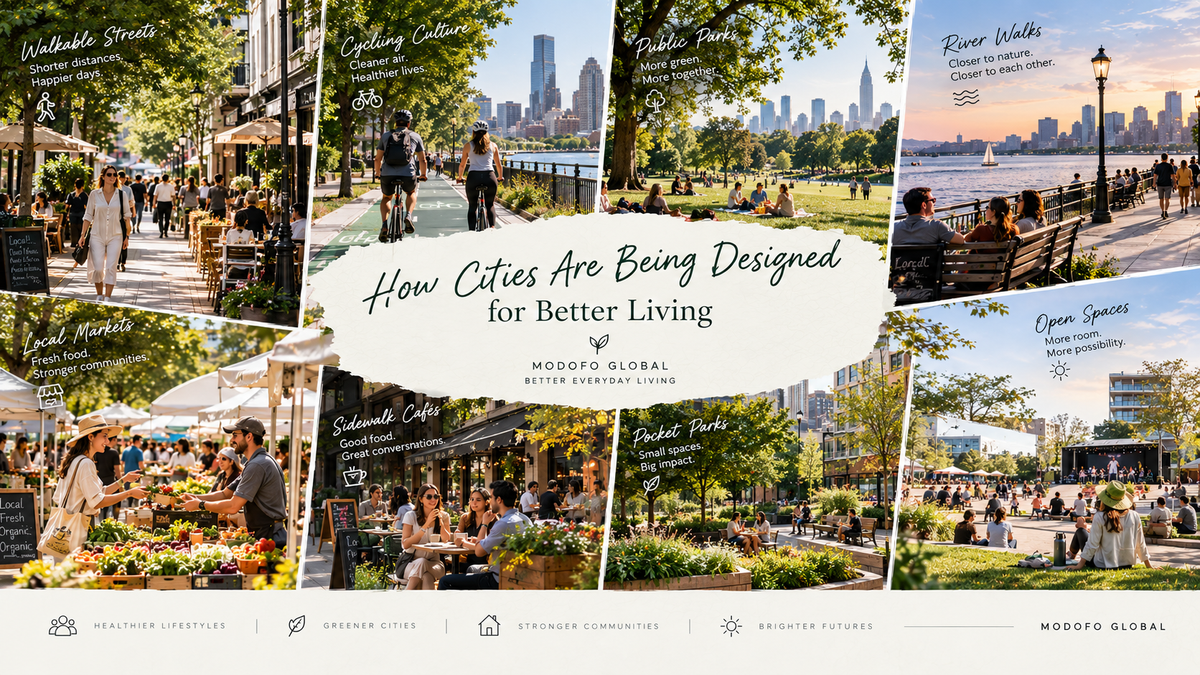
One of the biggest changes in modern urban planning is the growing importance of walkability.
People are increasingly choosing neighborhoods where daily destinations are only a short walk away.
A local bakery.
A coffee shop.
A grocery store.
A bookstore.
A nearby park.
The ability to complete everyday errands on foot transforms ordinary routines.
Walking slows people down just enough to notice their surroundings.
Seasonal flowers.
Neighborhood cafés.
Street musicians.
Friendly faces.
Instead of simply passing through the city, people begin experiencing it.
The journey itself becomes part of everyday happiness.
Cycling Is Becoming Part of Urban Culture
Cycling is no longer viewed only as transportation.
It has become a lifestyle.
Across many European cities, protected bike lanes continue to expand.
People ride to work.
Meet friends.
Visit weekend markets.
Explore neighborhoods.
Parents cycle with children.
Students ride to university.
Cycling offers something unique.
It combines movement with freedom.
Unlike driving, cycling allows people to experience the city at a human pace.
They notice architecture.
Public art.
Trees changing with the seasons.
Small businesses tucked between larger streets.
Cities designed for cycling often become cities where people naturally spend more time outdoors.
Public Parks Are the Living Rooms of Modern Cities
Every great city has places where people gather without needing to spend money.
Public parks provide exactly that.
Children play.
Families picnic.
Friends share coffee.
Readers find a quiet bench.
People practice yoga.
Musicians perform.
Dogs make friends before their owners do.
Parks create something every neighborhood needs:
Shared space.
Unlike private homes or commercial buildings, parks belong to everyone.
They encourage spontaneous encounters that strengthen communities.
Sometimes a simple afternoon under the trees becomes the highlight of an ordinary week.
Small Parks Can Make a Big Difference
Not every neighborhood has room for a large park.
That is why many cities are investing in pocket parks.
Tiny green spaces tucked between buildings.
A few benches.
Native plants.
Shade trees.
A drinking fountain.
A place to pause.
These compact spaces may only occupy a small corner of the city, yet they often become favorite meeting places.
They invite people to slow down.
Take a break.
Read a book.
Enjoy lunch outdoors.
Sometimes the smallest public spaces create the greatest sense of belonging.
Sidewalk Cafés Bring Streets to Life
Outdoor cafés have long been part of European city culture.
Today, more cities are embracing them as an essential part of urban life.
Sidewalk seating transforms streets.
Instead of becoming corridors for traffic, they become places where people stay.
Morning coffee.
Business meetings.
Weekend brunch.
Friends catching up after work.
Parents watching children play nearby.
Outdoor seating adds life to the street.
People become part of the city's scenery rather than simply moving through it.
The best streets are not always the busiest.
They are the ones where people choose to linger.
River Walks and Waterfronts Encourage Everyday Exploration
Water has always attracted people.
Many cities are now restoring riversides and waterfronts into public spaces designed for walking, cycling, and relaxation.
Boardwalks.
Riverside cafés.
Open lawns.
Public art.
Cycling paths.
Sunset viewpoints.
These places encourage movement without feeling like exercise.
People stroll after dinner.
Watch boats pass.
Meet friends.
Read beside the water.
Nature quietly becomes part of city life.
The city feels calmer simply because people have somewhere beautiful to go without needing a destination.
Open Spaces Make Cities Feel More Human
Not every valuable place needs a building.
Open plazas.
Pedestrian streets.
Community squares.
Outdoor seating.
Public gardens.
Temporary event spaces.
These environments create opportunities for life to happen naturally.
Weekend markets.
Street performances.
Food festivals.
Outdoor movie nights.
Seasonal celebrations.
Cities designed around people instead of traffic create more opportunities for unexpected moments.
And those moments often become lasting memories.
Better Cities Encourage Healthier Habits
Urban design quietly influences everyday behavior.
When walking is enjoyable, people naturally walk more.
When cycling feels safe, more people choose bicycles.
When parks are nearby, families spend more time outdoors.
When cafés open onto sidewalks, conversations become part of everyday life.
Healthy cities do not force healthier habits.
They simply make them easier.
The best design often feels invisible.
It quietly encourages better choices without demanding them.
The MODOFO GLOBAL Philosophy
At MODOFO GLOBAL, we believe everyday life extends far beyond the walls of home.
A morning coffee enjoyed at a neighborhood café.
A reusable bottle carried along a riverside walk.
Lunch shared in a public park.
Weekend markets with family.
Cycling through tree-lined streets.
Conversations that continue long after the drinks are finished.
Our everyday essentials are designed to move naturally through these experiences.
Not to define the moment.
But to quietly support it.
Because great products don't only belong in kitchens or offices.
They belong wherever everyday life happens.
Conclusion: Great Cities Are Designed Around People
The future of urban living is not about building taller buildings.
Or creating faster roads.
It is about creating places where people genuinely enjoy spending time.
Cities that invite walking instead of rushing.
Neighborhoods that encourage conversation instead of isolation.
Public spaces that welcome everyone.
Parks that become gathering places.
Cafés that become community living rooms.
River walks that inspire evening strolls.
Open spaces where children play, friends reconnect, and strangers become neighbors.
Perhaps the world's best cities have always shared one thing in common.
They make ordinary days feel extraordinary.
Because in the end, a city is not remembered only for its landmarks.
It is remembered for how it makes people feel while living there.
The future of cities isn't about building for cars.
It's about designing for people—and creating everyday places where life can truly flourish.
The best cities are not the ones we move through the fastest. They are the ones that invite us to slow down, step outside, and enjoy everyday life together.