
Introduction: Why the “Right Bottle” Often Feels Wrong
Most people have experienced this at some point: you buy a well-reviewed, high-quality bottle, only to find that it doesn’t quite fit your daily routine.
It might retain the smell of coffee longer than expected.
It might be inconvenient to clean after using it for milk-based drinks.
Or it might simply feel impractical for how you actually use it day to day.
In many cases, the issue is not the product itself—it is the mismatch between the type of drinkware and the way it is being used.
This reveals a key insight:
Choosing drinkware is not about finding the best product. It is about finding the right fit for your specific use case.
This guide breaks down the major types of drinkware, explains how they function, and helps you understand how to match them to real-life scenarios.
1. A Better Way to Understand Drinkware: Beyond Categories
Before diving into specific types, it is important to understand why so many different forms of drinkware exist.
They are not simply variations in design—they are responses to different functional priorities.
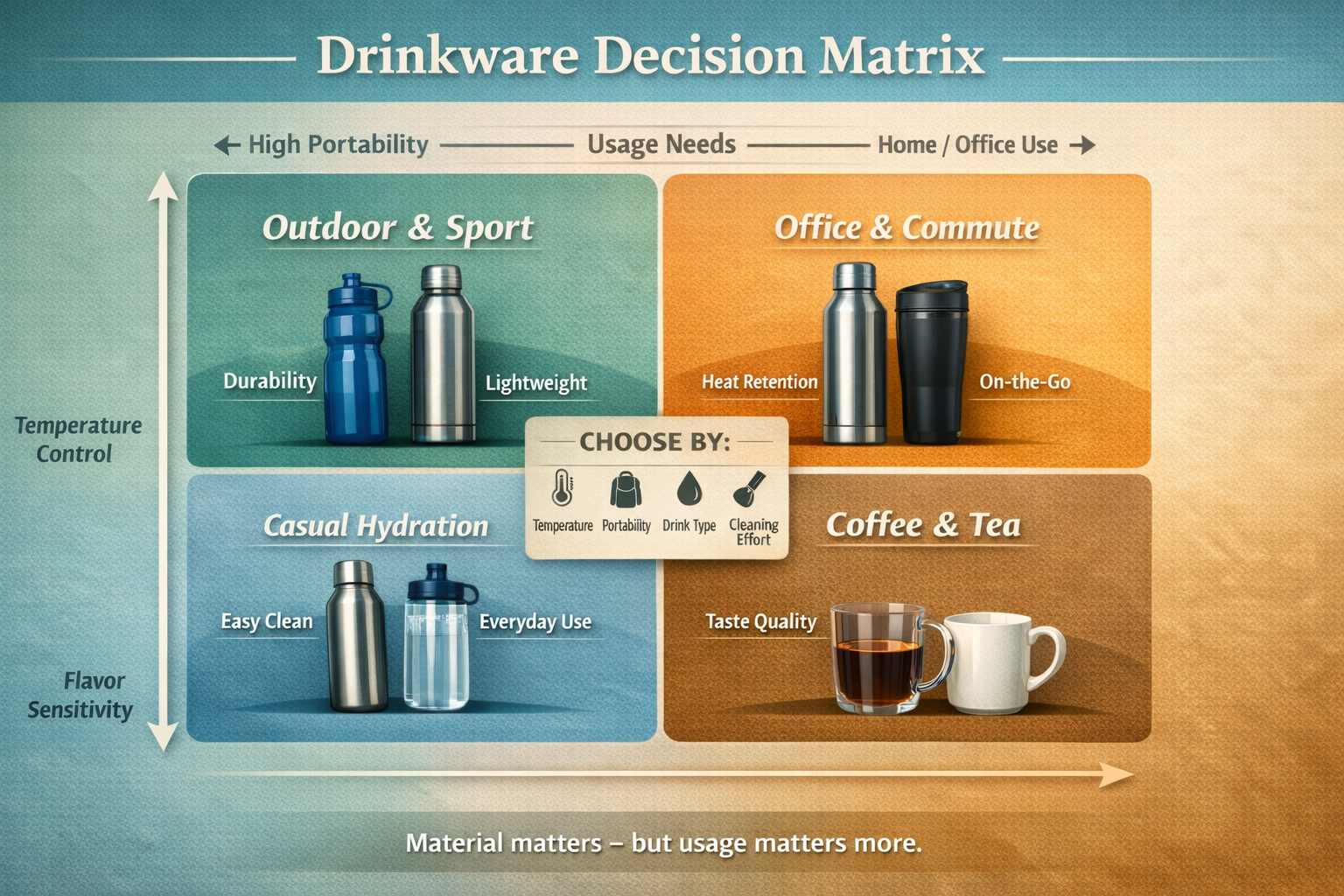
1.1 The Four Key Dimensions of Drinkware
Every type of drinkware can be understood through four core variables:
Temperature Control
Some containers are designed to maintain temperature for hours, while others prioritize immediate consumption.
- High insulation: Suitable for long-duration use
- Low insulation: Better for taste-sensitive beverages
Portability
How easily the drinkware integrates into movement:
- Lightweight and durable: Ideal for travel and outdoor use
- Fragile or bulky: Better for stationary environments
Liquid Compatibility
Different beverages interact with materials differently:
- Coffee: Contains oils that cling to surfaces
- Milk: Leaves protein residue
- Carbonated drinks: Introduce pressure and acidity
- Water: Neutral baseline
Maintenance Complexity
How easy the drinkware is to clean, dry, and maintain:
- Simple structure: Low effort
- Complex lid systems: Higher maintenance
1.2 Why There Is No “Perfect Bottle”
Each type of drinkware prioritizes certain dimensions while compromising others.
A bottle that excels at insulation may be harder to clean.
A cup that preserves flavor perfectly may not be portable.
This leads to a practical conclusion:
There is no universal solution—only optimized trade-offs.
2. Core Types of Drinkware and What They Are Designed For
2.1 Insulated Bottles (Vacuum Flasks)
Insulated bottles are among the most commonly used drinkware types, especially for people who need consistent temperature over time.
Best For
- Long commutes
- Keeping beverages hot or cold for extended periods
- Outdoor activities
Strengths
- Excellent temperature retention
- Durable and travel-friendly
- Reliable for long-duration use
Limitations
- Can retain odors when used with coffee or milk
- Narrow openings may complicate cleaning
- Not ideal for switching between different beverages
Practical Insight
Insulated bottles are designed for consistency, not versatility. They perform best when used for a single type of drink.
2.2 Plastic Bottles (Tritan / Sports Bottles)
Plastic bottles are optimized for movement and convenience.
Best For
- Gym and sports
- Daily hydration
- Situations requiring lightweight portability
Strengths
- Lightweight and impact-resistant
- Easy to carry and handle
- Often designed with wide openings
Limitations
- More prone to absorbing odors
- Not suitable for hot liquids
- Less stable for complex beverages
Practical Insight
Plastic bottles excel in high-frequency, low-complexity use cases, especially when durability matters more than taste neutrality.
2.3 Glass Drinkware
Glass is often associated with purity and simplicity.
Best For
- Home or office use
- Coffee and tea
- Flavor-sensitive drinks
Strengths
- Neutral taste (no flavor interference)
- Easy to clean
- Does not retain odor
Limitations
- Fragile
- Less suitable for travel
- Limited temperature retention
Practical Insight
Glass prioritizes experience and taste accuracy over convenience and durability.
2.4 Ceramic Cups and Mugs
Ceramic drinkware is widely used for coffee and tea.
Best For
- Coffee drinking
- Indoor environments
- Short-term use
Strengths
- Preserves flavor and aroma
- Comfortable to drink from
- Easy to clean
Limitations
- Not portable
- No insulation
- Can chip or break
Why It Matters
Ceramic is often preferred in cafés because it provides a consistent and clean taste experience, without altering the beverage.
2.5 Tumblers (Travel Cups)
Tumblers aim to balance portability and usability.
Best For
- Takeaway coffee
- Commuting
- Short to medium-duration use
Strengths
- Easy drinking experience
- More ergonomic than bottles
- Moderate insulation
Limitations
- Lid designs can be complex
- Cleaning may require extra effort
- Seal performance varies
Practical Insight
Tumblers are designed for accessibility and convenience, rather than maximum performance.
2.6 Specialty Drinkware
Some drinkware types are designed for very specific purposes:
- Wine glasses enhance aroma
- Cocktail glasses improve presentation
- Shaker bottles support mixing
Role in the System
These categories demonstrate how drinkware design adapts to specific functional needs and user expectations.
3. Matching Drinkware to Real-Life Scenarios
Understanding categories is only useful if it leads to better decisions.
3.1 Daily Hydration
Recommended:
- Plastic bottles
- Simple stainless steel bottles
Key Priority:
Ease of cleaning and consistent usability
3.2 Coffee and Flavor-Sensitive Drinks
Recommended:
- Glass
- Ceramic
- Coated interiors
Avoid:
- Plastic bottles
- Long-term use in standard stainless steel
3.3 Sports and Outdoor Activities
Recommended:
- Plastic bottles
- Stainless steel bottles
Key Priority:
Durability and portability
3.4 Milk and Dairy-Based Drinks
Recommended:
- Glass
- Ceramic-coated interiors
Key Priority:
Ease of cleaning and odor prevention
Key Insight
The best drinkware is not defined by its features, but by how well it aligns with your actual usage patterns.
4. Common Mistakes When Choosing Drinkware
Many user frustrations stem from a few recurring mistakes:
Using One Bottle for Everything
Switching between coffee, milk, and water in a single bottle leads to:
- Flavor mixing
- Odor retention
- Increased cleaning difficulty
Using the Wrong Type for the Wrong Liquid
- Sports bottles for coffee
- Insulated bottles for milk storage
- Glass for high-impact environments
Ignoring Maintenance Requirements
Some bottles require more care than others. Failing to account for this leads to long-term dissatisfaction.
Conclusion
Most drinkware problems are not product failures—they are usage mismatches.
5. Material vs Type: What Actually Matters More
When choosing drinkware, users often focus heavily on material.
However, both material and type play different roles.
Material Determines Behavior
- Heat retention
- Durability
- Chemical interaction
Type Determines Suitability
- Use case compatibility
- Ease of use
- Maintenance effort
Final Insight
Type determines whether a bottle fits your life. Material determines how it behaves within that fit.
6. How Drinkware Design Is Evolving (Light Brand Logic)
Modern drinkware design is increasingly focused on reducing friction in daily use.
Key Developments
- Wider openings for easier cleaning
- Smoother interior surfaces
- Coated linings to reduce odor retention
- Simplified lids to minimize hidden residue
Why This Matters
Users are no longer just buying products—they are buying ease of use over time.
Design is evolving to support that expectation.
7. Practical Guidelines for Choosing the Right Drinkware
To simplify decision-making, consider the following approach:
1. Start with Use Case
Ask:
- What do you drink most often?
- Where do you use your bottle?
2. Evaluate Maintenance Effort
Choose a product that matches how much effort you are willing to invest in cleaning and care.
3. Avoid Overgeneralization
Using multiple types of drinkware for different scenarios often leads to a better overall experience.
4. Prioritize Simplicity
Simpler designs are easier to maintain and tend to perform more consistently over time.
8. Key Takeaways
- There is no one-size-fits-all drinkware solution
- Each type exists to serve a specific purpose
- Misalignment between use and type causes most problems
- Maintenance should be considered before purchase
- Simplicity often leads to better long-term usability
Conclusion: Fit Matters More Than Features
The process of choosing drinkware is often approached as a search for the “best” option.
In reality, the better approach is to look for the right fit.
When drinkware aligns with your daily habits, it becomes effortless to use.
When it does not, even the highest-quality product can feel inconvenient.
The best drinkware is not the most advanced—it is the one that integrates seamlessly into your routine.
References & Supporting Sources
This article is informed by research and industry insights from:
- U.S. Food & Drug Administration (FDA) – Food Contact Materials
- European Food Safety Authority (EFSA) – Material Safety Guidelines
- International Stainless Steel Forum (ISSF) – Stainless Steel Properties
- Eastman Chemical Company – Tritan™ Material Data
- Journal of Food Engineering – Residue and odor retention studies
- ASTM International – Material durability standards
- World Health Organization (WHO) – Food safety and sustainability