
Expert Methods + Community-Tested Solutions
Stainless steel travel mugs are engineered for durability, insulation, and long-term daily use. But even premium models will eventually develop stains, discoloration, mineral buildup, or even small rust spots if not maintained properly.
The good news: most issues are cosmetic, not structural. The better news: nearly all of them are reversible.
This guide combines material science fundamentals with real-world solutions frequently discussed across communities like Reddit and Quora, alongside best practices supported by cleaning standards and stainless steel maintenance principles.
1. Understanding What You’re Actually Seeing
Before cleaning, you need to diagnose correctly. Not all discoloration is rust. Not all stains require heavy cleaners.
Coffee & Tea Stains (Tannin Buildup)
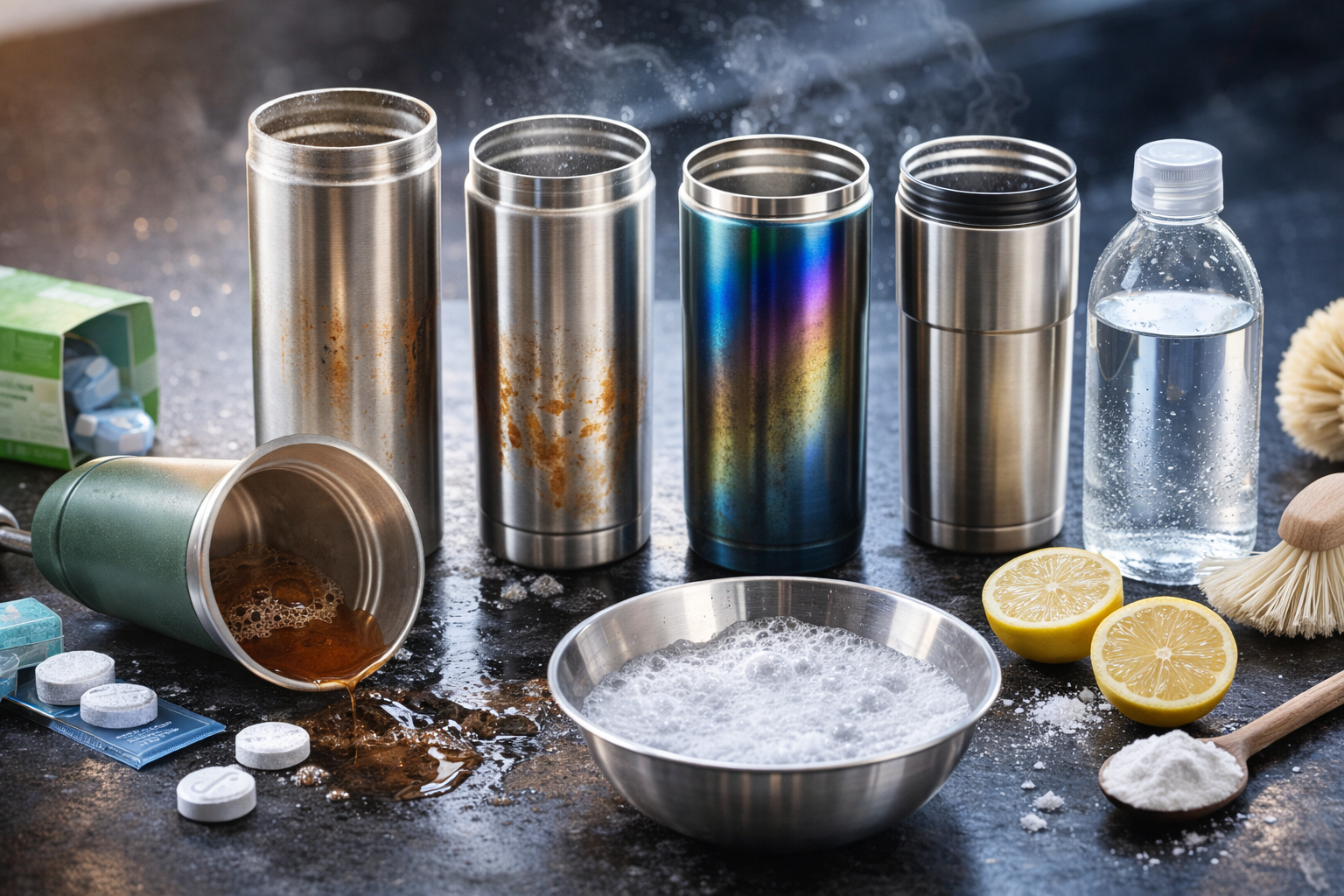
Dark rings or brown film inside the mug are typically tannins — natural organic compounds found in coffee and tea. These bond lightly to metal surfaces over time, especially if the mug is not rinsed immediately after use.
These stains are harmless but unpleasant.
Orange Spots (Surface Rust vs Mineral Deposits)
Stainless steel resists corrosion because chromium forms a protective oxide layer. However, contamination from hard water minerals or microscopic scratches can trap iron particles that later oxidize.
In many cases, what appears to be rust is actually mineral residue.
Rainbow Discoloration (Heat Oxidation)
If you see blue, gold, or rainbow-like hues inside your mug, that’s heat oxidation — a thin-layer interference effect caused by changes in the chromium oxide surface layer.
It looks dramatic. It is not dangerous.
2. Core Cleaning Methods (Expert-Approved)
These are reliable, repeatable solutions that align with stainless steel maintenance practices.
Method 1: Baking Soda Paste (Gentle Universal Fix)
Best for: coffee stains, mild discoloration.
Mix baking soda with warm water to form a paste. Apply to the stained area and let sit for 20–30 minutes. Use a soft sponge to scrub gently, then rinse thoroughly.
Why it works: Baking soda is mildly alkaline and lifts organic residues without scratching the surface.
Low cost. High reliability. Safe for regular use.
Method 2: Vinegar Soak (Mineral Breakdown)
Best for: hard water deposits.
Fill the mug with warm water and add white vinegar (about 1:3 ratio). Let soak for 30–60 minutes. Rinse thoroughly afterward.
Why it works: Acetic acid dissolves mineral bonds and restores surface clarity.
Avoid long overnight soaks unless heavily diluted.
Method 3: Oxalic-Based Cleaners (Heavy-Duty Option)
Products like Bar Keepers Friend contain oxalic acid and are effective against stubborn tannin buildup.
Apply briefly according to instructions. Rinse immediately and completely.
Use sparingly. Prolonged exposure can dull finishes.
Method 4: Denture Cleaning Tablets (Community Favorite)
This method is repeatedly recommended in Reddit threads involving narrow-neck bottles and hard-to-reach staining.
Fill the mug with warm water, drop in one denture tablet, and allow it to dissolve for 30–60 minutes.
Why it works: Effervescent action lifts debris from crevices without abrasion.
Excellent for lids and straw assemblies.
Method 5: Dishwasher Pod + Hot Water (Deep Soak Hack)
For severe buildup, some users recommend filling the mug with boiling water and dissolving a dishwasher pod overnight.
This is effective but should not be done frequently. Prolonged chemical exposure may degrade seals.
Use as a reset method, not routine maintenance.
3. Rust Removal (When It’s Real Rust)
True rust can occur if the protective chromium layer is compromised.
First rule: do not panic.
Baking Soda Scrub
Create a thick paste and scrub gently with a soft cloth. Often sufficient for surface oxidation.
Lemon + Salt Method
Apply lemon juice and sprinkle salt over the area. Let sit for 20 minutes before scrubbing gently.
The mild acid breaks down oxidation while salt provides gentle mechanical action.
What Not to Use
Never use steel wool. It embeds iron particles that will rust later.
Avoid bleach. Chlorine aggressively damages stainless steel.
4. Lids, Seals & Hidden Zones (The Real Problem Areas)
Most odor complaints do not originate from the steel body — they come from silicone seals and hidden cavities.
Best practices:
- Remove seals if detachable.
- Soak seals separately in vinegar or baking soda solution.
- Use a narrow bottle brush for lid channels.
- Denture tablets are particularly effective here.
Dry all components fully before reassembly.
Moisture retention inside seals is the leading cause of recurring odor.
5. Preventive Maintenance Strategy
Prevention is easier than correction.
Rinse immediately after coffee use.
Deep clean weekly if used daily.
Dry completely before storage.
Avoid leaving acidic beverages in the mug overnight.
Periodic mild vinegar rinse can maintain the oxide layer clarity.
6. Common Misconceptions
“Stainless steel cannot rust.”
Incorrect. It resists corrosion but is not immune.
“Dishwasher cleaning solves everything.”
Dishwashers clean surfaces but often miss internal lid cavities.
“More scrubbing equals better cleaning.”
Excessive abrasion damages the protective chromium layer.
7. When to Replace a Travel Mug
You rarely need to replace a mug due to staining alone.
Consider replacement if:
- Deep pitting corrosion is visible.
- Interior surface feels rough after cleaning.
- Lid mechanism fails repeatedly.
- Seal elasticity is permanently degraded.
Cosmetic discoloration alone is not a functional failure.
Final Perspective
Stainless steel is remarkably resilient. Most cleaning challenges arise from neglect, not material failure.
The best approach is not aggressive scrubbing but controlled, chemistry-informed cleaning combined with regular maintenance.
The community wisdom circulating across platforms like Reddit and Quora often converges on the same conclusion professionals would reach: gentle, consistent cleaning outperforms harsh intervention.
A well-maintained stainless steel travel mug can last years — sometimes decades — with only minimal upkeep.
Frequently Asked Questions
1. Is it safe to drink from a stainless steel mug with stains?
Yes. Most stains inside stainless steel mugs are caused by coffee or tea tannins and are cosmetic. They do not indicate contamination or material failure. However, regular cleaning is recommended to prevent buildup in lid seals.
2. Can stainless steel travel mugs actually rust?
Stainless steel resists corrosion but is not completely rust-proof. Rust can occur if the protective chromium oxide layer is damaged or if iron particles from hard water accumulate on the surface. Most rust spots are superficial and removable.
3. What causes rainbow discoloration inside stainless steel mugs?
Rainbowing is a result of heat oxidation. It occurs when the chromium oxide layer thickens or changes under high temperature. It is harmless and does not affect safety or performance.
4. Are denture cleaning tablets safe for stainless steel mugs?
Yes. Denture tablets are commonly used to remove stains in narrow-neck bottles and travel mugs. They are generally safe when used as directed and thoroughly rinsed afterward.
5. Can I use bleach to clean a stainless steel mug?
No. Bleach and chlorine-based cleaners can damage the protective oxide layer of stainless steel and may cause corrosion over time.
6. How often should I deep clean my travel mug?
If used daily for coffee or tea, a deep clean once per week is recommended. For water-only use, biweekly cleaning is usually sufficient.
7. Why does my travel mug smell even after washing?
Odor often originates from silicone seals or lid cavities rather than the steel body. Removing and soaking seals separately usually resolves the issue.