
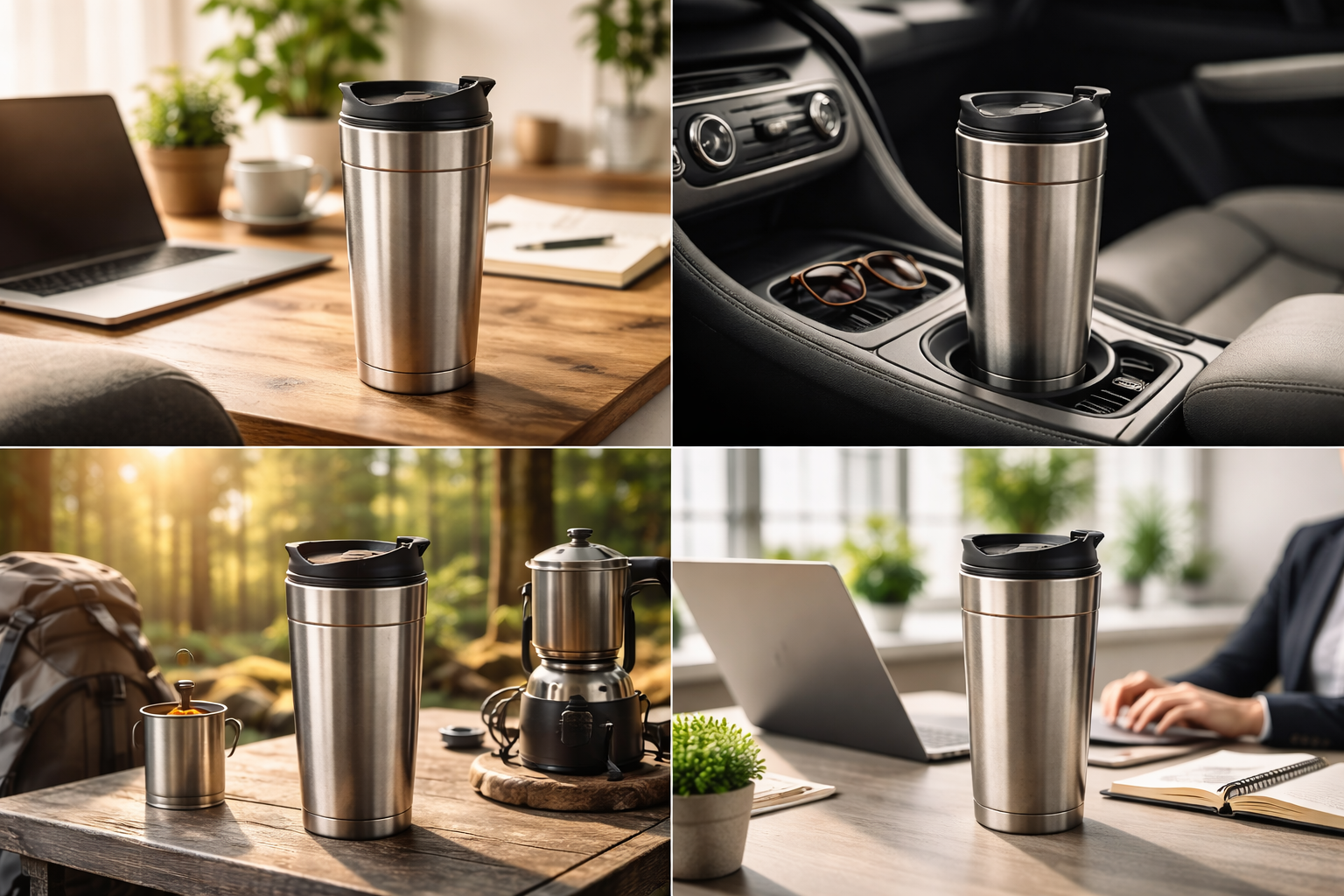
Modern life rarely stays in one place. The boundaries between home, office, commute, and leisure have blurred. A morning may begin at a kitchen counter, continue in a car, shift to a shared workspace, and end outdoors. As environments multiply, the objects we carry with us either adapt—or get left behind.
Among everyday items, few illustrate this shift better than the tumbler. What used to be a simple drinking vessel has evolved into something more strategic: a portable constant in a fragmented day. The idea of a “multi-environment tumbler” is not about novelty. It is about continuity. One cup, many contexts.
This article examines what makes a tumbler truly adaptable across environments, the design trade-offs involved, and why the most successful models are built not for one location, but for movement itself.
Modern Life Is Context-Switching by Default
In previous generations, daily life was geographically stable. Work happened in one place. Meals happened in another. Travel was occasional. Today, routines are modular. Remote work, hybrid schedules, flexible hours, and mobile lifestyles mean people transition between spaces constantly.
Each transition introduces friction. Objects that perform well in one context often fail in another. A wide ceramic mug may be perfect for a desk but useless in a car. A lightweight plastic bottle may travel well but feel out of place in a professional meeting.
The modern user does not want to swap tools at every transition. They want continuity. The multi-environment tumbler emerges from this need.
What Defines a Multi-Environment Product?
A product designed for multiple environments must satisfy a specific set of criteria. It must travel well without sacrificing performance. It must look appropriate in different social contexts. It must tolerate varying temperatures, surfaces, and movement conditions.
Portability alone is insufficient. True multi-environment design balances:
- Size compatibility across surfaces and holders
- Temperature retention across time spans
- Visual neutrality across settings
- Ease of maintenance regardless of location
- Structural durability across impacts
When one of these factors is compromised, the object becomes context-limited.
The Home Workspace: Stability and Quiet Performance
At home, especially in desk-based settings, a tumbler must function quietly. Stability becomes critical. A wide base reduces tipping risk. Insulation maintains beverage temperature during long sessions. Lid design minimizes accidental spills near electronics.
Noise also matters more than expected. Metallic scraping, loose lids, or hollow resonance can become distracting in quiet environments. A well-designed tumbler remains unobtrusive.
In this context, performance is measured in predictability. The cup should stay where it is placed, maintain temperature steadily, and avoid demanding attention.
Commuting and Travel: Movement Changes Everything
In transit, the design priorities shift. Cup holder compatibility becomes non-negotiable. Standard automotive cup holders in many markets range between 70–75 mm in diameter, forcing design constraints on base width.
Leak resistance is critical. Even minor lid failures become major inconveniences during motion. One-handed usability becomes more important than aesthetic considerations. The user may need to operate the lid while steering, walking, or carrying other items.
Grip comfort also changes under movement. Condensation, sweat, and vibration increase slip risk. Textured surfaces or powder coatings improve friction and control.
In commuting contexts, safety replaces convenience as the primary metric.
Professional Environments: Visual Adaptability
In office settings, the tumbler becomes a visible object within social space. Design language matters. Loud graphics or overly casual aesthetics may feel inappropriate in formal settings. Conversely, overly industrial styles may feel heavy in collaborative or creative environments.
Material perception influences how a product is interpreted. Stainless steel conveys durability and neutrality. Matte finishes signal restraint. Transparent plastic can feel informal. Glass feels refined but fragile.
The multi-environment tumbler must navigate these perceptions without forcing the user to adapt their behavior or presentation.
Outdoor and Casual Contexts: Performance Under Stress
Outdoor settings introduce environmental variables: temperature extremes, uneven surfaces, impact risks. Insulation performance becomes measurable rather than aesthetic. A double-wall vacuum structure significantly reduces heat transfer, preserving temperature for extended periods.
Durability matters more outdoors. Drop resistance, scratch tolerance, and lid security determine whether the tumbler survives the environment.
Ease of refilling becomes practical. Wide mouths facilitate cleaning and refilling from varied water sources. However, wide openings can conflict with spill control, creating a design tension.
Outdoor performance demands structural resilience without excessive weight.
The Core Design Trade-Offs
Designing for multiple environments requires compromise. Every structural decision influences portability, insulation, and comfort.
Weight versus insulation is a primary trade-off. Double-wall stainless steel improves temperature retention but increases mass. A heavier tumbler feels solid at a desk but burdensome in transit.
Capacity versus portability is another balancing act. Larger volumes reduce refill frequency but increase diameter and height, affecting grip comfort and cup holder compatibility.
Handle versus compact form creates a spatial decision. Handles improve grip security but increase footprint and reduce compatibility with narrow holders.
Straw lids versus sealed lids reflect usability differences. Straw systems allow effortless sipping during movement but introduce more components and cleaning complexity. Sealed lids reduce leak risk but require tilting and sometimes two-handed operation.
A multi-environment tumbler succeeds by optimizing these tensions rather than maximizing a single attribute.
Psychological Continuity Across Spaces
Carrying one tumbler across contexts reduces cognitive load. Familiarity matters. The weight, texture, and mechanism become habitual. This consistency reduces decision fatigue.
The human brain prefers predictable tools. When an object behaves consistently across spaces, it reinforces trust. Trust reduces friction. Friction reduction encourages retention.
This psychological dimension explains why users often prefer a slightly imperfect but familiar tumbler over a technically superior replacement.
Capacity Across Contexts: Perception Shifts
Volume perception changes depending on setting. A 20-ounce tumbler may feel large on a small desk but insufficient during a long outdoor event. A 40-ounce model may feel reassuring in transit but excessive in formal meetings.
Global labeling standards further complicate perception. In some regions, milliliters dominate; in others, ounces prevail. A truly multi-environment product considers international measurement familiarity.
Designers must account not only for actual volume but perceived adequacy within different contexts.
Maintenance Across Environments
Cleaning conditions vary. At home, users may have full access to sinks and brushes. At the office, cleaning may be limited. Outdoors, it may be minimal.
Complex lids with multiple seals increase leak resistance but require thorough cleaning. Straw components introduce additional maintenance steps. Materials that resist odor retention and staining perform better in long-term cross-environment use.
Low-maintenance design is not optional in multi-environment products. It is foundational.
Failure Modes in Multi-Environment Tumblers
Many tumblers claim versatility but fail under practical conditions. Common failure patterns include:
- Excessive weight that discourages daily transport
- Oversized bases incompatible with standard holders
- Fragile coatings prone to visible wear
- Lid systems that leak under movement
- Designs that feel socially mismatched in professional settings
These failures rarely appear in specifications. They emerge through real-world use.
Designing for Mobility Rather Than Location
Traditional product design optimizes for static use. Modern tumbler design must optimize for mobility.
Mobility-centered design considers transitions as primary use cases. The tumbler is lifted, carried, placed, removed, opened, and closed repeatedly across contexts.
Durability must account for horizontal movement, vibration, and varying temperature gradients. Grip surfaces must function with dry hands and wet hands alike. Weight must balance perceived quality with transport comfort.
Mobility is not a feature. It is a design philosophy.
The Economics of One Object Replacing Many
From a consumer perspective, a multi-environment tumbler reduces redundancy. Instead of owning separate mugs for home, bottles for travel, and insulated containers for outdoors, one well-designed product can fulfill multiple roles.
This consolidation reduces clutter and simplifies routines. It also reinforces attachment. The object becomes integrated into daily rhythm.
Long-term retention often follows versatility.
Sustainability Through Continuity
Sustainability discussions often focus on materials. However, product lifespan plays a larger role in environmental impact.
A tumbler used consistently across contexts is less likely to be replaced. Fewer replacements mean reduced material consumption and waste generation.
Longevity is achieved not only through durability but through relevance. A multi-environment tumbler remains relevant because it adapts.
Why Context Consistency Builds Loyalty
Consistency across environments creates emotional durability. When the same tumbler appears at home, in transit, at work, and outdoors, it becomes a personal constant.
Objects that travel with users accumulate familiarity. Scratches and marks reflect experiences rather than defects. This emotional reinforcement reduces replacement motivation.
Loyalty often arises from continuity rather than innovation.
The Role of Neutral Design Language
A tumbler that works everywhere must avoid extreme aesthetic positioning. Neutral color palettes, restrained graphics, and balanced proportions increase contextual flexibility.
Design neutrality does not mean blandness. It means adaptability. A product that visually integrates into multiple settings increases its functional range.
Visual overstatement limits context compatibility.
Thermal Performance as a Cross-Context Anchor
Temperature retention connects multiple environments. Whether at a desk, in a vehicle, or outdoors, consistent thermal performance supports continuity.
Vacuum insulation significantly reduces heat transfer by minimizing conduction and convection. This engineering principle allows beverages to maintain temperature for extended periods.
Reliable thermal performance reinforces trust in varied conditions.
The Future of Multi-Environment Drinkware
As mobility increases globally, design priorities will continue shifting toward adaptability. Modular lids, adjustable handles, and improved weight distribution may become more common.
Measurement labeling may evolve toward dual-unit visibility to accommodate global users. Cleaning-friendly designs will likely become more standardized.
The tumbler is no longer a single-environment accessory. It is an everyday mobility tool.
Conclusion: One Cup as a Daily Constant
The multi-environment tumbler represents a broader shift in product philosophy. It is designed not for a room, but for a routine. Not for a surface, but for movement.
By balancing portability, capacity, insulation, maintenance, and visual neutrality, a well-designed tumbler can serve across home, commute, office, and outdoors without compromise.
One cup, many contexts. The value lies not in specialization, but in continuity.
In a world defined by transition, the most useful objects are those that move with you—quietly, consistently, and without demanding attention.