
I. Introduction: When Water Bottles Became “Smart”
For decades, water bottles were simple objects. They held liquid, prevented spills, and were largely invisible in daily life unless they leaked or broke. Over time, materials improved, insulation became common, and design aesthetics evolved. Eventually, something new entered the category: intelligence.
Smart water bottles promise to transform hydration from a passive habit into an actively managed behavior. Through sensors, reminders, and mobile apps, they aim to nudge users toward drinking more water throughout the day. The appeal is straightforward—if technology can track steps, sleep, and productivity, why not water intake?
Yet the core question remains surprisingly difficult to answer: do smart water bottles actually change how people drink water, or do they simply add complexity to a simple behavior? To explore this, it is necessary to look beyond feature lists and marketing claims and examine how humans interact with tools, data, and reminders over time.
II. What Makes a Water Bottle “Smart”?
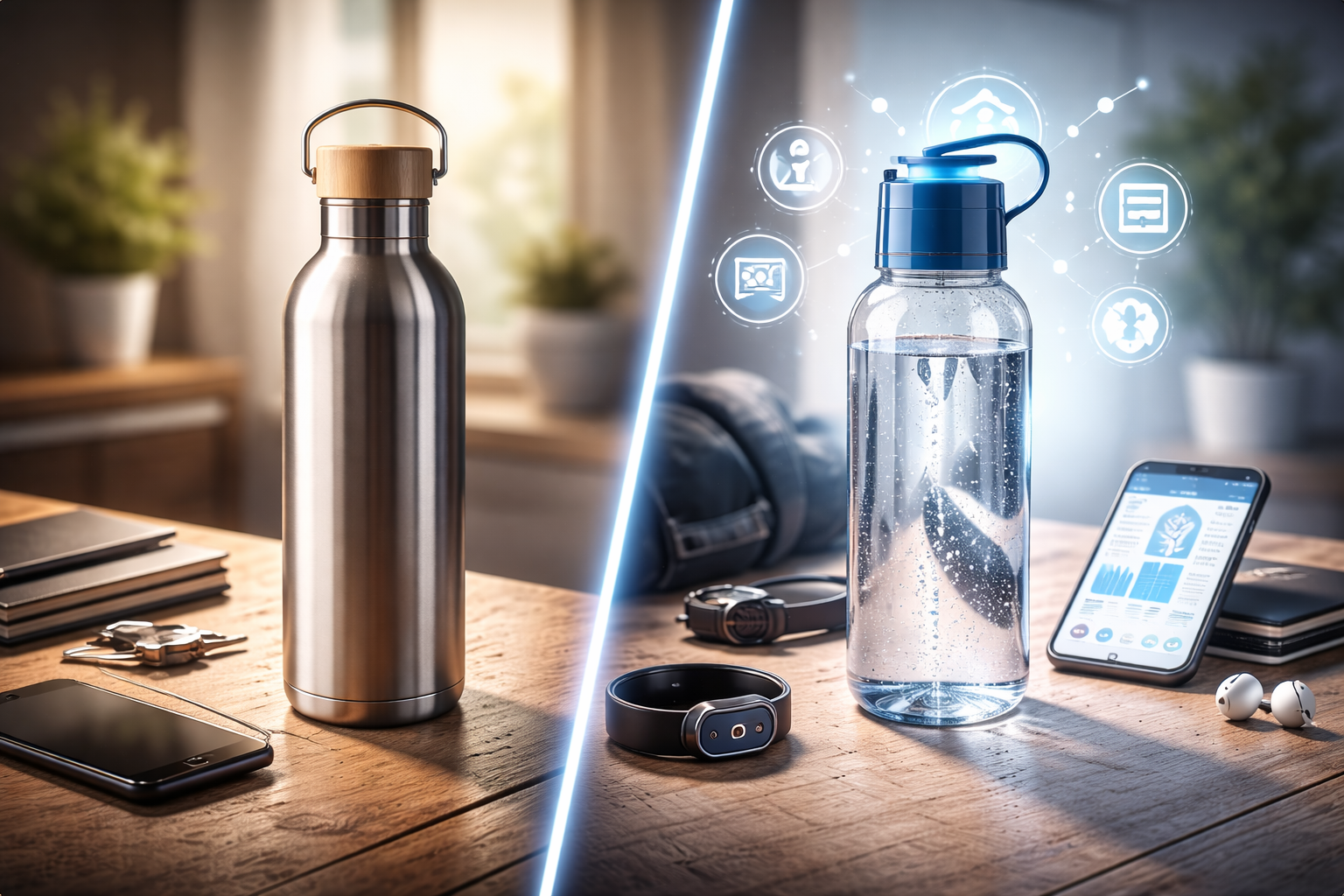
A smart water bottle is not defined by a single feature but by a combination of digital elements layered onto a physical container. Most models on the market include at least one of the following capabilities.
The most common feature is hydration reminders. These can take the form of blinking lights, gentle vibrations, or notifications sent to a connected smartphone. The goal is to interrupt routine behavior and prompt the user to take a sip.
Another core function is intake tracking. Smart bottles estimate how much water has been consumed by monitoring bottle angle, weight changes, or flow sensors. This data is then displayed in an app, often alongside a daily target.
Many smart bottles also integrate with mobile ecosystems, syncing data to fitness apps or wearable devices. This positioning reframes hydration as part of a broader “quantified self” experience rather than an isolated habit.
What these bottles do not do, however, is drink water on behalf of the user. They remain tools, not autonomous solutions. Every benefit they offer depends on how consistently and intentionally the user engages with them.
III. The Behavioral Theory Behind Smart Hydration
To understand whether smart bottles work, it helps to understand the behavior they are trying to influence.
Human habits generally follow a loop: cue, action, and feedback. Traditional water bottles rely almost entirely on internal cues—thirst, routine, or visual presence. Smart bottles introduce external cues in the form of reminders and data.
In theory, reminders act as prompts that compensate for forgetfulness, while tracking provides feedback that reinforces behavior. Seeing progress toward a goal can create a sense of momentum, at least in the short term.
However, behavior change research consistently shows that awareness does not automatically lead to sustained action. Many people already know they should drink more water. The limiting factor is not information but consistency.
Smart bottles attempt to bridge this gap by reducing the mental effort required to remember hydration. Whether this succeeds depends less on the technology itself and more on how users respond to repeated prompts over time.
IV. What Smart Bottles Do Well
In certain contexts, smart water bottles genuinely provide value.
For individuals who spend long hours in front of screens, time can pass unnoticed. In these environments, hydration reminders can serve as useful interruptions, especially during the initial stages of habit formation. The bottle becomes a visible, interactive signal rather than background clutter.
Smart bottles also excel at making consumption visible. Instead of relying on vague impressions (“I think I drank enough today”), users can see concrete numbers. This visibility can be motivating, particularly for those who respond well to metrics and progress tracking.
For users already embedded in app-driven ecosystems—such as fitness tracking or productivity tools—smart bottles fit naturally into existing routines. Hydration becomes another data stream rather than an isolated task.
In short, smart bottles are effective at bringing attention to drinking behavior, especially for users who value structure and feedback.
V. Where Smart Bottles Fall Short
Despite their strengths, smart water bottles face several practical limitations.
One common issue is notification fatigue. When reminders appear too frequently, they lose their impact. Users begin to ignore them, silence them, or disable features entirely. At that point, the bottle offers little advantage over a traditional one.
Another challenge is usage friction. Smart bottles often require charging, app updates, Bluetooth connections, and occasional recalibration. Each added step increases the likelihood that the user disengages, particularly over long periods.
Accuracy is another concern. Intake estimates are approximations, not precise measurements. Spills, partial sips, or refills can distort data, reducing trust in the system. Once users doubt the accuracy of the feedback, motivation declines.
Finally, smart features introduce new failure points. Electronics can malfunction, batteries degrade, and water resistance has limits. When a smart component fails, the entire product may feel compromised, even if the bottle still holds water.
VI. Smart vs. “Mindful” Drinking: Which Works Better Long-Term?
An important comparison emerges between smart hydration and mindful drinking.
Mindful drinking relies on environmental cues—keeping a bottle visible, associating water intake with routines, or responding to physical signals. It requires no technology, only awareness and repetition.
Smart bottles externalize this process. Instead of building internal cues, they rely on alerts and dashboards. This can be helpful initially, but it raises a critical question: what happens when the reminders stop?
For many users, smart bottles are most effective as training wheels. They help establish a pattern but become less necessary once habits stabilize. Others find that once novelty fades, the technology becomes background noise.
Neither approach is inherently superior. Effectiveness depends on personality, environment, and long-term willingness to engage with tools.
VII. The Hidden Cost of Smart Features
Beyond behavior, smart bottles must also be evaluated as physical products.
Adding sensors, lights, and batteries complicates design. These components must be protected from moisture, impact, and wear. This often results in thicker bases, limited dishwasher compatibility, or reduced modularity.
Durability is another concern. While a traditional stainless steel bottle can last many years with minimal maintenance, smart bottles are constrained by electronic lifespans. Batteries degrade, charging ports wear out, and software support eventually ends.
From a longevity perspective, smart bottles trade simplicity for functionality. Whether that trade-off is worthwhile depends on how much value the user extracts from the smart features before they fail.
VIII. Are Smart Bottles Worth It for Most People?
There is no universal answer, but some patterns are clear.
Smart bottles tend to benefit users who:
- Appreciate structured reminders
- Enjoy interacting with data
- Are comfortable managing apps and devices
They are less beneficial for users who:
- Prefer low-maintenance products
- Already have stable hydration habits
- Find notifications distracting
Importantly, smart bottles do not solve hydration on their own. They support behavior, but they do not replace motivation or intention.
IX. How to Choose Between Smart and Non-Smart Bottles
Choosing the right bottle begins with honest self-assessment.
Consider how often reminders actually change your behavior in other areas. If notifications are routinely ignored, a smart bottle is unlikely to be different.
Think about environment as well. In active or outdoor settings, durability and simplicity often matter more than data tracking. In office settings, smart features may integrate more naturally.
Finally, consider longevity. If long-term use and minimal replacement matter most, simpler designs often outperform complex ones over time.
X. Conclusion: Technology as a Tool, Not a Solution
Smart water bottles reflect a broader trend in consumer products: the belief that data and connectivity can improve everyday habits. In some cases, they do.
They can increase awareness, provide structure, and help certain users drink more water—especially in the short term. However, they are not magic solutions. Their effectiveness depends entirely on user engagement, context, and tolerance for complexity.
Ultimately, hydration is a behavior, not a feature. Smart bottles can support that behavior, but they cannot replace the simple act of reaching for water. In the long run, the most effective bottle is the one that fits seamlessly into daily life and is used consistently—smart or not.