
Table of Contents
- Introduction: The Rise of the Reusable Drink Bottle
- The Evolution of Reusable Drink Bottles
- Market Drivers Behind Global Growth
- Market Segmentation: Understanding Consumer Demand
- Materials and Manufacturing Logic
- Reusable Drink Bottles as a Branding Asset
- Environmental and Economic Impact
- Emerging Trends and Future Outlook
- Conclusion: Infrastructure, Not Just a Product
- References
1. Introduction: The Rise of the Reusable Drink Bottle
The reusable drink bottle is no longer a niche eco-product carried only by environmental advocates. It has evolved into a daily utility item embedded in modern lifestyles across offices, gyms, schools, airports, and corporate campuses.
What began as a simple alternative to disposable plastic water bottles has matured into a multi-billion-dollar global industry. The transformation has been driven not only by environmental awareness but also by health consciousness, regulatory shifts, material innovation, and lifestyle branding.
Today, a reusable drink bottle functions simultaneously as:
- A hydration tool
- A sustainability signal
- A lifestyle accessory
- A corporate branding vehicle
Understanding this product category requires more than discussing plastic waste reduction. It demands analysis of consumer behavior, industrial design, material science, and market positioning.
This article examines the structural evolution of reusable drink bottles and why they have become everyday infrastructure rather than optional accessories.
2. The Evolution of Reusable Drink Bottles
2.1 Phase One: Functional Substitution
The earliest wave of reusable bottles focused on replacing disposable plastic water bottles. Products were simple, often single-layer stainless steel or basic BPA-free plastic designs. Their primary value proposition was environmental responsibility.
At this stage, differentiation was minimal. Price sensitivity was high. Branding power was limited.
2.2 Phase Two: Performance and Material Innovation
The second stage introduced vacuum insulation, double-wall construction, and improved sealing systems. Brands like Hydro Flask and YETI transformed the perception of drinkware from basic utility to performance equipment.
Key innovations included:
- Double-wall vacuum insulation
- Powder-coated exteriors for grip and durability
- High-grade stainless steel interiors
- Leak-proof lid systems
Consumers were no longer just buying a container; they were investing in temperature control performance and durability.
2.3 Phase Three: Lifestyle and Identity Integration
In recent years, reusable drink bottles have become identity markers. Colors, limited editions, collaborations, and aesthetic design matter.
Brands such as S'well demonstrated that drinkware could merge fashion and function. Social media further amplified this shift, turning water bottles into visible daily lifestyle objects.
The bottle moved from backpack interior to desktop centerpiece.
3. Market Drivers Behind Global Growth
The sustained growth of the reusable drink bottle market is supported by structural forces rather than short-term trends.
3.1 Regulatory Pressure on Single-Use Plastics
Governments worldwide continue implementing measures to reduce plastic waste. Policies restricting single-use plastics increase consumer motivation to adopt refillable alternatives.
This regulatory backdrop reduces the long-term viability of disposable bottle reliance.
3.2 Rising Health and Hydration Awareness
Hydration has become part of the broader wellness economy. Fitness tracking, nutrition awareness, and workplace health initiatives all reinforce the habit of carrying water throughout the day.
A reusable drink bottle acts as a behavioral reminder. Users with visible bottles tend to drink more water simply because accessibility improves compliance.
3.3 Cost Rationality
While reusable bottles involve higher upfront cost, long-term savings compared to frequent bottled water purchases are substantial. Businesses also recognize cost savings when replacing event-based disposable drinkware with branded reusable options.
3.4 ESG and Corporate Responsibility
Enterprises are increasingly aligning procurement decisions with Environmental, Social, and Governance (ESG) frameworks. Reusable drink bottles provide a visible and measurable sustainability initiative.
4. Market Segmentation: Understanding Consumer Demand
Not all reusable drink bottles serve the same purpose. Clear segmentation is critical for product strategy and positioning.
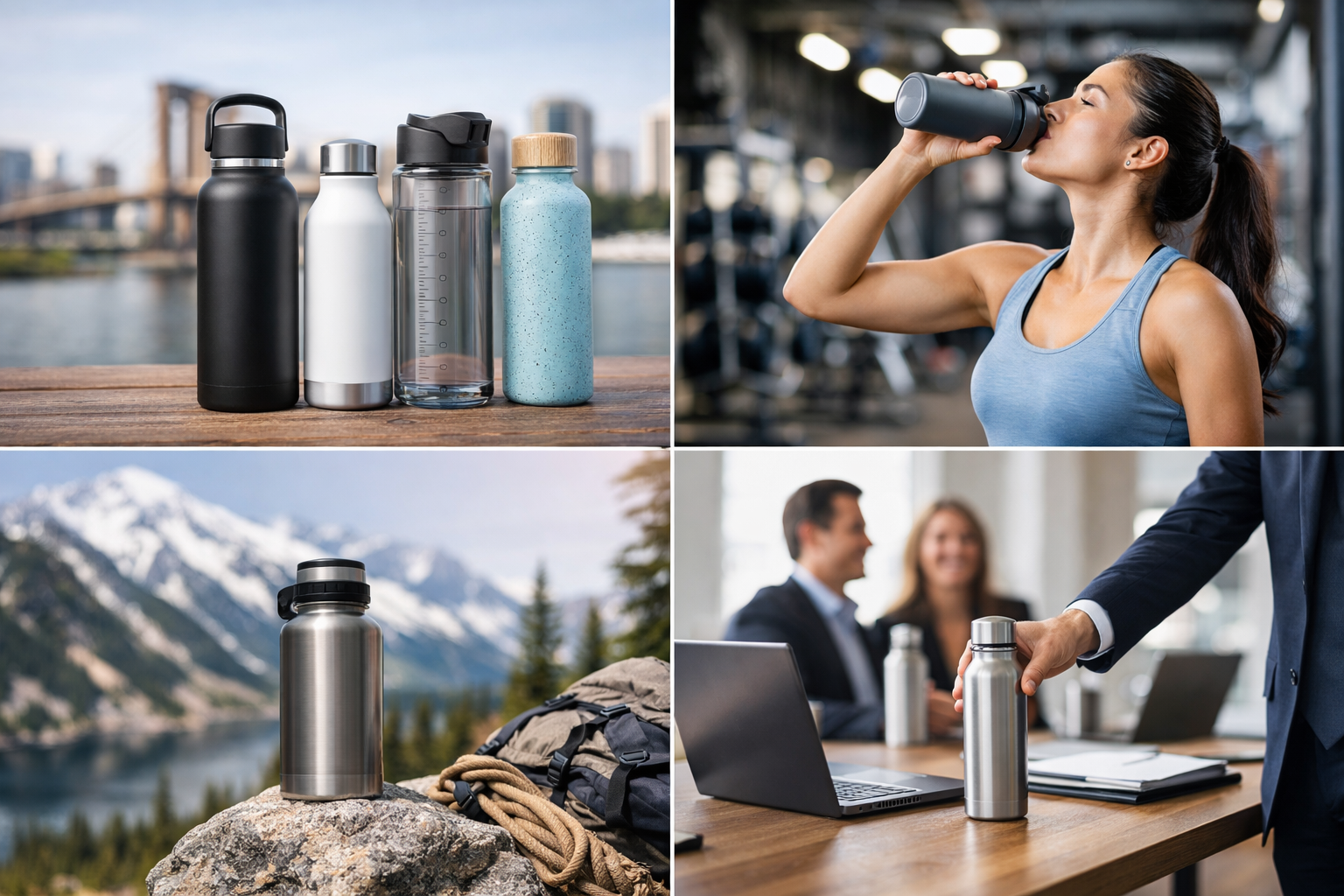
4.1 Commuter Bottles
- Slim profiles
- Cup-holder compatibility
- One-hand opening mechanisms
- Moderate capacity (500ml–750ml)
Target users prioritize portability and efficiency.
4.2 Outdoor and Adventure Bottles
- Large capacity (1L–2L)
- Heavy-duty stainless steel
- Maximum insulation performance
- Impact resistance
These compete in durability and temperature retention.
4.3 Fitness and Straw Bottles
- Flip-top or straw systems
- Fast-flow hydration
- Sweat-resistant exterior
- Grip-friendly design
Convenience during movement defines this segment.
4.4 Kids and School Bottles
- Lightweight materials
- Spill-proof lids
- Colorful design elements
- Safety-certified materials
Durability and safety are critical decision drivers for parents.
4.5 Corporate Custom Bottles
- Logo engraving or printing
- Bulk order scalability
- Controlled unit pricing
- Packaging customization
This segment connects directly to brand visibility and internal engagement programs.
Segmentation allows companies to optimize SKU structure while aligning pricing tiers with usage scenarios.
5. Materials and Manufacturing Logic
Material selection determines both performance and pricing architecture.
5.1 304 Stainless Steel
The industry standard for insulated bottles.
Advantages:
- Strong corrosion resistance
- Food-grade safety
- Durable and recyclable
- Competitive cost-performance ratio
Ideal for mainstream market positioning.
5.2 316 Stainless Steel
Higher resistance to saltwater and acidic environments.
Used in premium or coastal-market offerings.
It supports higher price tiers but may not be necessary for all consumer segments.
5.3 Tritan and BPA-Free Plastics
Lightweight and cost-efficient.
Transparent and visually accessible.
Best suited for sports, kids, and entry-level markets.
5.4 Glass
Pure taste retention and premium aesthetic.
However, fragility limits portability.
Material strategy is not about superiority; it is about alignment with use-case and price architecture.
6. Reusable Drink Bottles as a Branding Asset
From a business perspective, reusable drink bottles offer unusually strong brand exposure frequency.
Unlike promotional apparel worn occasionally, drink bottles:
- Sit on desks
- Travel in vehicles
- Appear in meetings
- Enter gyms and public spaces
This creates daily brand impressions.
Corporate applications include:
- Employee onboarding kits
- Conference merchandise
- Sustainability campaigns
- Client appreciation gifts
The ROI is measurable in repeated visual exposure and ESG narrative reinforcement.
7. Environmental and Economic Impact
Lifecycle assessments indicate that reusable bottles offset their manufacturing footprint after repeated usage cycles. The exact break-even point varies by material and production process but generally occurs within months of consistent use.
Economic impact includes:
- Reduced household bottled water expenditure
- Reduced waste management costs in corporate events
- Lower plastic procurement volume for institutions
Environmental benefit is not theoretical. It scales with behavior consistency.
However, sustainability claims only hold if bottles are genuinely reused over extended periods. Durability and user engagement therefore directly influence environmental return.
8. Emerging Trends and Future Outlook
The next phase of growth is defined by integration and differentiation.
8.1 Smart Hydration Systems
Brands like HidrateSpark integrate sensors and mobile apps to track water intake.
While niche today, such features reflect broader IoT integration trends.
8.2 Modular Lid Systems
Interchangeable lids for straw, chug, or sealed formats enhance cross-scenario usability.
8.3 Design-Led Differentiation
Matte coatings, engraved finishes, and limited collaborations elevate perceived value.
8.4 Sustainable Material Innovation
Research into bio-based polymers and recycled stainless steel inputs may reshape supply chains over the coming decade.
The category’s future does not depend solely on environmental messaging. It depends on functionality, aesthetics, and emotional resonance.
9. Conclusion: Infrastructure, Not Just a Product
The reusable drink bottle has completed a structural transformation.
It started as:
- An environmental alternative
It evolved into:
- A performance product
It now operates as:
- A lifestyle object
- A corporate branding asset
- A daily behavioral tool
In modern urban and professional environments, carrying a reusable drink bottle is not exceptional behavior. It is normalized infrastructure.
Brands that understand this shift can position themselves not merely as drinkware suppliers, but as participants in long-term lifestyle systems.
The opportunity lies in product clarity, material integrity, segmentation precision, and disciplined brand architecture.
Reusable drink bottles are not just containers.
They are touchpoints embedded in daily life.
10. References
- Global reusable water bottle market research reports (2023–2025 industry analysis summaries)
- Lifecycle assessment studies comparing reusable and single-use plastic bottles
- ESG procurement trend reports on sustainable corporate merchandise
- International environmental agency data on plastic waste generation
- Wellness industry trend reports on hydration and health behavior