
Water bottles and tumblers are among the most frequently used everyday items. For something so simple, the design of drinkware has remained surprisingly stable for decades. A container, a lid, and a single drinking opening—this basic formula defined most water bottles for generations.
Yet in recent years, drinkware design has begun to evolve more rapidly. New materials, improved insulation, larger capacities, and more sophisticated lid systems have all emerged as manufacturers respond to changing lifestyles. Among these developments, one design trend has attracted particular attention: the dual-lid tumbler.
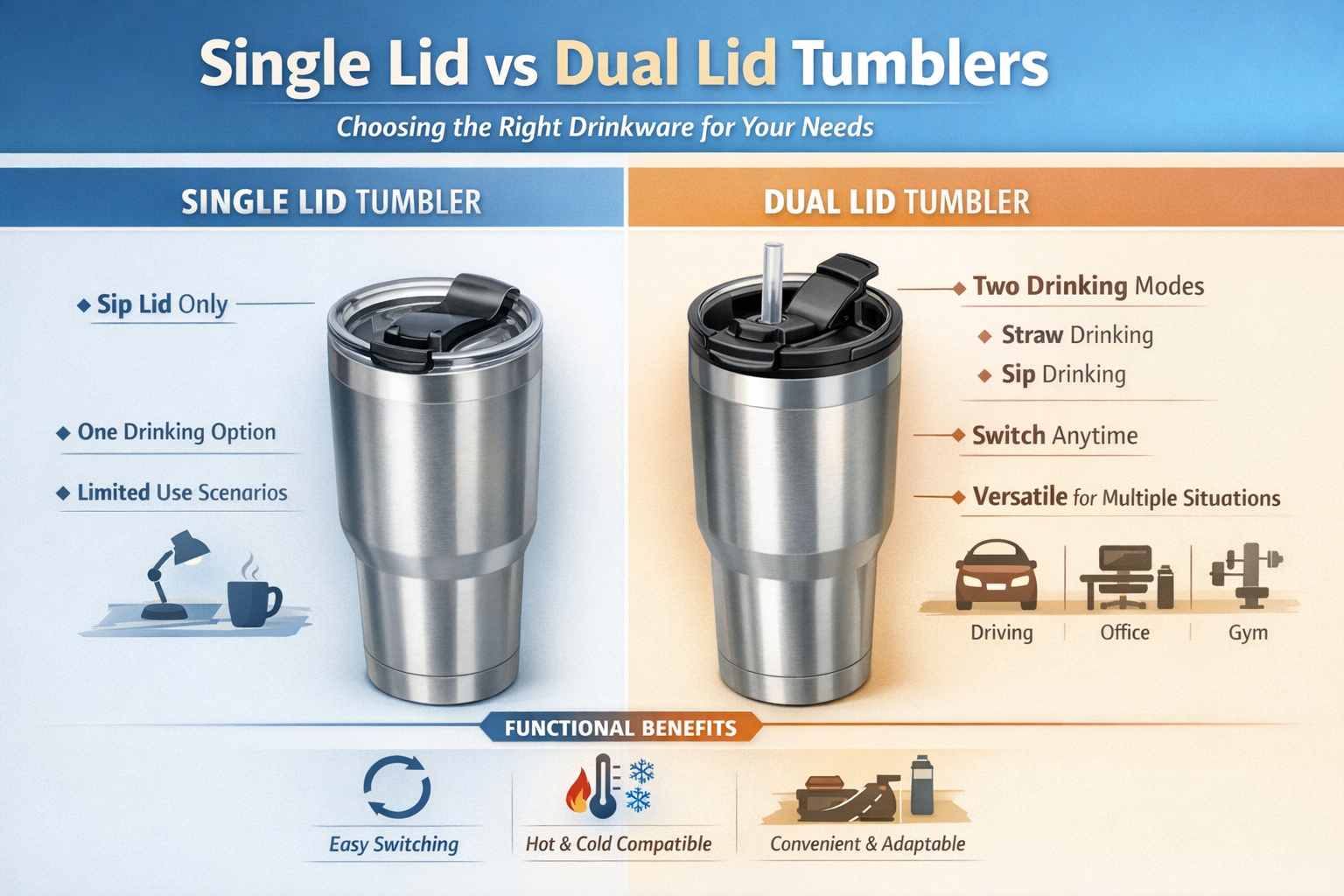
At first glance, a dual-lid design may seem like a minor modification. Instead of a single drinking opening, the lid provides two ways to drink—typically a straw opening and a direct sip opening. For some people, this might look like a clever convenience feature. For others, it may feel like an unnecessary complication.
So the question becomes: is dual-lid drinkware a meaningful functional upgrade, or simply another passing trend in product design?
To answer that, it helps to understand how drinking habits, lifestyle patterns, and product engineering have all gradually reshaped something as ordinary as a water bottle.
The Quiet Evolution of Everyday Drinkware
Drinkware has historically evolved slowly. Early bottles and flasks focused primarily on durability and portability. As manufacturing improved, materials such as stainless steel and vacuum insulation expanded the functional range of water bottles, allowing them to keep beverages hot or cold for extended periods.
However, the basic interaction between user and bottle changed very little. Most bottles offered a single drinking method:
- A simple screw cap
- A flip lid
- A small spout opening
Each design worked well for specific situations, but none addressed the full range of daily use scenarios that modern consumers face.
Today, people often carry the same bottle throughout an entire day. That bottle might move through several environments:
- Morning commute
- Office desk
- Gym session
- Car cup holder
- Outdoor activities
A single design solution must now adapt to multiple contexts and behaviors. As a result, the humble bottle lid has quietly become one of the most actively redesigned components in modern drinkware.
Dual-lid designs are one response to this new complexity.
The Limitations of Traditional Single-Lid Bottles
To understand why dual-lid tumblers exist, it is useful to examine the limitations of traditional lid systems.
Most drinkware falls into one of two drinking styles: direct sip lids or straw lids. Each serves a different purpose, but neither is universally ideal.
Direct Sip Lids
Direct sip lids allow users to tilt the bottle and drink through a larger opening. This design is common on many insulated bottles and travel mugs.
Advantages include:
- Faster water flow
- Better for hot beverages
- Simple construction
- Easier cleaning
However, sip lids also have limitations.
Drinking often requires tilting the bottle significantly, which can be inconvenient during activities like driving or exercising. Larger openings also increase the risk of spills or splashes, especially with larger capacity tumblers.
For people who move frequently during the day, this style of drinking can feel slightly less controlled.
Straw Lids
Straw lids take the opposite approach. Instead of tilting the bottle, users sip through a built-in straw mechanism.
This design offers several advantages:
- Drinking without tilting the bottle
- Easier one-hand operation
- Reduced risk of spills
- Comfortable during exercise
These characteristics make straw lids popular for sports bottles and large tumblers.
However, straw systems also introduce challenges.
They are often less suitable for hot beverages, and the internal straw structure can make cleaning slightly more complex. In addition, the drinking flow through a straw tends to be slower compared to direct sip openings.
The Behavioral Gap Between Two Drinking Styles
The key insight behind dual-lid design is that both drinking methods are valuable, depending on the situation.
Consider a typical day.
In the morning, someone might want a quick drink of hot coffee while sitting at a desk. Later, during a commute or a gym session, that same person may prefer to sip water through a straw while keeping one hand free.
Traditional bottles force users to choose one method permanently.
Dual-lid designs remove that constraint by offering both options in a single system.
Instead of selecting between straw or sip functionality at the time of purchase, users can simply switch between drinking modes as needed.
From a design perspective, this is not merely a cosmetic feature. It addresses a genuine behavioral flexibility problem.
What Exactly Is a Dual-Lid Tumbler?
While designs vary between brands, most dual-lid tumblers share a common structure.
The lid contains two separate drinking openings:
-
Straw opening
Designed for continuous sipping without tilting the bottle. -
Direct sip opening
A larger opening for faster drinking or hot beverages.
In many designs, both openings are integrated into a rotating or sliding top section that allows users to expose one drinking mode at a time.
Some lids also include an internal straw that can be removed or replaced depending on the preferred drinking method.
The goal is simple: one tumbler, two drinking experiences.
The Engineering Challenge Behind Dual-Lid Designs
Although the concept sounds straightforward, implementing a reliable dual-lid system presents several engineering challenges.
Adding more moving parts inevitably increases the complexity of the design.
Three aspects are particularly critical.
Seal Integrity
A water bottle lid must prevent leaks during transport. Introducing two drinking openings creates additional sealing points that must remain secure when closed.
Designers must carefully balance:
- Silicone gasket placement
- Thread alignment
- Pressure tolerance
Even small misalignments can compromise leak resistance.
Durability of Moving Components
Dual-lid systems often include rotating covers, push buttons, or hinged elements. These components may be used dozens of times per day.
Over the lifetime of a bottle, that can translate into thousands of open-and-close cycles.
Manufacturers therefore need to consider:
- Plastic fatigue resistance
- Reinforced hinge mechanisms
- Long-term wear on sealing surfaces
A poorly designed lid may initially feel convenient but degrade over time.
Temperature Compatibility
Many insulated tumblers are designed to handle both hot and cold beverages. However, straw systems are typically better suited to cold drinks.
Dual-lid designs attempt to accommodate both temperature conditions by offering a straw option for cold beverages and a sip opening for hot liquids.
This versatility expands the range of situations in which a single bottle can be used.
Why Dual-Lid Drinkware Became Popular in Recent Years
Product trends rarely appear in isolation. They usually reflect broader changes in lifestyle and consumer expectations.
The rise of dual-lid drinkware can be linked to several overlapping factors.
Larger Bottle Capacities
Over the past decade, larger tumblers have become increasingly popular. Sizes such as 30 oz and 40 oz are now common in daily use.
With larger volumes, tilting the bottle to drink becomes more cumbersome. Straw systems offer a more comfortable solution, but direct sipping still remains useful in certain contexts.
Dual-lid designs help manage this balance.
Multi-Environment Daily Routines
Modern routines often involve constant movement between environments.
A single bottle might travel through:
- Office workspaces
- Public transportation
- Car cup holders
- Fitness centers
- Outdoor activities
Different situations call for different drinking behaviors. Flexibility becomes a meaningful advantage.
User Experience Expectations
Consumers increasingly expect everyday products to reduce small inconveniences. Many modern design improvements focus not on dramatic technological breakthroughs but on removing friction from daily tasks.
Dual-lid drinkware reflects this philosophy. The design reduces the need to carry multiple bottles or adapt to a single drinking method.
Instead, the bottle adapts to the user.
Situations Where Dual-Lid Bottles Offer Real Advantages
While not every user needs a dual-lid system, certain scenarios highlight its practical benefits.
Commuting and Driving
Driving requires minimal distraction and often limits the use of both hands.
A straw opening allows users to sip without tilting the bottle, while the direct sip opening remains available when the vehicle is stationary.
Office Work
Desk environments often involve both hot and cold beverages throughout the day.
A dual-lid tumbler allows users to enjoy hot drinks through the sip opening while maintaining the straw option for water or cold beverages later.
Exercise and Outdoor Activities
Physical activity makes straw drinking particularly convenient because it allows continuous hydration without interrupting movement.
However, direct sipping can still be useful when refilling or consuming larger amounts of water quickly.
Travel and Long Days Outside
For people who carry a single bottle during extended outings, versatility becomes valuable.
Instead of choosing between two specialized bottles, a dual-lid design provides multiple drinking styles in one container.
When a Dual-Lid Design May Not Be Necessary
Despite these advantages, dual-lid drinkware is not essential for every user.
In many cases, a simple single-lid bottle works perfectly well.
For example, if someone primarily drinks from a bottle at a desk or at home, the additional flexibility may offer limited benefits. Simpler designs can also be slightly easier to clean and maintain.
Minimalist users may prefer fewer moving parts and a straightforward drinking mechanism.
Product design always involves trade-offs. More features can improve versatility but also introduce complexity.
The Broader Trend Toward Adaptive Drinkware
Dual-lid tumblers represent one step in a broader evolution of drinkware design.
Manufacturers are increasingly experimenting with adaptive systems that allow bottles to support different usage styles.
Examples include:
- Interchangeable lid systems
- Modular straw components
- Rotating lid mechanisms
- Hybrid drinking openings
The goal is not necessarily to create more complicated products but to make everyday tools more responsive to real behavior patterns.
Drinkware, despite its simplicity, sits at the intersection of hydration habits, daily routines, and personal convenience. Small improvements in design can significantly influence how comfortable and consistent hydration becomes throughout the day.
The Future of Drinkware Lid Design
Looking ahead, several developments may shape the next generation of bottle lids.
One possibility is fully modular lid systems, where users can swap different drinking modules depending on the activity. Another direction could involve improved sealing technologies that allow more complex mechanisms without compromising leak resistance.
Materials science may also play a role. Advances in polymers and silicone components could enable lighter, stronger, and longer-lasting lid structures.
Even digital integration has occasionally appeared in experimental designs, with hydration tracking systems embedded in bottle caps.
While some of these innovations may remain niche, they illustrate an important idea: even the most ordinary objects continue to evolve as designers rethink how people interact with them.
Functional Upgrade or Design Trend?
Returning to the original question—whether dual-lid drinkware is a meaningful innovation or simply a trend—the answer likely lies somewhere in between.
The concept is not revolutionary in the way vacuum insulation once was. However, it does address a real practical challenge: the need to support multiple drinking behaviors in a single product.
For people with varied daily routines, dual-lid tumblers can offer genuine convenience and flexibility. For others with simpler needs, the additional functionality may be unnecessary.
Ultimately, the success of any design feature depends on how well it aligns with the way people actually use a product.
Drinkware may seem simple, but the design choices behind it reveal something interesting about modern life. As routines become more mobile and multi-environmental, even everyday objects must adapt.
The dual-lid tumbler is one example of how a small design adjustment can quietly reshape the experience of something as basic as taking a drink of water.