
Market Landscape, Performance Standards & Brand Comparison
Executive Summary
The reusable water bottle market in 2026 is no longer defined by simple hydration. It has evolved into a category shaped by material science, thermal engineering, sustainability awareness, lifestyle segmentation, and brand positioning.
Consumers searching for the best water bottle are not merely looking for a container. They are evaluating durability, hygiene, insulation performance, portability, and long-term value. The phrase “best” has become contextual.
This report establishes three core conclusions:
- There is no universally best water bottle. There are optimized solutions for specific use cases.
- Performance engineering and material quality now differentiate serious brands from commodity manufacturers.
- Lifecycle value increasingly outweighs initial purchase price in consumer decision-making.
Rather than offering casual recommendations, this report defines how water bottles should be evaluated in 2026 and applies that framework across the current competitive landscape.
Chapter 1: The Evolution of the Modern Water Bottle
Two decades ago, reusable bottles were largely plastic utility products. Insulation was limited, lid mechanisms were basic, and longevity was secondary.
The rise of double-wall vacuum insulation changed the category permanently. Stainless steel bottles became temperature control devices rather than simple containers. Thermal performance extended from hours to all-day retention.
Design trends followed technology. Minimalist matte finishes, powder-coated exteriors, ergonomic handles, and car cup holder compatibility became competitive features. A water bottle is now both functional equipment and personal accessory.
What once was a commodity product has become a layered engineering object.
Chapter 2: Market Segmentation 2026
Understanding segmentation is essential before evaluating performance.
2.1 Insulated Water Bottles
Vacuum-insulated stainless steel bottles dominate the premium and mid-tier market. These products prioritize temperature stability, durability, and structural integrity.
Common characteristics:
- Double-wall vacuum construction
- Stainless steel interior (typically 304 or 316 grade)
- Powder-coated exterior
- Leak-resistant screw or flip lids
Primary use cases:
- Daily commute
- Office use
- Travel
- Outdoor activity
2.2 Lightweight Plastic Bottles
Plastic bottles remain relevant due to weight advantages and affordability. BPA-free labeling is standard, but material longevity varies significantly.
Primary use cases:
- Sports
- Short-duration outings
- School use
- Budget-focused buyers
2.3 Travel Mugs and Coffee Tumblers
Travel mugs and tumblers represent a specialized sub-category. They prioritize one-handed operation, controlled flow, and cup-holder compatibility.
Design differences include:
- Narrower bases
- Complex lid mechanisms
- Focus on hot beverage retention
2.4 Outdoor and Heavy-Duty Bottles
Outdoor-oriented bottles emphasize impact resistance, large capacity, and robust handles. Thermal performance is expected to be high, but structural durability becomes equally important.
Chapter 3: Evaluation Framework 2026
Defining the “Best Water Bottle”
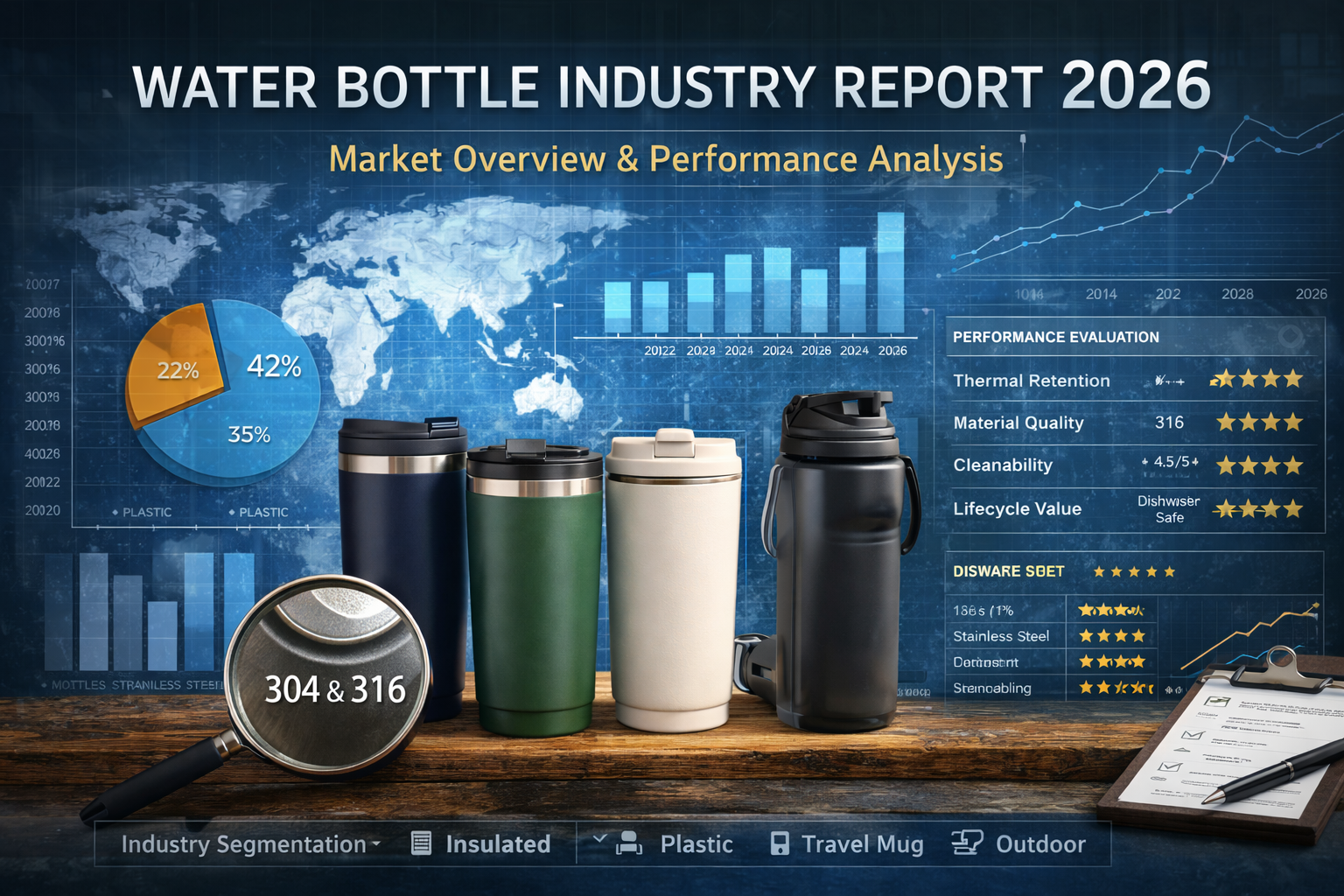
To evaluate products consistently, this report applies a structured framework across six performance pillars.
3.1 Thermal Retention Performance
Thermal performance should be evaluated through stability rather than marketing extremes.
Key evaluation factors:
- Temperature retention at 1, 3, and 6 hours
- Heat loss during lid opening
- External surface heat transfer
- Ice retention duration
In real-world use, maintaining drinkable temperature for a workday is often more practical than maximizing 24-hour claims.
3.2 Material Science
Material selection determines corrosion resistance, hygiene longevity, and taste neutrality.
Common stainless steel grades:
- 304 stainless steel: widely used, corrosion-resistant, cost-efficient
- 316 stainless steel: enhanced corrosion resistance due to molybdenum content
Interior surface finishing also matters. Smooth electropolished interiors reduce residue adhesion and improve long-term cleanliness.
Plastic models must be evaluated for:
- BPA compliance
- Structural integrity over repeated washing
- Odor retention tendency
Material quality is not marketing decoration; it directly influences lifecycle durability.
3.3 Lid Engineering & Leak Resistance
The lid is mechanically the most complex component of a water bottle.
Evaluation includes:
- Seal integrity under inversion
- Durability of silicone gaskets
- Ease of disassembly
- One-handed usability
- Flow control safety for hot beverages
Sophisticated lids improve convenience but introduce potential failure points. Engineering simplicity often correlates with longevity.
3.4 Cleaning & Maintenance Cost
Long-term hygiene depends on cleanability.
Assessment factors:
- Ability to fully disassemble lid components
- Dishwasher compatibility
- Risk of mold accumulation in straw mechanisms
- Coffee oil buildup in hot beverage tumblers
- Availability of replacement seals
Maintenance effort represents a hidden ownership cost often ignored in short reviews.
3.5 Ergonomics & Portability
Performance without usability has limited value.
Key factors:
- Weight when filled
- Grip comfort
- Balance during drinking
- Compatibility with standard car cup holders
- Handle design strength
Oversized capacity may reduce portability and increase fatigue during daily transport.
3.6 Lifecycle Value Index
Price must be evaluated relative to longevity.
Lifecycle value includes:
- Expected structural lifespan
- Warranty coverage
- Replacement part accessibility
- Performance degradation over time
A moderately priced bottle lasting five years may outperform a premium option with limited serviceability.
Chapter 4: Brand Landscape 2026
The competitive field includes both heritage brands and modern design-focused players.
YETI
Positioning: Premium outdoor durability
Strength: Structural robustness and brand loyalty
Typical Use Case: Outdoor and heavy-duty environments
Stanley
Positioning: Classic industrial durability
Strength: Heritage perception and functional reliability
Typical Use Case: Worksite and lifestyle crossover
Hydro Flask
Positioning: Lifestyle-oriented insulation
Strength: Color variety and youth appeal
Typical Use Case: Everyday carry and commuting
Contigo
Positioning: Convenience-driven design
Strength: One-handed operation lids
Typical Use Case: Office and commuting
Zojirushi
Positioning: Precision thermal engineering
Strength: Excellent heat retention performance
Typical Use Case: Hot beverage enthusiasts
Each brand optimizes for different performance pillars rather than dominating all categories.
Chapter 5: Comparative Performance Trends
Across the 2026 market, several trends emerge:
- Most insulated bottles provide adequate 6-hour temperature retention.
- Lid engineering differentiates user experience more than insulation alone.
- 304 stainless steel remains the dominant material standard.
- Dishwasher-safe claims are inconsistent across premium brands.
- Larger capacity models show higher variability in ergonomic comfort.
Performance convergence is evident in insulation. Differentiation increasingly occurs in usability and long-term maintainability.
Chapter 6: Common Misconceptions
Misconception 1: Longer insulation always means better performance.
In reality, daily consumption patterns often render extreme claims irrelevant.
Misconception 2: All stainless steel bottles are identical.
Material grade and finishing significantly affect durability.
Misconception 3: Larger capacity offers better value.
Increased weight can reduce convenience and real-world usability.
Misconception 4: Complex lids equal better engineering.
Additional moving parts increase maintenance burden.
Chapter 7: Emerging Trends 2026–2028
The next phase of market evolution is visible.
- Modular lid systems with replaceable components
- Increased demand for 316 stainless steel in premium segments
- Sustainable packaging and reduced material waste
- Simplified engineering to reduce maintenance friction
Technology is stabilizing. Usability optimization is accelerating.
Chapter 8: Strategic Buying Guidance
Selecting the right water bottle requires matching performance pillars to personal usage patterns.
Daily commuters should prioritize:
- Cup holder compatibility
- Leak resistance
- Moderate insulation
Outdoor users should prioritize:
- Structural durability
- Larger capacity
- Handle reinforcement
Office users may value:
- Aesthetic design
- Easy cleaning
- Controlled flow lid design
The optimal choice is contextual, not universal.
Conclusion
The search for the “best water bottle” reflects a desire for reliability, convenience, and durability. Yet no product dominates across every dimension.
In 2026, meaningful evaluation requires structured criteria rather than subjective preference. Insulation performance, material integrity, lid engineering, cleanability, ergonomics, and lifecycle value together define excellence.
A water bottle is a daily-use tool. Its performance must be judged across years, not moments.