
Introduction: They Look Similar, But They Serve Different Purposes
At a glance, tumblers and thermoses often appear nearly identical. Both are commonly made of stainless steel, both are designed to hold beverages, and both frequently advertise temperature retention as a key feature.
Because of these similarities, many people use the terms interchangeably. In everyday conversation, it is not uncommon for all insulated drinkware to be labeled simply as a “thermos.”
However, this assumption overlooks an important reality.
Tumblers and thermoses are designed with fundamentally different priorities in mind.
While they may share materials and general construction techniques, they are optimized for different types of usage. One emphasizes convenience and accessibility, while the other prioritizes insulation performance and leak resistance.
Understanding this distinction is essential—not just for choosing the right product, but for improving your overall daily experience with drinkware.
1. What Is a Tumbler? Design, Function, and Everyday Use
1.1 Core Characteristics of a Tumbler
A tumbler is typically designed for frequent, easy access to beverages. Its structure reflects this priority.
Common features include:
- A wide opening or drinking mouth
- A lid designed for quick access (flip-top, sliding cover, or straw)
- Moderate insulation, often sufficient for several hours
Tumblers are not built to remain sealed for extended periods. Instead, they are optimized for repeated use throughout the day.
1.2 Typical Use Cases
Tumblers are most commonly used in situations where convenience matters more than long-term temperature retention.
Examples include:
- Morning coffee during a commute
- Iced beverages throughout the day
- Casual hydration at a desk or workspace
In these scenarios, users open and close the container frequently, often with one hand.
1.3 Strengths of a Tumbler
The primary advantages of tumblers include:
- Ease of use: Quick access to drinks
- Comfort: Designed for natural drinking positions
- Versatility: Suitable for both hot and cold beverages
1.4 Limitations of a Tumbler
However, these advantages come with trade-offs:
- Lower sealing performance compared to thermoses
- Reduced insulation duration, especially with frequent opening
- Greater risk of spills if tipped over
Key Insight
A tumbler is designed to fit into your routine, not to isolate your drink from it.
2. What Is a Thermos? Performance and Long-Term Storage
2.1 Core Characteristics of a Thermos
A thermos, also known as a vacuum flask, is designed to maintain the temperature of a beverage for extended periods.
Key features include:
- Fully sealed lid system
- High-efficiency vacuum insulation
- Minimal air exchange
The design focuses on preserving internal conditions rather than facilitating frequent access.
2.2 Typical Use Cases
Thermoses are ideal for situations where maintaining temperature is critical:
- Carrying hot water or tea throughout the day
- Outdoor activities such as hiking or travel
- Long periods without access to refilling
2.3 Strengths of a Thermos
The advantages of thermoses include:
- Superior insulation performance
- Strong leak resistance
- Reliability over long durations
2.4 Limitations of a Thermos
These benefits come with certain drawbacks:
- Less convenient for frequent drinking
- More complex lid systems
- Often harder to clean
Key Insight
A thermos is designed to protect your drink from the outside world.
3. Key Differences Between Tumbler and Thermos
Understanding the differences requires looking beyond labels and focusing on design intent.
3.1 Design Philosophy
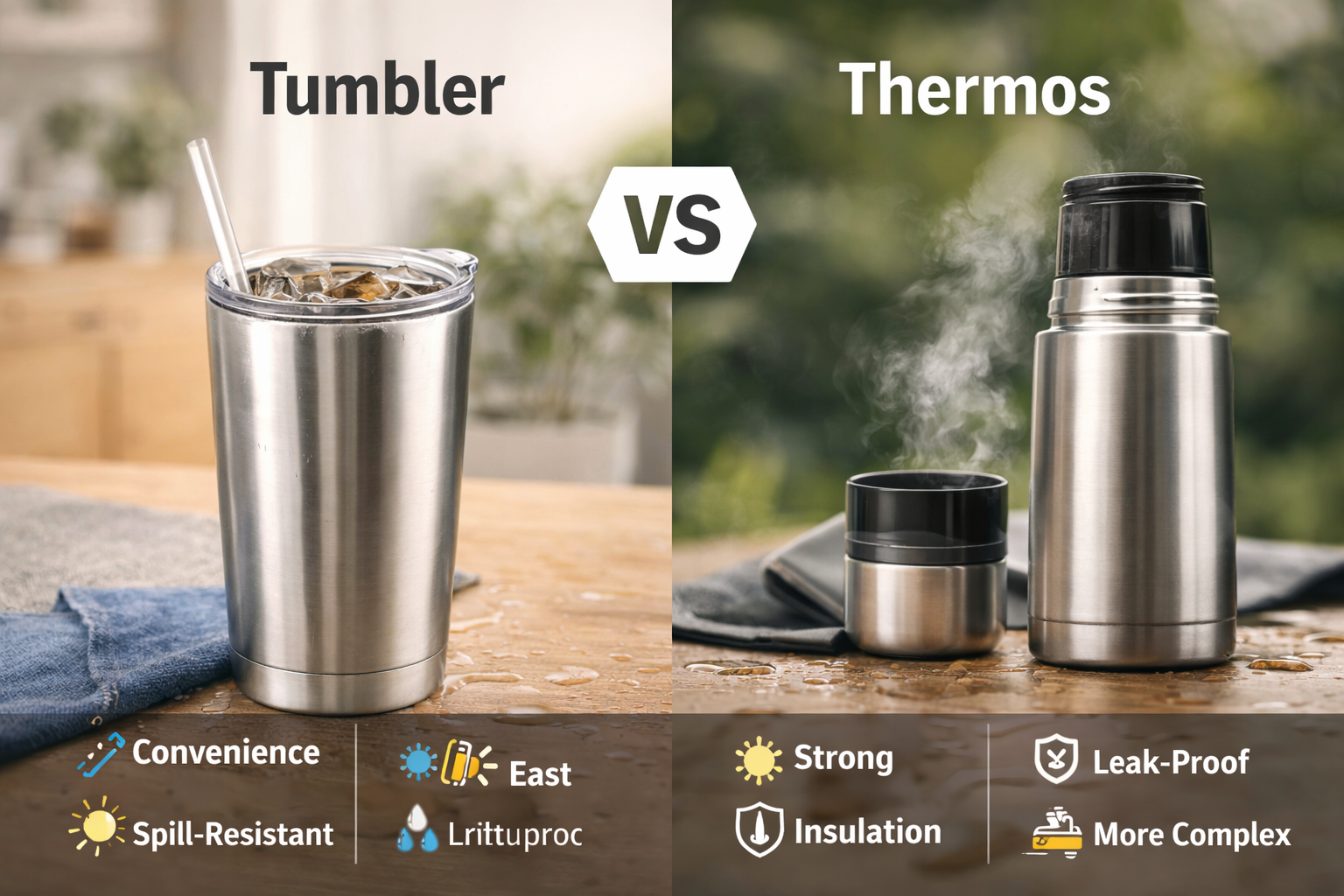
- Tumbler: Open, accessible, user-friendly
- Thermos: Closed, sealed, performance-driven
3.2 Insulation Performance
- Tumblers provide moderate insulation
- Thermoses are engineered for maximum retention
3.3 Leak Resistance
- Tumblers are often spill-resistant, not fully leak-proof
- Thermoses are built for complete sealing
3.4 Ease of Cleaning
- Tumblers tend to be easier to clean due to simpler structures
- Thermoses may have narrow openings and complex lids
3.5 Daily Use Fit
- Tumblers suit fast-paced, urban lifestyles
- Thermoses suit planned, long-duration usage
Core Insight
These products are not competing—they are optimized for different behaviors.
4. Real-World Scenarios: Choosing the Right Option
4.1 Coffee Commute
For daily commuting with coffee:
- Frequent sipping
- One-handed use
- Quick access
Best choice: Tumbler
4.2 Outdoor Travel or Long Trips
For extended outdoor use:
- Limited access to refills
- Need for temperature stability
Best choice: Thermos
4.3 Cold Beverages and Iced Drinks
For drinks like iced coffee, juice, or soda:
- Frequent drinking
- Need for convenience
Best choice: Tumbler
4.4 Hot Water or Tea Throughout the Day
For maintaining hot beverages:
- Long duration
- Consistent temperature
Best choice: Thermos
Conclusion
The right choice depends on how you use the product—not what the product is called.
5. Why People Often Choose the Wrong One
5.1 Over-Reliance on Appearance
Many products look similar, leading users to assume similar performance.
5.2 Misunderstanding Insulation Claims
Consumers often focus on advertised “hours of insulation” without considering real usage patterns.
5.3 Ignoring Lifestyle Fit
The biggest mistake is failing to match the product to daily behavior.
Key Insight
The wrong choice is rarely about quality—it is about mismatch.
6. Understanding Design Trade-Offs
6.1 Convenience vs Performance
- Easier access reduces sealing efficiency
- Strong sealing reduces usability
6.2 Opening Frequency vs Temperature Retention
Every time the container is opened:
- Heat escapes
- Cold is lost
Frequent use reduces insulation effectiveness regardless of design.
6.3 Cleaning vs Structural Complexity
- Simple designs are easier to clean
- Complex designs often perform better but require more maintenance
Core Insight
There is no perfect solution—only balanced trade-offs.
7. Material and Structural Considerations
7.1 Common Materials
Both tumblers and thermoses often use:
- Stainless steel
- Silicone seals
- Plastic components
7.2 Structural Differences
The key differences lie in:
- Thickness of insulation layers
- Lid sealing mechanisms
- Internal air management
Key Insight
Structure has a greater impact on performance than material alone.
8. How to Choose: A Practical Decision Framework
Step 1: Identify Your Main Use
- Daily coffee
- Hydration
- Outdoor use
Step 2: Consider Beverage Type
- Hot drinks
- Cold drinks
- Mixed usage
Step 3: Evaluate Usage Frequency
- Frequent opening → Tumbler
- Long-term storage → Thermos
Step 4: Assess Maintenance Preferences
- Prefer easy cleaning → Tumbler
- Willing to maintain → Thermos
Final Rule
Choose based on how you drink, not what you drink from.
9. The Rise of Hybrid Designs
9.1 Market Trends
Manufacturers are increasingly combining features:
- Improved sealing in tumblers
- Easier access in thermoses
9.2 Limitations of Hybrid Products
Despite innovation, trade-offs remain:
- Improved convenience often reduces insulation
- Strong sealing often reduces usability
Key Insight
Hybrid designs reduce compromises, but cannot eliminate them.
10. Key Takeaways
- Tumblers prioritize convenience and accessibility
- Thermoses prioritize insulation and sealing
- Both serve different use cases
- Choosing the wrong one leads to poor experience
- The best product is the one that fits your daily behavior
Conclusion: It’s Not About the Product—It’s About the Fit
The debate between tumbler and thermos is not about which one is better. It is about which one is better for a specific context.
When users align their choice with their habits, both products perform exactly as intended. When they do not, even the highest-quality product can feel inadequate.
In the end, effectiveness is not determined by features—it is determined by fit.
The right drinkware is the one that works with your lifestyle, not against it.