
Material science has become one of the most influential forces shaping the modern coffee-drinking experience. As consumer expectations continue to shift toward performance, safety, sustainability, and sensory consistency, the material behind a coffee cup is no longer a passive component. It is the engine that governs heat retention, flavor clarity, tactile experience, durability, and long-term product value.
For brands within the drinkware sector, understanding material behavior is now a strategic requirement. For consumers, it directly impacts taste and usability. This article examines how material science drives coffee cup performance, why stainless steel is redefining the category, and what innovations will guide the industry’s next decade.
1. Why Coffee Cup Materials Matter
The moment coffee meets a cup, a series of physical and chemical interactions begins. These interactions determine how fast heat dissipates, how aroma compounds evolve, how acidity or bitterness shifts, and how stable the flavor stays across time. Material science dictates these outcomes through measurable properties such as thermal conductivity, surface reactivity, porosity, and structural density.
The choice of cup material has moved from aesthetics to functional performance. For users, this affects drinking comfort and flavor accuracy. For brands, it influences product positioning, value perception, and competitive differentiation in an increasingly saturated market.
2. The Scientific Basis Behind Material–Coffee Interaction
Coffee contains volatile aromatic compounds, oils, acids, and dissolved solids. These elements respond differently depending on the material they contact.
Key scientific drivers include:
Thermal conductivity:
A material's ability to transfer heat directly influences how quickly coffee cools and how long it stays within the “optimal flavor window.”
Surface energy and reactivity:
Some materials interact minimally with organic compounds (e.g., glass, stainless steel), while others may retain odors or alter taste over time (e.g., certain plastics).
Porosity:
Porous materials allow micro-absorption, affecting flavor neutrality and long-term cleanliness.
Heat capacity:
The material’s mass and density affect the initial temperature drop when hot coffee is poured.
These principles sit at the intersection of material science, sensory science, and thermodynamics—three disciplines increasingly relevant to today’s coffee culture.
3. A Technical Comparison of Common Materials
Porcelain
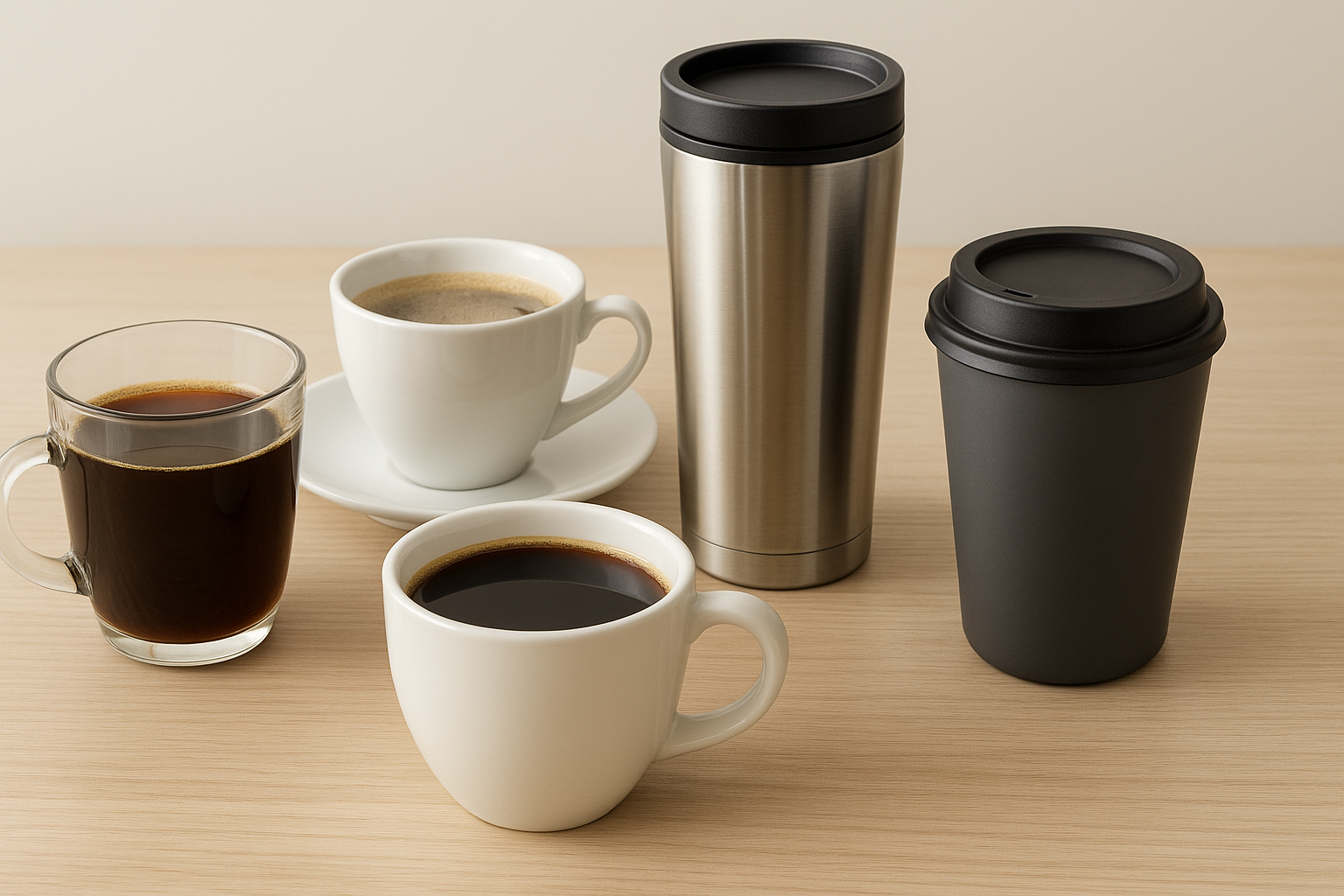
Porcelain is favored in cafés for its neutrality and stable tactile feel. It does not alter flavor, and it supports the visual presentation of specialty drinks.
Its primary limitation is heat loss. Without insulation, porcelain dissipates heat rapidly, shortening the enjoyment window for slow drinkers and commuters.
Glass
Glass provides exceptional chemical stability and clarity. It is ideal for showcasing color, crema layers, and latte art.
However, even with double-wall construction, its thermal performance remains modest. Fragility also limits its suitability for mobile, outdoor, and family-oriented use cases.
Plastic (e.g., Tritan)
Modern BPA-free plastics are lightweight and durable, making them practical for everyday use.
Yet plastic surfaces can accumulate micro-scratches over time, potentially influencing odor retention and impurity absorption. Thermal performance remains low, which constrains taste consistency for hot beverages.
Stainless Steel (304 & 316)
Food-grade stainless steel provides the strongest balance of performance, safety, and resilience.
It excels in durability, non-reactivity, and temperature stability—especially when paired with vacuum insulation.
304 stainless steel is widely used, while 316 stainless steel offers higher corrosion resistance and is preferred for premium-grade coffee tumblers.
4. Stainless Steel as a High-Performance Material
Stainless steel has evolved from an industrial alloy into a consumer-preferred premium material.
Its performance attributes include:
High corrosion resistance:
304 and 316 stainless steel resist acids and salts common in coffee.
Superior structural strength:
Impact resistance supports mobile, outdoor, and all-day usage scenarios.
Flavor neutrality:
A smooth, non-porous surface prevents odor absorption and ensures long-term taste integrity.
Vacuum insulation compatibility:
Stainless steel serves as an optimal shell for double-wall and vacuum chamber systems, maximizing temperature retention.
Between the two grades, 316 stainless steel—with added molybdenum—provides enhanced corrosion resistance and is often used in high-end drinkware.
5. Temperature Control: The Core of Coffee Quality
Temperature engineering is where material science has the greatest influence.
Coffee flavor changes rapidly when temperature fluctuates.
A higher thermal conductivity material—like porcelain or glass—causes a steep heat drop, shifting the flavor profile toward increased bitterness and reduced aromatic clarity.
Vacuum-insulated stainless steel, however, creates a low-exchange environment:
- It slows heat transfer
- It stabilizes flavor over longer periods
- It prevents rapid oxidation of aroma compounds
- It enables “slow drinking” without flavor degradation
This thermal advantage is the primary reason stainless steel dominates premium coffee containers today.
6. How Material Choice Influences Taste Perception
Taste perception is not only chemical—it is also mechanical.
Material factors influencing perceived flavor include:
• Odor retention: Some materials retain aroma after repeated use.
• Surface smoothness: Impacts how lip oils and coffee oils interact with the vessel.
• Porosity: Drives micro-absorption, influencing long-term neutrality.
• Thermal behavior: A stable temperature curve preserves sweetness and reduces harshness.
• Mouthfeel: The rim material affects tactile sensation, influencing flavor interpretation.
Stainless steel, porcelain, and glass provide high neutrality, while plastics may show flavor drift over time.
7. The Evolution of Coffee Cup Materials
The journey from traditional ceramics to precision-engineered insulated cups reflects market and cultural shifts:
- The rise of specialty coffee increased consumer expectations
- Remote work and travel created demand for portable, long-lasting solutions
- Sustainability concerns accelerated the decline of disposable materials
- Engineering advances introduced high-performance thermal designs
Today’s drinkware market blends lifestyle branding with technical capability—an evolution driven by material science innovation.
8. Why Stainless Steel Leads the Contemporary Market
Several macro factors explain why stainless steel is becoming the category standard:
Performance assurance:
It addresses critical needs—temperature retention, flavor stability, and portability.
Health and hygiene reliability:
Consumers perceive stainless steel as safer and cleaner compared to plastics.
Sustainability alignment:
Durability and recyclability match global expectations for responsible consumption.
Design flexibility:
The material supports premium finishes, color coatings, and ergonomic structures.
Market economics:
Longer lifecycle value enables higher price points and stronger customer loyalty.
This combination positions stainless steel as both a functional and strategic material for modern drinkware brands.
9. The Future of Material Science in Coffee Drinkware
Emerging innovations will further reshape the competitive landscape:
Hybrid materials:
Stainless steel paired with ceramic coatings to enhance flavor neutrality.
Advanced alloys:
Higher corrosion resistance and lighter weight structures.
Nano-insulation technology:
Thinner walls with higher thermal efficiency.
Smart drinkware:
Temperature sensors, beverage analytics, and app-driven systems.
Regulatory acceleration:
Stricter global health and chemical safety standards will continue pushing the market away from plastic-based solutions.
Material science will remain central to this growth, driving differentiation and long-term brand competitiveness.
10. Conclusion
Material science is no longer an invisible detail behind the coffee cup—it is a critical driver of taste, temperature, safety, durability, and sustainability.
As stainless steel continues to define modern drinkware, the industry is transitioning toward performance-first design grounded in engineering and health science.
Brands that understand the scientific foundation behind material selection will be better positioned to deliver superior products, strengthen market trust, and lead the next phase of drinkware innovation.
References
- Thermal conductivity and heat retention research across food-safe materials
- Stainless steel (304/316) corrosion resistance and food safety standards
- Sensory science literature on taste perception and material interaction
- Reusability and sustainability lifecycle assessments in drinkware
- Market behavior studies in premium beverage container adoption