
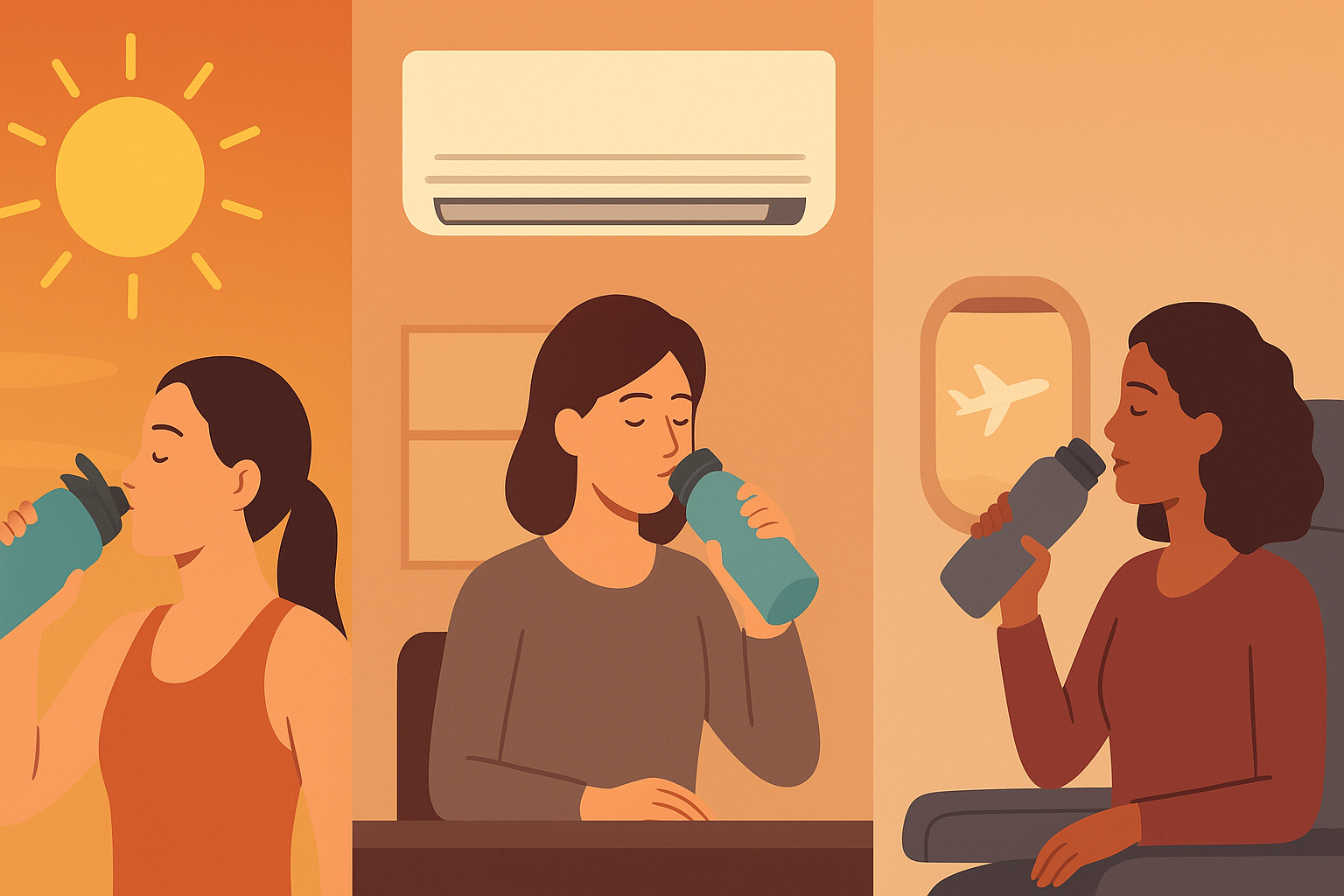
Environmental conditions shape how our bodies retain or lose water—and most people underestimate just how dramatically temperature, humidity, and air pressure can shift hydration needs. A person can stay in an air-conditioned office all day, travel through a long-haul flight, and then walk into tropical heat, and each of those environments triggers a completely different set of biological responses.
This article builds a scenario-based hydration framework to help consumers understand when, how, and how much to drink. It also connects hydration behavior with the functional value of different drinkware types—capacity, materials, lid formats, and portability—giving readers a practical path to make better bottle choices.
1. Executive Summary
Hydration is not a fixed formula. It is an environment-driven requirement.
This means:
- Hot weather = elevated sweat loss + increased electrolyte depletion
- AC rooms = unnoticed moisture evaporation + low humidity dehydration
- Air travel = extremely dry cabin air + reduced pressure + rapid fluid loss
Across all scenarios, hydration quality improves when people adopt structured drink routines, choose the right lid type for their drinking behavior, and carry bottles designed for each environment.
A structured, environment-based hydration approach improves comfort, productivity, physical performance, and travel wellbeing—while strengthening readiness in any climate.
2. The Science Behind Environmental Hydration Needs
2.1 How Temperature, Humidity, and Air Pressure Affect Water Loss
Human hydration is governed primarily by:
- Thermoregulation (sweating to cool down)
- Evaporation rate (how quickly moisture escapes the skin and airways)
- Respiratory water loss (breathing in low-humidity environments)
High-temperature environments
In hot climates, the body dissipates heat by sweating. Sweat rate can jump from 0.8 L/hour to more than 2 L/hour depending on activity level. Humid environments reduce evaporation efficiency, making sweat production even heavier.
Air-conditioned rooms
Most AC systems drop humidity below 30%, which accelerates skin evaporation even when the user does not feel sweaty. The “silent dehydration” in AC rooms often goes unnoticed.
Airplane cabins
Aircraft cabins typically maintain:
- Humidity: 10–20% (drier than most deserts)
- Air pressure: Equivalent to 1,800–2,400m elevation
- Oxygen availability: Slightly reduced
Lower humidity accelerates fluid evaporation from the skin and airway surfaces. Reduced pressure increases respiratory water loss. Combined, dehydration on flights occurs faster than most people expect.
2.2 Signs of Underhydration Across Environments
Hot weather
- Rapid fatigue
- Faster heart rate
- Head discomfort
- Reduced concentration
- Muscle weakness
- Salt imbalance symptoms (cramps)
Air-conditioned rooms
- Dry eyes and lips
- Mild thirst that appears late
- Sluggish cognitive performance
- Skin tightness
- Decreased water intake despite constant evaporation
Air travel
- Dry throat
- Headache
- Jet lag intensification
- Poor circulation and swelling
- Dehydrated skin
Recognizing these early signals helps users build proactive hydration habits.
3. Hydration Strategies for Hot Weather
3.1 Establishing a Daily Water Intake Baseline
Most hydration specialists recommend pairing body weight with climate intensity.
A simple benchmark:
30–40 ml of water × per kilogram of body weight per day
Increase intake by 500–1,000 ml during outdoor activities or heat exposure.
For example:
A 60 kg person needs 1.8–2.4 L/day, and on hot days, may need up to 3 L/day.
3.2 Timing-Based Hydration Structure
In high heat, “small and frequent” is more effective than drinking large volumes at once.
- Pre-exposure: 300–500 ml before going outdoors
- During activity: 120–150 ml every 15–20 minutes
- After activity: Water + electrolytes to rebalance sodium/potassium
This stabilizes body temperature and prevents sudden dehydration spikes.
3.3 Electrolyte Support
Sweat contains water + minerals. The most essential electrolytes include:
- Sodium (prevents hyponatremia)
- Potassium (muscle function)
- Magnesium (reduces cramps)
High-intensity activity may require electrolyte drinks or dissolvable tablets.
3.4 Recommended Bottle Types for Hot Weather
Hot environments demand durability + temperature stability:
- Capacity: 750 ml–1 L
- Material: 316 or 304 stainless steel for thermal performance
- Lid choice: Straw lid supports high-frequency micro-sipping
- Surface: Condensation-free, easy grip
- Portability: Carry loops or straps
These features support steady intake without interrupting activity.
4. Hydration Strategies for Air-Conditioned Rooms
4.1 The “Invisible Dehydration” Risk
AC rooms drop humidity dramatically, promoting skin and airway drying even when there is zero sweat. Because people rarely feel thirsty in cool environments, dehydration symptoms accumulate slowly.
Workers in AC environments commonly experience:
- Cognitive decline
- Eye dryness
- Energy dips after long meetings
- Reduced water intake simply due to convenience barriers
4.2 Hydration Routines for Indoor Work
Adopting a structured hydration flow improves performance:
- Drink 150–200 ml every 1–2 hours
- Use a “sip scheduling system”—2–4 sips per work block
- Drink 200–300 ml after long speaking sessions or post-lunch
Setting workstation reminders or choosing accessible bottle designs helps enforce consistency.
4.3 Recommended Bottle Types for AC Rooms
Office hydration follows a convenience-first model:
- Capacity: 400–600 ml
- Lid type: Spout lid for quick, noise-free use
- Material: Stainless steel or Tritan
- Design: Leak-proof, easy to open with one hand
- Noise control: Soft opening mechanisms for shared workspaces
The goal is to reduce friction so users drink more frequently.
5. Hydration Strategies for Air Travel
5.1 Cabin Environment Realities
Passenger cabins maintain humidity around 10–20%, far below the typical indoor standard of 40–60%. This environment accelerates:
- Respiratory evaporation
- Skin water loss
- Eye dryness
- Nose and throat irritation
Long-haul passengers can easily lose 0.5–1.5 liters of water.
5.2 A Structured Pre-, In-, and Post-Flight Plan
Pre-flight hydration
- Drink 300–500 ml of water before airport arrival
- Avoid alcohol and coffee 4–6 hours before boarding
- Consume foods rich in water content (fruits, vegetables)
In-flight hydration
- Drink 200–250 ml every hour
- Choose small, regular sips rather than single large servings
- Carry electrolyte sachets for long-haul flights
Post-flight hydration
- Rehydrate with water + electrolytes
- Recover with antioxidant-rich foods to counter dehydration stress
- Gradually resume normal intake within 12 hours
5.3 Recommended Bottle Types for Travel
Air travel prioritizes portability and anti-leak protection.
- Capacity: 350–500 ml (ideal for TSA and seat-pocket fit)
- Lid type: Twist cap or spout cap for spill prevention
- Design: Slim, compact, with strong sealing
- Material: Insulated stainless steel to maintain drink temperature
Strong anti-leak safeguards protect bags and electronics during transit.
6. How to Choose the Right Bottle for Each Environment
6.1 Decision Framework
A simple environment-driven matrix helps consumers make the right choice:
| Environment | Ideal Capacity | Best Lid Type | Material Recommendation | Reason |
|---|---|---|---|---|
| Hot Weather | 750–1000 ml | Straw Lid | 316/304 Stainless Steel | High-frequency micro-sips, cooling stability |
| AC Rooms | 400–600 ml | Spout Lid | Stainless Steel / Tritan | Quick, convenient sipping |
| Air Travel | 350–500 ml | Twist or Spout Cap | Stainless Steel | Anti-leak protection & portability |
6.2 Material Considerations
Stainless steel (316/304)
- Best insulation
- Corrosion-resistant
- Suitable for hot climates and travel
Tritan
- Lightweight
- Shatter-resistant
- Suitable for office and indoor use
Glass
- Neutral taste
- Best for stationary indoor settings
- Not recommended for travel or outdoor sports
- 6.3 Lid Type Considerations
Straw lid
- Driven by high-frequency sipping
- Ideal for heat, sports, and cycling
Spout lid
- Easy to open with one hand
- Ideal for office or workouts
Twist cap
- Strongest anti-leak performance
- Ideal for travel and transportation
7. Environmental Impact: Sustainable Hydration Choices
Hydration is not just a health topic—it is also a sustainability issue. Disposable plastic bottles raise waste levels across travel and city environments.
7.1 Why Reuse Matters
Reusable bottles significantly reduce:
- Single-use plastic consumption
- Energy needed for bottled water production
- Waste footprint during travel
- Consumer long-term cost
Air travelers, in particular, generate large volumes of waste because bottled water is often the default option.
7.2 Extending the Life Cycle of Hydration Gear
Durability is determined by:
- Material quality (e.g., 316 stainless steel lasts longer)
- Replaceable components (straws, seals, caps)
- Structural design
Consumers save cost and reduce environmental impact by choosing long-life products instead of frequently replacing cheap bottles.
8. Practical Hydration Checklists
8.1 Hot Weather
- Start with 300–500 ml before exposure
- Drink 120–150 ml every 20 minutes
- Use insulated bottles
- Add electrolytes when sweating heavily
- Avoid overheating by pacing activity
8.2 AC Rooms
- Drink 150–200 ml every 1–2 hours
- Set reminders during work
- Choose moderate-capacity bottles for convenience
- Use a spout lid for micro-sips
- Rehydrate before sleeping and after waking
8.3 Air Travel
- Carry a compact bottle
- Drink 200–250 ml per hour
- Avoid alcohol/caffeine
- Use electrolyte sachets on long flights
- Rehydrate deeply after landing
9. Unified Hydration Framework
Across hot climates, indoor AC environments, and air travel, hydration needs are uniquely shaped by temperature, humidity, and pressure. A rigid “daily liters” formula does not reflect real-world water loss. Instead, consumers gain the most value from scenario-based hydration routines tied to environmental conditions.
When hydration strategy aligns with the correct bottle capacity, lid type, and material, people maintain better energy, physical comfort, and cognitive performance. Ultimately, this builds both short-term wellbeing and long-term resilience—whether at work, on the move, or under the sun.