
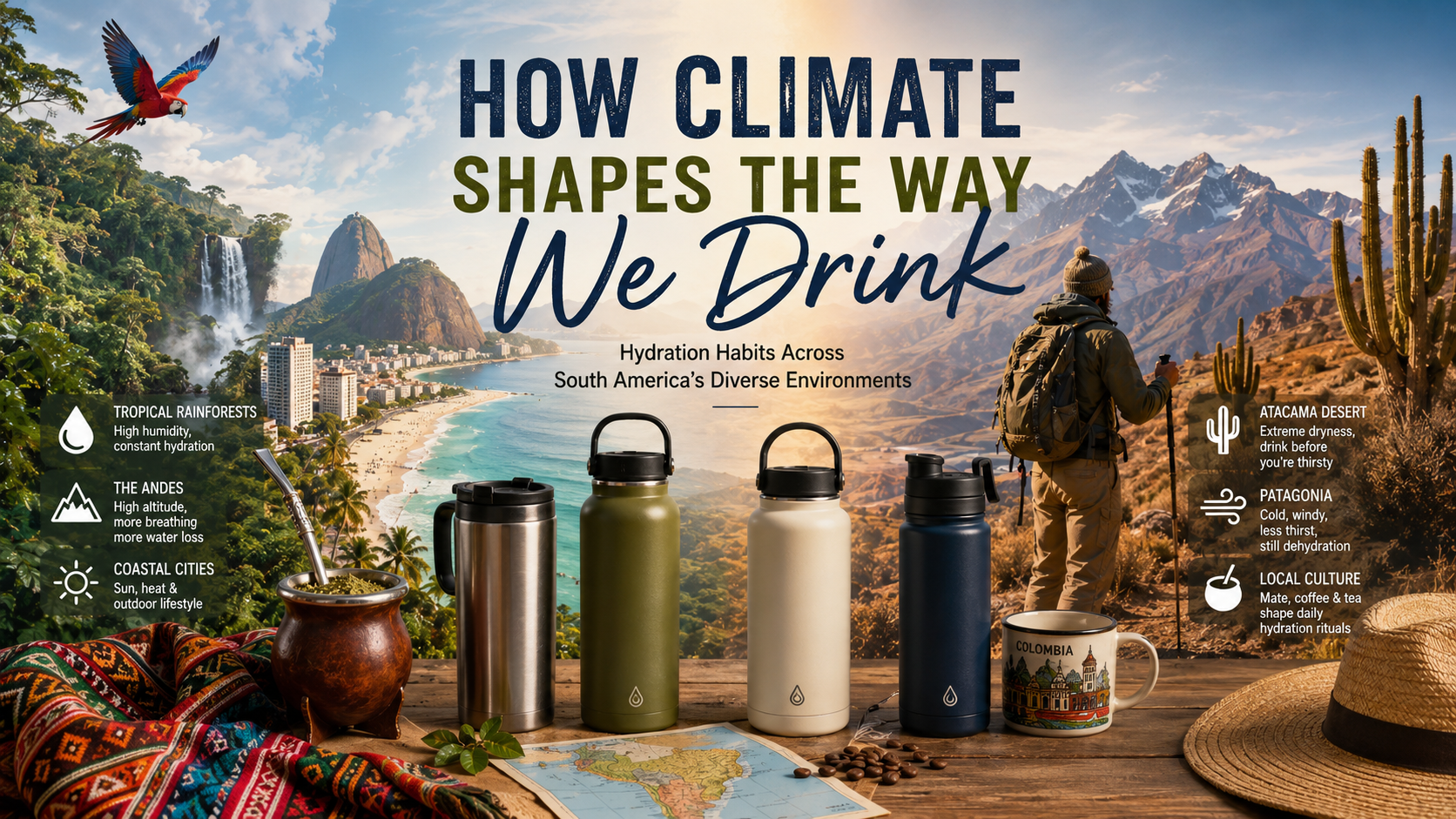
What Different Landscapes Can Teach Us About Hydration, Drinkware, and Everyday Comfort
Part 1 — Climate, Geography, and the Science of Everyday Hydration
Introduction: One Continent, Countless Ways to Stay Hydrated
Water is universal, but the way people drink it is surprisingly local.
Across the world, hydration is often discussed using broad recommendations—drink more water, carry a reusable bottle, stay hydrated during hot weather. While these guidelines are useful, they rarely account for one of the most influential factors affecting our daily hydration habits: the environment around us.
Climate shapes nearly every aspect of our lives. It determines what we wear, how we build our homes, when we exercise, what we grow, and even the beverages we enjoy. Yet when it comes to hydration, many people still assume there is a universal formula that works for everyone.
In reality, hydration is dynamic. The amount of water we need, the temperature we prefer, and the type of drinkware that fits our lifestyle can change dramatically depending on where we live and how we spend our day.
Few places illustrate this better than South America.
Stretching nearly 7,500 kilometers (about 4,660 miles) from north to south, South America is home to one of the widest ranges of climates on Earth. Within a single continent, travelers can experience humid tropical rainforests, high-altitude mountain ranges, arid deserts, Mediterranean valleys, temperate grasslands, and subpolar landscapes.
These environments do more than create breathtaking scenery. They influence how people stay hydrated, what beverages they choose, and even the design of the bottles, mugs, and thermoses they carry every day.
This article explores how geography and climate shape hydration habits across South America. Rather than focusing solely on how much water to drink, we'll examine how weather, altitude, humidity, local traditions, and everyday routines affect hydration—and how choosing the right drinkware can make healthy habits easier to maintain.
Why Climate Shapes the Way We Drink
Climate is more than a weather forecast. It is the long-term pattern of temperature, rainfall, humidity, wind, and seasonal variation that defines a region.
Over time, these environmental conditions influence daily behavior. In warmer climates, people often seek cold beverages throughout the day. In colder regions, hot drinks become part of daily comfort. In high-altitude cities, hydration becomes especially important because the body loses moisture more quickly through respiration. Even humidity changes how we perceive thirst.
In other words, climate doesn't simply affect what we drink—it influences how, when, and why we drink.
For example:
- A construction worker in coastal Brazil may carry a one-liter insulated bottle filled with ice water to stay cool throughout the afternoon.
- A university student in Bogotá might keep a compact insulated tumbler filled with coffee while walking across campus in cooler mountain air.
- Families in Argentina and Uruguay often travel with hot water in insulated flasks, ready to prepare yerba mate wherever they gather.
- Hikers exploring Patagonia may rely on vacuum-insulated bottles to keep tea warm during long hours in cold, windy conditions.
Each routine reflects a combination of environment, culture, and personal comfort.
This is why there is no single "best" hydration strategy. The most effective approach is one that adapts to the conditions around us.
South America: One of the World's Most Diverse Climate Regions
To understand why hydration varies so much across South America, it's worth appreciating the continent's extraordinary geography.
Unlike continents dominated by a single climate zone, South America includes nearly every major climate classification.
Tropical Rainforests
Northern South America contains vast stretches of tropical rainforest, where temperatures remain consistently warm and humidity frequently exceeds 80 percent.
Tropical and Subtropical Coasts
Countries such as Brazil experience long coastlines with warm temperatures, strong sunlight, and seasonal rainfall.
High Mountain Regions
The Andes Mountains extend through seven countries, creating dramatic differences in altitude and temperature.
Deserts
Northern Chile is home to the Atacama Desert, widely recognized as one of the driest places on Earth.
Temperate Grasslands
Central Argentina and Uruguay experience moderate seasonal changes that support agriculture and urban life.
Cold Southern Regions
Patagonia introduces strong winds, cool temperatures, and rapidly changing weather patterns.
For hydration, this means one recommendation cannot reasonably fit every environment.
The Science Behind Everyday Hydration
Hydration is often associated with sweating, but the body loses water through several pathways every day.
Understanding these processes helps explain why weather matters so much.
Perspiration
Sweating is the body's primary cooling system.
When sweat evaporates, it removes heat from the skin and helps regulate body temperature.
However, evaporation behaves differently depending on humidity.
Respiration
Every breath releases water vapor.
In dry climates or at high altitudes, respiratory water loss increases because the body must humidify incoming air before it reaches the lungs.
Metabolism
Water supports countless biological functions, including nutrient transport, temperature regulation, digestion, and circulation.
Even at rest, the body continuously uses and loses water.
Daily Activity
Walking, commuting, climbing stairs, exercising, and carrying bags all increase fluid requirements.
Environmental conditions determine how significant these losses become.
Temperature Isn't the Whole Story
One of the most common misconceptions about hydration is that hot weather is the only time people need extra water.
Temperature certainly matters, but it is only one piece of the puzzle.
Other important factors include:
- Humidity
- Wind speed
- Solar radiation
- Altitude
- Physical activity
- Clothing
- Exposure time
For example, a sunny but dry afternoon may lead to faster evaporation than a humid day with similar temperatures.
Likewise, a cool mountain hike can still produce significant dehydration because of increased breathing and ultraviolet exposure.
Understanding hydration requires looking beyond the thermometer.
The Hidden Influence of Humidity
Humidity describes how much moisture is already present in the air.
It affects how efficiently sweat evaporates.
High Humidity
When humidity is high, sweat remains on the skin longer.
People often feel hotter because evaporation slows down.
To compensate, the body may produce more sweat.
As a result, water loss can become surprisingly high.
Low Humidity
In dry environments, sweat evaporates almost immediately.
People may not notice perspiration because clothing stays relatively dry.
Yet water loss continues.
Both environments increase hydration needs—but for different reasons.
The Amazon Rainforest: Where Heat and Humidity Work Together
No place demonstrates this relationship better than the Amazon Rainforest.
Covering millions of square kilometers across Brazil, Peru, Colombia, Ecuador, Bolivia, Venezuela, Guyana, Suriname, and French Guiana, the Amazon represents one of Earth's most biologically rich ecosystems.
For visitors, however, the rainforest also presents a unique hydration challenge.
Temperatures commonly range between 25°C and 32°C (77–90°F), while humidity often remains above 80 percent.
This combination creates continuous moisture loss.
Even casual walking can leave clothing damp with sweat.
Unlike dry climates where perspiration evaporates quickly, rainforest humidity prevents efficient cooling.
The body works harder to maintain a stable temperature, producing additional sweat throughout the day.
Many travelers mistakenly believe rainy weather reduces dehydration risk.
In reality, frequent rainfall has little connection to the body's internal water balance.
People often become mildly dehydrated simply because they underestimate how much fluid they are losing.
Practical Hydration Tips for Tropical Rainforests
- Drink small amounts regularly instead of waiting until you feel thirsty.
- Carry sufficient water before entering remote areas.
- Consider beverages containing electrolytes during prolonged outdoor activity.
- Use insulated bottles to keep water refreshingly cool despite high ambient temperatures.
Why Cold Water Feels More Refreshing in Tropical Climates
Temperature influences not only comfort but also drinking behavior.
Research suggests that many people voluntarily drink more water when it is served cool rather than warm, particularly after physical activity or in hot environments.
This is one reason insulated bottles have become increasingly popular in tropical regions.
Instead of allowing water to become lukewarm after an hour in the sun, vacuum insulation helps maintain a refreshing drinking temperature for much longer.
While hydration ultimately depends on total fluid intake rather than water temperature, improving the drinking experience often encourages more consistent hydration throughout the day.
Brazil's Coastal Lifestyle: Hydration Under the Sun
Brazil's Atlantic coastline stretches for more than 7,000 kilometers, encompassing world-famous beaches, vibrant cities, and warm tropical weather.
Whether walking along Copacabana, cycling in Florianópolis, or enjoying family weekends in Salvador, many outdoor activities involve prolonged sun exposure.
Unlike rainforest environments, coastal regions often combine:
- Direct sunlight
- Sea breezes
- Moderate to high humidity
- Long hours outdoors
The presence of wind can be deceptive.
Because moving air accelerates evaporation, people may not realize how much moisture they are losing.
This phenomenon is especially common during beach sports, jogging, cycling, or sightseeing.
Reusable insulated bottles have become a practical companion for many people living in or visiting these areas because they help maintain cold drinking water throughout the day without relying on single-use plastic bottles.
Colombia and Ecuador: Elevation Meets Tropical Warmth
Countries such as Colombia and Ecuador demonstrate another fascinating aspect of South America's geography.
Within a relatively short distance, travelers can move from tropical lowlands to cooler mountain cities.
Take Colombia as an example.
A morning in Cartagena may involve humid coastal heat, while an afternoon flight to Bogotá introduces cooler temperatures and significantly higher elevation.
Although Bogotá feels much cooler than Cartagena, hydration remains equally important.
Higher elevations increase respiratory water loss, while lower oxygen levels encourage the body to work slightly harder during physical activity.
For travelers unfamiliar with these conditions, carrying an insulated bottle makes adapting to changing environments much easier.
Instead of constantly purchasing beverages, they can maintain access to water at a comfortable temperature throughout the day.
Drinkware as Part of Everyday Wellness
Hydration is often discussed as a health goal.
Less frequently discussed is the role of the container itself.
Yet behavioral science consistently suggests that convenience strongly influences healthy habits.
A reusable bottle sitting on a desk, clipped to a backpack, or placed in a car cup holder serves as a subtle reminder to drink regularly.
Its design also affects the experience.
Features such as leak-resistant lids, comfortable handles, wide-mouth openings, and effective insulation reduce small inconveniences that might otherwise discourage consistent use.
In this sense, well-designed drinkware becomes more than a product.
It becomes part of an everyday routine that supports comfort, sustainability, and long-term wellness.
Part 2 — Mountains, Deserts, Cultural Traditions, and Choosing Drinkware for Every Climate
The Andes Mountains: Where Elevation Changes the Rules of Hydration
Stretching for more than 7,000 kilometers (4,300 miles), the Andes Mountains form the longest continental mountain range in the world. Running through Venezuela, Colombia, Ecuador, Peru, Bolivia, Chile, and Argentina, the Andes are more than a dramatic geographical feature—they shape weather patterns, biodiversity, agriculture, and everyday life across the continent.
For hydration, altitude introduces a set of challenges that many first-time visitors underestimate.
Unlike tropical environments where sweating is the primary concern, mountain regions increase fluid loss in more subtle ways.
Why High Altitude Increases Water Loss
As elevation increases, atmospheric pressure decreases.
Although the percentage of oxygen remains roughly the same, each breath delivers less oxygen to the body. To compensate, people naturally breathe more frequently and more deeply.
Every exhalation carries water vapor.
The higher the altitude, the more moisture leaves the respiratory system throughout the day.
At elevations above approximately 2,500 meters (8,200 feet), respiratory water loss can increase noticeably, particularly during hiking or prolonged outdoor activity.
At the same time, mountain air is often considerably drier than tropical climates, accelerating evaporation from both the skin and respiratory tract.
Cooler Temperatures Can Be Misleading
Many travelers associate dehydration with heat.
Yet cool mountain weather often masks the body's need for water.
People simply feel less thirsty.
Combined with increased respiratory water loss, this creates a situation where dehydration develops gradually without obvious warning signs.
Common symptoms include:
- Mild headaches
- Fatigue
- Reduced concentration
- Dry lips
- Muscle fatigue during hiking
For visitors adjusting to altitude, consistent hydration becomes just as important as proper nutrition and adequate rest.
Practical Drinkware for Mountain Environments
Mountain travel often involves changing temperatures throughout the day.
A morning hike may begin close to freezing, followed by warm afternoon sunshine before temperatures drop again after sunset.
Because of these fluctuations, insulated bottles that preserve both hot and cold beverages become particularly practical.
Popular choices include:
- Vacuum-insulated stainless steel bottles
- Wide-mouth bottles for adding ice or preparing tea
- Leak-resistant lids suitable for backpacks
- Medium-capacity bottles (600–900 ml) for balanced portability
Unlike beach destinations, mountain environments often prioritize versatility over maximum cold retention alone.
Peru: Ancient Mountains, Modern Hydration
Few countries demonstrate the relationship between geography and hydration as clearly as Peru.
Travelers may begin their journey along the Pacific coast, continue into the Andes, and eventually descend into the Amazon Basin—all within a relatively short period.
Each region requires different hydration strategies.
Along the coast, warm sunshine encourages frequent water consumption.
In mountain cities such as Cusco, altitude becomes the primary factor.
Meanwhile, the Amazon emphasizes heat and humidity.
For travelers exploring multiple regions, carrying a single reliable insulated bottle simplifies the transition between climates.
Whether filled with cold water, herbal tea, or coffee, a quality bottle adapts more easily than purchasing disposable drinks throughout the journey.
The Atacama Desert: Lessons from One of the World's Driest Places
Northern Chile is home to the Atacama Desert, widely recognized as one of the driest non-polar deserts on Earth.
Some weather stations within the region have recorded years without measurable rainfall.
Despite its harsh appearance, the Atacama has become a popular destination for astronomy, photography, hiking, and geological tourism.
Its climate also provides one of the clearest examples of how dry air influences hydration.
When Sweat Disappears Before You Notice It
In extremely dry environments, sweat evaporates almost immediately.
This rapid evaporation cools the body efficiently, but it also makes water loss difficult to notice.
Unlike humid climates, clothing rarely feels damp.
Many people assume they are sweating less.
The opposite may be true.
Because evaporation occurs so quickly, the body can continue losing water at a significant rate without creating obvious visual cues.
Desert Air Draws Moisture from the Body
Dry air also increases moisture loss through:
- Breathing
- Skin
- Eyes
- Lips
Visitors frequently report dry skin and chapped lips within hours of arrival.
These visible changes are reminders that hydration extends beyond simply replacing sweat.
Drinkware for Desert Travel
Desert environments reward preparation.
Helpful features include:
- High-capacity insulated bottles (750 ml–1.2 L)
- Durable stainless steel construction
- Light-colored exterior finishes that reduce heat absorption in direct sunlight
- Wide openings for adding ice during extended excursions
For photographers, hikers, and road-trippers exploring remote areas, carrying sufficient water is often more important than relying on opportunities to purchase beverages along the route.
Patagonia: Why Cold Weather Doesn't Eliminate Dehydration
At the southern end of South America lies Patagonia, a region famous for glaciers, rugged mountains, dramatic coastlines, and powerful winds.
Compared with tropical South America, Patagonia feels refreshingly cool.
However, cool weather introduces its own hydration challenges.
Cold Reduces the Feeling of Thirst
One of the most interesting characteristics of cold environments is that thirst perception often decreases.
People simply feel less inclined to drink water.
Yet the body continues losing moisture through breathing and daily activity.
Outdoor enthusiasts hiking through Patagonia often remain physically active for hours while consuming surprisingly little water.
This imbalance can contribute to reduced performance and unnecessary fatigue.
Wind Accelerates Moisture Loss
Patagonia's famous winds increase evaporation from exposed skin.
Combined with layers of insulating clothing that trap body heat, outdoor activities can still generate significant perspiration.
The result is a climate where hydration remains important despite cool temperatures.
Warm Drinks Become Part of the Experience
Unlike tropical destinations where cold water dominates, Patagonia encourages different beverage choices.
Travelers often enjoy:
- Hot tea
- Coffee
- Herbal infusions
- Hot chocolate
A well-insulated bottle or travel mug supports comfort while reducing dependence on disposable cups during long outdoor excursions.
Climate Shapes Culture—And Culture Shapes Drinkware
Weather influences more than hydration.
Over generations, it also shapes local beverage traditions.
Across South America, different drinks have become closely connected with regional lifestyles.
Brazil: Cold Refreshment and Outdoor Living
Brazil's warm climate encourages beverages that provide refreshment throughout the day.
Cold water, fruit juices, coconut water, and iced coffee have become common companions during outdoor activities.
Insulated bottles that preserve cold temperatures fit naturally into this lifestyle.
Large capacities are particularly useful for beach visits, parks, cycling, and commuting.
Colombia: Coffee Beyond the Farm
Although Colombia is internationally celebrated for coffee production, coffee also plays an important role in everyday social life.
Rather than drinking large quantities at once, many people enjoy several smaller servings throughout the day.
Compact insulated tumblers help maintain flavor while supporting busy urban routines.
Argentina and Uruguay: The Social Ritual of Yerba Mate
Few beverages illustrate the relationship between drinkware and culture better than Yerba Mate.
In Argentina and Uruguay, mate is far more than a drink.
It is a daily ritual shared among friends, colleagues, and family members.
Unlike coffee, which is typically prepared individually, mate often encourages conversation and community.
Maintaining the correct water temperature is essential.
Water that is too hot can alter flavor and bitterness.
Water that cools too quickly interrupts the experience.
This explains why insulated flasks have become almost inseparable from mate culture.
Many people carry them everywhere—from city parks and offices to road trips and sporting events.
Chile: A Country of Climate Extremes
Chile presents one of the widest climate ranges found within a single country.
Travelers can experience:
- Desert landscapes
- Mediterranean valleys
- Snow-covered mountains
- Coastal cities
- Cold southern fjords
Rather than relying on multiple bottles, many consumers prefer versatile insulated drinkware capable of adapting to rapidly changing environments.
This versatility reflects a broader lesson.
The best bottle is not necessarily the one with the longest advertised temperature retention.
It is the one that performs consistently across different situations.
Choosing Drinkware Based on Climate Rather Than Marketing
Modern drinkware advertisements often emphasize impressive laboratory figures such as:
- Keeps drinks cold for 24 hours
- Keeps drinks hot for 12 hours
While these measurements are useful, everyday performance depends on much more than laboratory testing.
Environmental conditions matter.
So do daily habits.
Instead of asking:
"Which bottle is the best?"
A more helpful question is:
"Which bottle best supports my lifestyle?"
Tropical Climates
Priorities
- Cold retention
- Sweat-resistant exterior
- Large capacity
- Comfortable carrying handle
Ideal Users
Beachgoers, commuters, outdoor workers, cyclists.
Mountain Regions
Priorities
- Hot and cold versatility
- Leak resistance
- Moderate weight
- Durable construction
Ideal Users
Travelers, hikers, students, photographers.
Desert Environments
Priorities
- Maximum capacity
- Excellent insulation
- Rugged durability
- Easy refilling
Ideal Users
Road-trip travelers, campers, explorers.
Cold Southern Regions
Priorities
- Hot beverage performance
- Comfortable grip
- Reliable sealing
- Easy cleaning
Ideal Users
Outdoor enthusiasts, commuters, winter travelers.
The Psychology of Drinking More Water
Climate influences hydration, but habits ultimately determine outcomes.
Behavioral research has shown that small environmental cues can significantly affect water consumption.
People are generally more likely to drink water when:
- It is within easy reach.
- It tastes pleasant.
- It remains at a preferred temperature.
- The container is enjoyable to use.
- Carrying it fits naturally into daily routines.
These seemingly minor details explain why reusable drinkware has become part of broader wellness trends.
A thoughtfully designed bottle doesn't merely hold water.
It encourages consistency.
Sustainability Meets Everyday Convenience
South America's growing interest in sustainability has also influenced drinkware preferences.
Reusable bottles help reduce dependence on single-use plastic containers during:
- Daily commuting
- University life
- Outdoor recreation
- Domestic travel
- International tourism
For many consumers, choosing a reusable insulated bottle reflects both practical convenience and environmental awareness.
A durable bottle that lasts for years often has a smaller long-term environmental footprint than repeatedly purchasing disposable alternatives.
Conclusion: The Best Hydration Habit Is the One That Fits Your Environment
South America reminds us that hydration is never one-size-fits-all.
From the humid rainforests of the Amazon to the windswept plains of Patagonia, every landscape presents unique challenges—and unique opportunities—to care for our health.
Climate influences how our bodies lose water.
Culture shapes what we choose to drink.
Lifestyle determines when and where hydration fits into our day.
The most effective hydration routine is therefore not built around rigid numbers, but around awareness.
By paying attention to temperature, humidity, altitude, activity, and local traditions, we can make more informed choices about both hydration and drinkware.
In the end, the best insulated bottle is not simply the one that promises the longest performance in a laboratory.
It is the one that becomes part of everyday life—whether accompanying a morning commute in Bogotá, a beach afternoon in Rio de Janeiro, a mountain trek through Peru, or a shared mate with friends in Buenos Aires.
A good bottle carries water.
A great bottle supports the moments, places, and routines that make daily life more comfortable, wherever the journey leads.
Appendix: Climate, Hydration & Drinkware Reference Guide
Why This Guide Matters
Hydration is often presented as a simple daily target—drink a certain amount of water and you're done. Yet decades of research in physiology, environmental science, and public health show that hydration requirements vary considerably depending on climate, altitude, humidity, activity level, age, diet, and individual health.
South America provides an exceptional example of this principle. Within one continent, people routinely experience some of the world's most humid rainforests, driest deserts, highest mountain cities, longest coastlines, and coldest inhabited regions outside Antarctica.
Understanding these environmental differences helps transform hydration from a fixed recommendation into a flexible daily habit.
Rather than focusing solely on "how much" to drink, this guide encourages readers to consider when, where, why, and how they hydrate.
South America Climate Comparison
| Region | Typical Climate | Main Hydration Challenge | Recommended Drinkware | Beverage Preference |
|---|---|---|---|---|
| Amazon Basin | Tropical Rainforest | Heavy sweating caused by heat and humidity | Large insulated bottle (750–1000 ml) | Cold water, electrolyte drinks |
| Northern Brazil Coast | Tropical Coastal | Sun exposure and prolonged outdoor activity | Leakproof insulated bottle | Cold water, fruit-infused water |
| Andes Mountains | High Altitude | Increased respiratory water loss | Vacuum insulated bottle | Water, tea, coffee |
| Atacama Desert | Hyper-Arid Desert | Rapid evaporation and dry air | Large-capacity insulated bottle | Water, electrolyte beverages |
| Central Chile | Mediterranean | Warm summers with seasonal variation | Medium insulated bottle | Water, iced coffee |
| Buenos Aires | Temperate | Urban commuting and daily routines | Travel tumbler | Coffee, water |
| Uruguay | Temperate | Daily mate preparation | Hot-water insulated flask | Yerba Mate |
| Patagonia | Cold & Windy | Reduced thirst perception | Thermal bottle | Tea, coffee, hot chocolate |
Choosing the Right Drinkware by Environment
Tropical Rainforests
Primary Needs
- Excellent cold retention
- Large water capacity
- Comfortable carrying handle
- Durable stainless steel construction
Ideal for:
- Hiking
- Ecotourism
- Wildlife photography
- Outdoor work
Coastal Cities
Priorities include:
- Cold drinks throughout the day
- Easy portability
- Leak resistance
- Cup-holder compatibility
Suitable for:
- Beach trips
- Cycling
- Walking tours
- Daily commuting
Mountain Regions
Recommended Features:
- Double-wall vacuum insulation
- Moderate capacity (600–900 ml)
- Secure lid for backpacks
- Wide mouth for tea or ice
Suitable for:
- Hiking
- Trekking
- High-altitude travel
- Long-distance bus journeys
Desert Travel
Focus on:
- Maximum capacity
- Excellent insulation
- Easy cleaning
- Rugged durability
Suitable for:
- Road trips
- Desert hiking
- Camping
- Astronomy tours
Cold Regions
Recommended:
- Hot beverage performance
- Comfortable grip
- Easy one-handed use
- Reliable sealing system
Ideal beverages:
- Coffee
- Tea
- Herbal infusions
Hydration Checklist for Travelers
Before leaving each day, consider:
✓ Is today's weather hotter or colder than yesterday?
✓ Will I spend extended time outdoors?
✓ Am I traveling to a higher altitude?
✓ Will refill stations be available?
✓ Am I carrying enough water?
✓ Does my bottle match today's activities?
✓ Have I considered both hydration and beverage temperature?
These simple questions often have a greater impact than trying to remember an exact daily water target.
Common Hydration Myths
Myth 1
"You only need extra water during summer."
Reality:
Cold weather, wind, and high altitude can also increase water loss.
Myth 2
"Rainy weather prevents dehydration."
Reality:
High humidity often increases sweating while making water loss less noticeable.
Myth 3
"Thirst is always an accurate indicator."
Reality:
Research shows that thirst can lag behind the body's actual hydration needs, particularly in older adults, during prolonged exercise, and in cold environments.
Myth 4
"Any bottle works the same."
Reality:
Bottle design influences convenience, accessibility, temperature retention, and ultimately how consistently people stay hydrated.
Frequently Asked Questions
Does humidity increase dehydration?
Indirectly, yes.
High humidity reduces sweat evaporation, causing the body to produce more sweat in an attempt to cool itself. This can increase overall fluid loss.
Why do I feel less thirsty in cold weather?
Cold temperatures may reduce thirst perception even though the body continues losing water through breathing and physical activity.
Is an insulated bottle necessary?
Not always.
However, maintaining a preferred beverage temperature often encourages people to drink more consistently throughout the day.
Which bottle material performs best?
For most everyday users, food-grade stainless steel with double-wall vacuum insulation offers an effective balance of durability, temperature retention, hygiene, and long-term performance.
Does bottle size matter?
Yes.
The best size depends on your routine.
Smaller bottles suit commuting, while larger bottles are often more practical for outdoor activities and travel.
Key Takeaways
- Hydration needs change with climate rather than following one universal rule.
- Humidity, altitude, wind, and sunlight all influence daily water requirements.
- South America's diverse geography illustrates how local environments shape drinking habits.
- Drinkware should be selected according to lifestyle and climate rather than temperature-retention claims alone.
- Consistent hydration is easier when water is accessible, enjoyable to drink, and integrated into everyday routines.
Final Thoughts
One of the most interesting lessons from South America is that hydration is deeply connected to place.
In the Amazon, staying hydrated means managing constant heat and humidity.
In the Andes, it means respecting the effects of altitude.
In Patagonia, it means drinking before thirst appears.
In Argentina and Uruguay, it becomes part of a shared cultural ritual through mate.
Across every landscape, one principle remains the same:
Healthy hydration isn't about following a rigid formula.
It's about understanding your environment and building habits that adapt with it.
Whether you're preparing for a weekend hike, commuting across a busy city, traveling through changing climates, or simply enjoying a quiet afternoon at home, thoughtful drinkware can become a small but meaningful part of a healthier daily routine.
References & Further Reading
To support the scientific, environmental, and cultural information presented in this article, the following authoritative resources were consulted. These sources cover hydration physiology, climate science, public health guidance, beverage culture, and sustainability.
Hydration & Public Health
- World Health Organization (WHO) – Health Topics and Healthy Living
- Pan American Health Organization (PAHO)
- Centers for Disease Control and Prevention (CDC) – Water and Healthier Drinks
- European Food Safety Authority (EFSA) – Dietary Reference Values for Water
- Hydration for Health Scientific Library
Climate & Geography
- World Meteorological Organization (WMO)
- National Oceanic and Atmospheric Administration (NOAA) Climate Resources
- Food and Agriculture Organization of the United Nations (FAO) Climate Information
- United Nations Environment Programme (UNEP)
- NASA Earth Observatory – Climate and Environmental Studies
Materials & Drinkware
- ASM International – Stainless Steel Resources
- British Stainless Steel Association (BSSA)
- International Organization for Standardization (ISO)
- National Institute of Standards and Technology (NIST) – Heat Transfer Fundamentals
- American Society of Mechanical Engineers (ASME) Learning Resources
Coffee, Tea & Cultural Context
- Specialty Coffee Association (SCA)
- International Tea Committee
- National Institute of Yerba Mate (INYM), Argentina
- International Coffee Organization (ICO)