
1. Introduction: Why Bottle Durability Matters More Than Ever
Reusable water bottles have moved from niche accessories to everyday essentials. They are carried to offices, gyms, schools, airports, and outdoor activities, often used multiple times a day and expected to perform consistently for years. As usage frequency increases, durability becomes more than a marketing term—it becomes a practical concern that directly affects cost, convenience, and user experience.
Many purchasing decisions still focus on capacity, appearance, or insulation claims. However, over time, users tend to judge bottles by different standards: how long they last, how they age, how much maintenance they require, and how often they need to be replaced. This is where the comparison between metal and plastic bottles becomes especially relevant.
Rather than framing this debate around trends or labels, this article examines metal and plastic water bottles as long-term tools. By comparing their longevity, usage-related safety considerations, and total cost of ownership, the goal is to help readers make decisions based on practical value rather than assumptions.
2. What “Durability” Really Means in Drinkware
Durability in drinkware is often misunderstood as simple resistance to breaking. In reality, it includes several overlapping factors that determine how long a bottle remains usable and pleasant to use.
Physical durability refers to a bottle’s ability to withstand drops, impacts, and pressure without cracking, deforming, or leaking. Functional durability, on the other hand, focuses on how well the bottle continues to perform its intended role over time—maintaining a seal, resisting odors, preserving taste, and remaining easy to clean.
There is also the concept of perceived durability. A bottle may technically still function, but visible scratches, dents, discoloration, or lingering smells can lead users to replace it prematurely. In this sense, durability is not only about engineering but also about long-term user satisfaction.
When comparing metal and plastic bottles, it is important to evaluate all three dimensions together rather than focusing on a single failure point.
3. Material Basics: Metal and Plastic at a Structural Level
Most durable metal water bottles are made from stainless steel, typically food-contact-grade alloys designed to resist corrosion and structural fatigue. Stainless steel is inherently rigid, does not flex under pressure, and maintains its shape even after repeated impacts.
Plastic bottles, by contrast, are produced from a variety of polymers such as Tritan, polypropylene, or polyethylene-based blends. These materials are lighter and more flexible, which can help absorb shocks without cracking. However, flexibility also means that plastic surfaces can gradually deform, scratch, or cloud with repeated use.
From a structural standpoint, metal relies on strength and rigidity, while plastic relies on flexibility and impact absorption. These fundamental differences shape how each material ages and how it responds to daily stress.
4. Longevity Comparison: How Long Do They Actually Last?
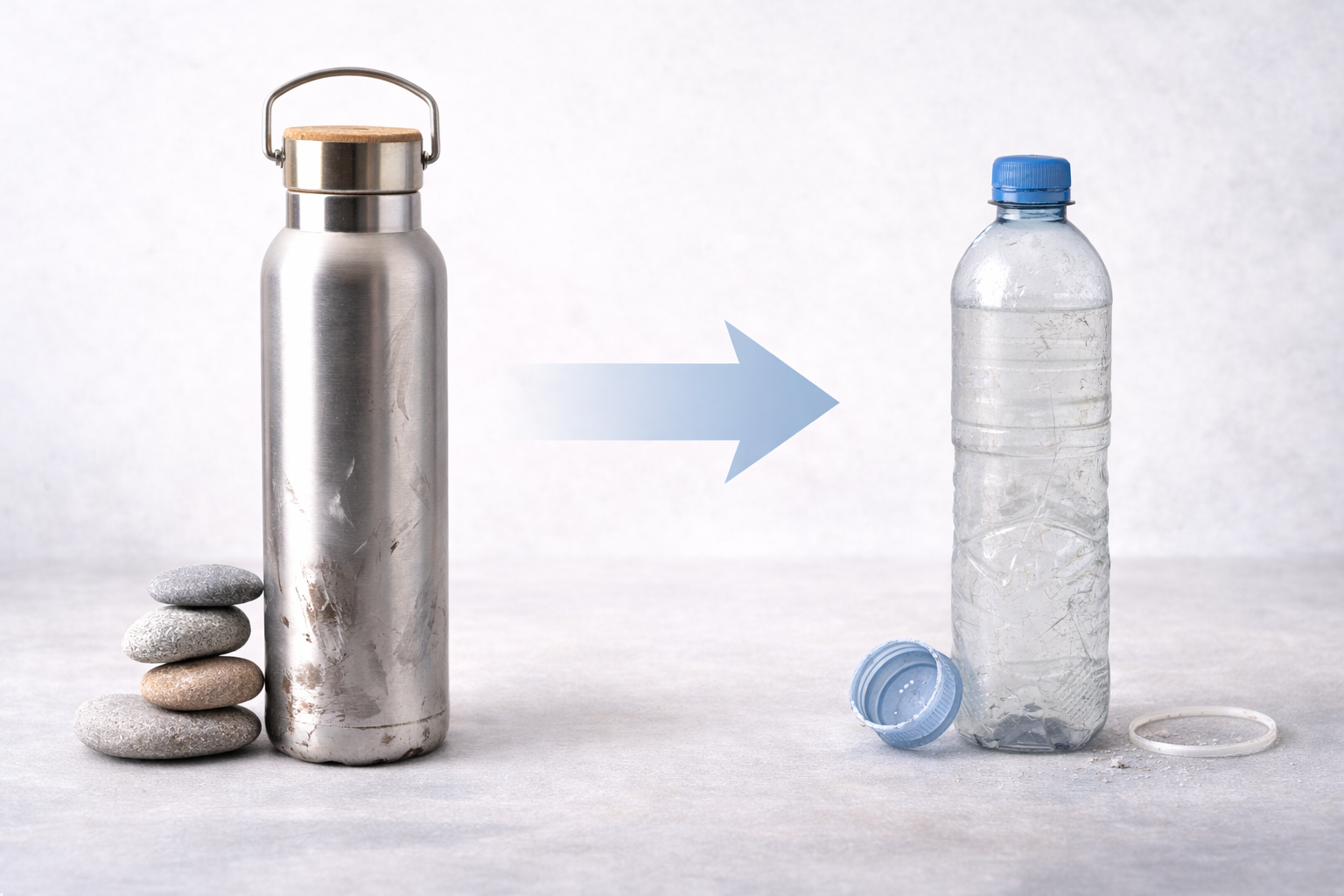
In real-world use, metal bottles tend to have longer physical lifespans. Stainless steel resists cracking and does not become brittle with age. Even after years of use, most metal bottles remain structurally intact, with dents being the most common sign of wear.
Plastic bottles may initially appear more forgiving when dropped, especially at lower heights. However, over time, repeated impacts, exposure to temperature changes, and frequent washing can lead to micro-scratches, surface dulling, and subtle shape changes. While these issues may not cause immediate failure, they often shorten the usable lifespan.
Replacement patterns reflect this difference. Metal bottles are often replaced due to cosmetic damage or changing preferences rather than functional failure. Plastic bottles, on the other hand, are more commonly replaced due to odor retention, staining, or wear-related concerns.
In terms of sheer longevity, metal bottles generally last longer before users feel compelled to replace them.
5. Safety Considerations (Use-Condition Focused, Non-Medical)
When discussing safety in the context of water bottles, it is important to focus on usage conditions rather than health claims. This includes how materials behave under heat, cold, prolonged liquid storage, and repeated cleaning.
Metal bottles are chemically stable across a wide temperature range. They do not absorb flavors or odors and are less affected by prolonged contact with liquids. This stability contributes to consistent taste and reduces the need for deep cleaning.
Plastic bottles vary depending on material type and quality. While many modern plastics are designed for repeated use, they are generally more sensitive to heat and surface wear. Over time, scratches can create areas where residues accumulate, making cleaning more difficult and affecting taste perception.
These factors do not automatically make one category “safe” and the other “unsafe.” Instead, they highlight how durability and surface integrity influence long-term usability under everyday conditions.
6. Maintenance and Wear Over Time
Maintenance plays a significant role in how long a bottle remains usable. Metal bottles are typically easier to maintain in the long term. Their non-porous surfaces resist staining, and they tolerate a wide range of cleaning methods without degrading.
Plastic bottles often require more attentive care. Scratches and clouding can develop from abrasive cleaning tools or dishwashers, particularly at high temperatures. Odor retention is another common maintenance issue, especially when bottles are used for beverages other than water.
Over time, maintenance fatigue can influence replacement decisions. Users may choose to replace a plastic bottle not because it no longer functions, but because it no longer feels clean or fresh despite regular washing.
7. Cost Analysis: Upfront Price vs Lifetime Cost
At first glance, plastic bottles usually appear more affordable. Their lower upfront price makes them attractive for casual use, short-term needs, or situations where loss is likely.
Metal bottles generally have higher initial costs due to material, manufacturing processes, and, in some cases, insulation features. However, when cost is evaluated over time, the picture changes.
A plastic bottle replaced every one to two years may ultimately cost more than a metal bottle used for five years or longer. This makes cost-per-year a more meaningful metric than purchase price alone.
For users who prioritize long-term value, metal bottles often provide better financial efficiency despite higher initial investment.
8. Environmental Impact from a Practical Perspective
Environmental discussions often focus on recyclability, but durability is equally important. A bottle that lasts longer reduces the frequency of replacement, which in turn lowers material consumption and waste generation.
Metal bottles benefit from extended lifespans and high recyclability at end of life. Plastic bottles may be recyclable depending on material type, but shorter replacement cycles can offset these benefits.
From a practical sustainability standpoint, fewer replacements often have a greater impact than the choice between materials alone. Durability, therefore, becomes a key environmental multiplier.
9. Use-Case Scenarios: Which Bottle Fits Which Lifestyle
Different lifestyles place different demands on water bottles. For daily commuting and office use, metal bottles offer durability, consistent performance, and a premium feel that aligns with long-term use.
For sports, travel, or situations where weight matters, plastic bottles remain practical. Their lighter weight and lower cost make them suitable for short-term or high-risk environments.
In family or shared settings, metal bottles often perform better over time due to ease of cleaning and resistance to odor retention. Plastic bottles may still be appropriate for children or temporary use cases where durability requirements are lower.
10. Trade-Off Summary: Strengths and Limitations of Each
Metal bottles excel in longevity, maintenance ease, and long-term cost efficiency. Their main drawbacks include higher upfront cost and greater weight.
Plastic bottles offer affordability, lightness, and flexibility but tend to require more frequent replacement and maintenance over time.
Neither option is universally superior. The optimal choice depends on usage patterns, expectations, and priorities.
11. Decision Framework: How to Choose Based on Priorities
For users who value longevity and minimal maintenance, metal bottles are often the better choice. For those prioritizing low upfront cost or lightweight convenience, plastic bottles may be sufficient.
Understanding how often a bottle will be used, how it will be cleaned, and how long it is expected to last can clarify which trade-offs are acceptable.
Rather than choosing based on labels or trends, evaluating bottles as long-term tools leads to more satisfying decisions.
12. Conclusion: Durability as a Long-Term Value Decision
The comparison between durable metal water bottles and plastic bottles is ultimately a comparison between short-term convenience and long-term value. While both materials have valid use cases, durability shapes cost efficiency, maintenance effort, and overall user experience.
By focusing on longevity, usage conditions, and realistic replacement cycles, consumers can make more intentional choices. In this context, a water bottle is not just a container—it is a daily-use product whose true value reveals itself over time.
Choosing wisely means looking beyond the surface and considering how a bottle will perform not just today, but years down the line.
Data Sources & Reference Materials
To ensure objectivity and technical accuracy, the information discussed in this article is based on publicly available material science documentation, product lifecycle research, and industry standards related to reusable drinkware. Key reference directions include:
Material durability and lifecycle
- Stainless steel material lifecycle and corrosion resistance data from materials engineering handbooks and metallurgy references.
- Polymer wear behavior, surface abrasion, and aging characteristics referenced from plastic engineering and polymer science publications.
- Comparative lifespan discussions drawn from consumer product durability studies and reusable container lifecycle analyses.
Usage and maintenance considerations
- Cleaning and maintenance recommendations referenced from manufacturer care guidelines for stainless steel and plastic drinkware.
- Surface wear, odor retention, and material aging behavior summarized from product testing reports and industrial design case studies.
Cost and replacement cycle insights
- Price range and replacement frequency estimates based on aggregated retail market observations across reusable bottle categories.
- Long-term cost-per-use concepts adapted from sustainability and consumer goods lifecycle assessment frameworks.
Environmental perspective
- General recyclability and material recovery information referenced from environmental agencies and recycling industry associations.
- Sustainability framing based on product lifespan extension rather than material claims alone.
These sources reflect industry-wide knowledge rather than brand-specific claims, and are intended to provide contextual support for material comparison, durability evaluation, and cost reasoning discussed throughout the article.