
Understanding Beverage Packaging Materials, Food-Grade Plastics, and Whether They Can Be Reused
Every day, millions of people around the world purchase beverages without giving much thought to the packaging that holds them.
Whether it's a bottle of water, a can of soda, a carton of milk, or a ready-to-drink tea, the container is often treated as a disposable item that serves a single purpose.
Yet behind every beverage package is a carefully engineered design decision.
Manufacturers must consider:
- Food safety
- Shelf life
- Transportation efficiency
- Cost
- Consumer convenience
- Environmental impact
Different drinks require different types of packaging because each material has unique strengths and limitations.
At the same time, consumers are becoming increasingly curious about topics such as:
- What plastics are food-safe?
- Why are some drinks sold in aluminum cans?
- Can plastic bottles be reused?
- Is glass safer than plastic?
- Which materials are more environmentally friendly?
Understanding beverage packaging can help us make better purchasing decisions and develop healthier long-term habits when choosing reusable drinkware.
Let's take a closer look at the materials that surround us every day.
Why Beverage Packaging Matters
Many people view packaging simply as a container.
In reality, packaging plays a critical role in protecting beverages from the moment they leave the factory until they reach consumers.
An effective beverage package must:
Protect the Product
The container prevents contamination from dust, dirt, bacteria, and other environmental factors.
Preserve Flavor
Many beverages are sensitive to oxygen, sunlight, and temperature changes.
Packaging helps maintain taste and freshness.
Extend Shelf Life
Milk, juice, tea, coffee, and soft drinks all have different shelf-life requirements.
The packaging helps keep products stable during storage and transportation.
Ensure Safety During Transportation
Billions of beverage containers are transported every year.
Packaging must survive:
- Warehouses
- Trucks
- Ships
- Retail shelves
without breaking or leaking.
Improve Convenience
Modern consumers value portability.
Lightweight, resealable, and durable packaging often improves user experience.
The Most Common Beverage Packaging Materials
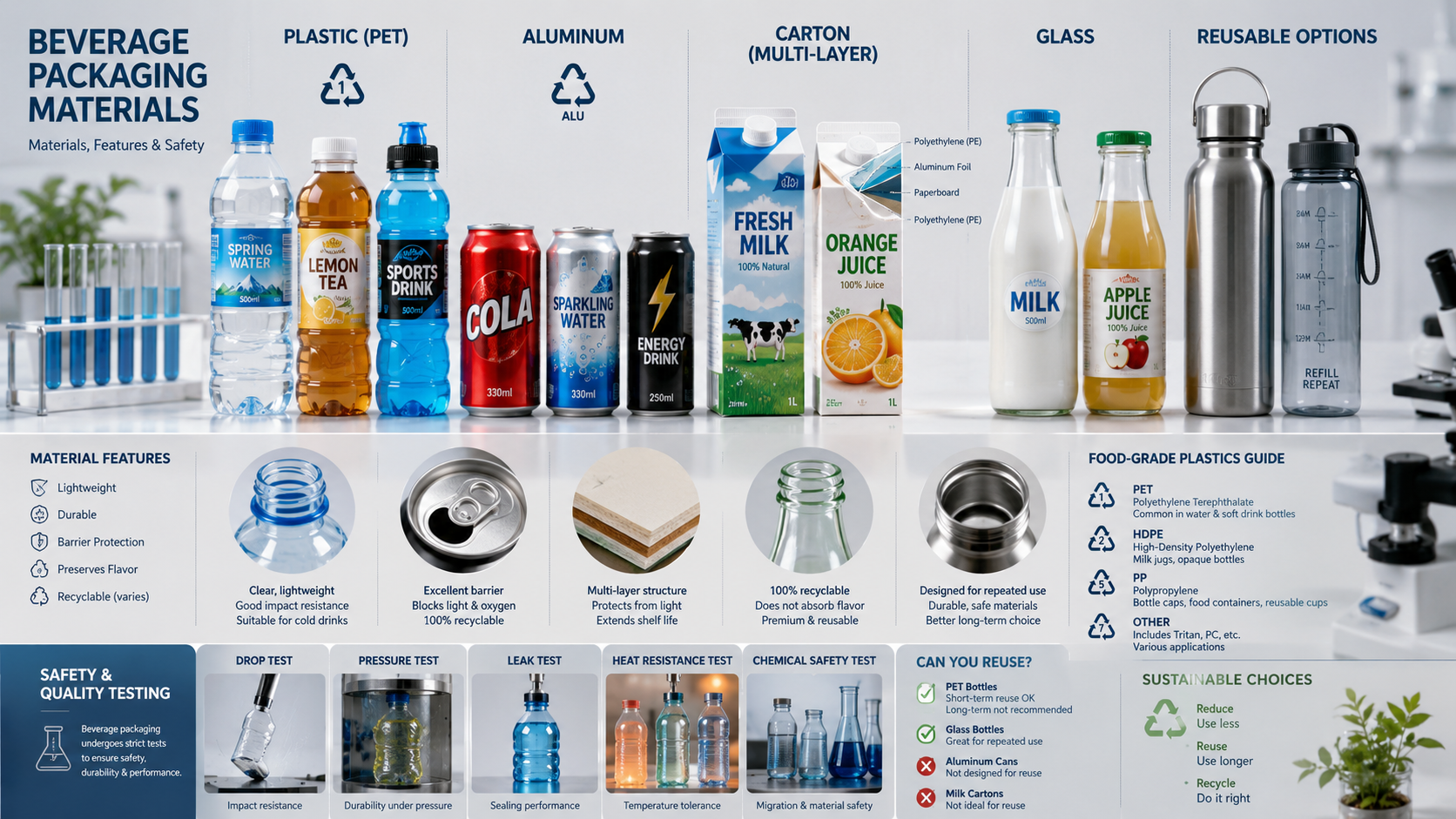
Today, most beverages are packaged using one of five primary materials:
- PET plastic
- HDPE plastic
- Aluminum
- Cartons
- Glass
Each serves a different purpose.
PET Plastic Bottles (Plastic #1)
PET stands for Polyethylene Terephthalate.
It is one of the most widely used beverage packaging materials in the world.
Common Uses
PET bottles are frequently used for:
- Bottled water
- Soft drinks
- Sports drinks
- Ready-to-drink tea
- Juice beverages
Examples include many products from major global beverage brands.
Why Manufacturers Use PET
PET offers several advantages:
Lightweight
PET bottles weigh significantly less than glass.
This reduces transportation costs.
Transparent
Consumers can easily see the contents.
Durable
PET is resistant to impact and less likely to shatter than glass.
Cost-Effective
Mass production makes PET relatively inexpensive.
Limitations of PET
Despite its advantages, PET also has limitations.
Lower Heat Resistance
PET bottles are generally designed for cold or room-temperature beverages.
Excessive heat may deform the bottle.
Wear Over Time
Repeated use can cause scratches and surface wear.
These areas may become harder to clean effectively.
HDPE Plastic Bottles (Plastic #2)
HDPE stands for High-Density Polyethylene.
This plastic is commonly used when products require greater durability and protection from light.
Common Uses
HDPE is often found in:
- Fresh milk bottles
- Dairy products
- Some juice products
Advantages
Strong and Durable
HDPE resists cracking and impact.
Better Light Protection
Unlike clear PET bottles, HDPE can help shield sensitive products from sunlight.
Chemical Resistance
It performs well under various storage conditions.
Why Milk Often Uses HDPE
Milk quality can degrade when exposed to light.
Opaque HDPE containers help reduce this risk.
Aluminum Cans
Aluminum cans are among the most recognizable beverage packages in the world.
They are commonly used for:
- Soft drinks
- Sparkling water
- Energy drinks
- Coffee beverages
- Beer
Why Aluminum Is So Popular
Excellent Light Protection
Aluminum completely blocks sunlight.
This helps preserve flavor.
Excellent Oxygen Barrier
Air exposure can affect beverage quality.
Aluminum helps prevent oxidation.
Fast Cooling
Many consumers appreciate how quickly aluminum cans become cold.
High Recyclability
Aluminum is one of the most recycled packaging materials globally.
Unlike many materials, aluminum can often be recycled repeatedly without significant quality loss.
Limitations of Aluminum Cans
Not Resealable
Once opened, most cans cannot be closed again.
Designed for Single Use
Most aluminum beverage cans are intended for one-time consumption.
Carton Packaging
Milk and juice cartons appear simple from the outside.
However, they are actually complex packaging systems.
Common Uses
Cartons are frequently used for:
- Milk
- Plant-based beverages
- Juice
- Soup products
What Are Cartons Made Of?
Many consumers assume cartons are made entirely from paper.
In reality, they usually contain multiple layers.
These layers may include:
- Paperboard
- Plastic layers
- Thin aluminum layers
Each serves a specific purpose.
Benefits
Lightweight
Cartons are easy to transport.
Good Shelf Life
The layered structure helps protect beverages.
Efficient Storage
Cartons are easy to stack and ship.
Challenges
The mixed-material construction can make recycling more complicated in some regions.
Glass Bottles
Glass has been used for beverage packaging for centuries.
Although less common than plastic today, glass remains popular for premium products.
Common Uses
Glass bottles are often used for:
- Milk
- Juice
- Tea beverages
- Premium mineral water
- Specialty drinks
Advantages
Highly Stable Material
Glass does not absorb flavors or odors.
Easy to Clean
Glass can be cleaned thoroughly and reused many times.
Premium Appearance
Many consumers associate glass with quality.
Limitations
Heavy
Glass increases transportation costs.
Fragile
Breakage remains a concern.
Understanding Food-Grade Plastics
One of the most common consumer concerns involves food-safe plastics.
Many containers display a recycling number inside a triangular symbol.
These numbers help identify the plastic type.
Plastic #1 – PET
Common Uses:
- Water bottles
- Soft drink bottles
Advantages:
- Lightweight
- Clear
- Widely recycled
Plastic #2 – HDPE
Common Uses:
- Milk containers
- Food storage applications
Advantages:
- Durable
- Good chemical resistance
Plastic #4 – LDPE
LDPE stands for Low-Density Polyethylene.
Common Uses:
- Flexible packaging
- Squeeze bottles
- Plastic bags
Plastic #5 – PP
PP stands for Polypropylene.
This is one of the most important plastics used in reusable food containers.
Common Applications
- Food storage containers
- Reusable drinkware components
- Microwave-safe containers
- Bottle caps
Advantages
Better Heat Resistance
PP generally handles higher temperatures better than PET.
Durability
It performs well during repeated use.
Wide Food Industry Adoption
Many food-contact products use PP due to its practical performance.
Plastic #7 – Other Plastics
Category #7 includes various plastics not covered by categories 1–6.
Because this category contains multiple materials, individual evaluation is often necessary.
Can You Reuse Beverage Bottles?
This is one of the most frequently discussed topics online.
The answer is:
Sometimes—but it depends on the material and intended use.
Reusing PET Bottles
Many people refill water bottles multiple times.
Short-term reuse is common.
Examples include:
- Refilling during the day
- Carrying extra water during travel
However, PET bottles were originally designed as single-use beverage packaging.
Over time:
- Scratches can develop
- Cleaning becomes more difficult
- Wear accumulates
For long-term daily use, purpose-built reusable bottles are generally a more practical option.
Reusing Glass Bottles
Glass bottles are often well-suited for repeated use.
Many households reuse them for:
- Drinking water
- Homemade beverages
- Storage purposes
Proper cleaning remains essential.
Reusing Aluminum Cans
Most aluminum cans are not designed for repeated daily use.
They can be damaged easily once opened.
For this reason, recycling is usually preferable to reuse.
Reusing Milk Cartons
Although some creative projects use cartons for crafts, long-term beverage storage is generally not recommended.
The layered interior can be difficult to clean thoroughly.
Creative Ways People Reuse Bottles at Home
Online DIY communities frequently share creative reuse ideas.
Popular examples include:
Plant Watering Bottles
Small holes can create simple watering systems.
Herb Gardens
Plastic bottles are often converted into herb planters.
Storage Containers
Some households reuse bottles for organizing small items.
Children's Craft Projects
Many schools and families use clean containers for educational activities.
DIY Garden Projects
Upcycled containers are often used in urban gardening.
When Is It Better to Use a Reusable Water Bottle?
Disposable beverage packaging and reusable drinkware serve different purposes.
Single-use packaging is designed primarily for:
- Manufacturing efficiency
- Transportation
- Retail distribution
Reusable bottles are designed for:
- Long-term daily use
- Repeated cleaning
- Durability
- Convenience
Popular Reusable Bottle Materials
Stainless Steel
Advantages:
- Durable
- Long-lasting
- Excellent insulation
Glass
Advantages:
- Pure taste
- Easy cleaning
- Reusable for many years
Tritan™
A modern BPA-free plastic often used in reusable drinkware.
Advantages:
- Lightweight
- Durable
- Clear appearance
Food-Grade Polypropylene (PP)
Frequently used in lids, caps, and drinkware components.
Sustainability: Reduce, Reuse, and Choose Wisely
Discussions about sustainability often focus on recycling.
Recycling is important.
However, sustainability involves more than recycling alone.
Many environmental experts emphasize three principles:
Reduce
Use fewer disposable products when possible.
Reuse
Extend the life of suitable products.
Recycle
Recycle materials correctly when they reach the end of their useful life.
A durable reusable bottle used for years can often reduce the need for hundreds of disposable containers.
This is one reason reusable drinkware has become increasingly popular worldwide.
Conclusion: The Packaging Around Us Tells a Bigger Story
The next time you pick up a bottle of water, a can of soda, or a carton of milk, it is worth remembering that the package itself represents decades of engineering, manufacturing, and material science.
PET bottles offer convenience and affordability.
Aluminum cans provide excellent protection and recyclability.
Glass bottles deliver durability and purity.
Cartons help preserve sensitive beverages efficiently.
Each material has strengths and limitations.
Understanding these differences helps consumers make more informed choices about:
- Food safety
- Reuse
- Sustainability
- Long-term drinkware selection
While disposable packaging remains an important part of modern life, choosing the right reusable bottle for daily hydration can be a practical step toward convenience, durability, and reduced waste.
References and Further Reading
Disclaimer
This article is intended for educational and informational purposes only. Packaging standards, recycling systems, and food-contact regulations vary by country and region. Consumers should follow local guidelines and manufacturer recommendations regarding food packaging use and recycling practices.
Industry and Research Sources
- U.S. Food and Drug Administration (FDA) – Food Contact Materials Guidance
- European Food Safety Authority (EFSA) – Food Packaging Safety Resources
- International Bottled Water Association (IBWA)
- The Aluminum Association
- Plastics Industry Association
- Tetra Pak Sustainability and Packaging Resources
- World Packaging Organisation (WPO)
- Ellen MacArthur Foundation – Circular Economy and Packaging Research
- National Geographic reporting on plastics and recycling
- Community discussions from home organization, sustainability, DIY upcycling, and consumer product forums
Community Insights Referenced
This article also incorporates commonly shared experiences from:
- Home organization communities
- DIY upcycling groups
- Sustainability forums
- Consumer discussions regarding reusable bottles and beverage packaging
These shared experiences provide practical perspectives but should not replace official guidance from manufacturers or regulatory agencies.