
Introduction: Most People Don’t Lack Options—They Lack a System
Walk into any modern shopping mall and you’ll find yourself surrounded by choices.
Rows of neatly arranged products. Dozens of variations for the same category. Subtle differences in design, material, and price. Everything looks considered, curated, and appealing.
And yet, despite having more options than ever, many people still end up buying things they rarely use.
The problem isn’t access. It’s decision-making.
Most shopping decisions are made quickly, often influenced by visual appeal, promotions, or momentary emotion. What’s missing is a structured way to evaluate whether a product will actually fit into your daily life.
Because the truth is simple:
A product only proves its value after you leave the mall—not when you’re inside it.
This article is not about what to buy. It’s about how to choose—using a practical, repeatable framework supported by real-life examples.
1. The Reality of Mall Shopping: Where Decisions Go Wrong
1.1 The Illusion of Choice
At first glance, more options should make better decisions easier.
In reality, it often does the opposite.
Consider a typical scenario: you walk into a store looking for a water bottle. You are presented with 20 different designs:
- Different sizes
- Different materials
- Different lid mechanisms
- Different price points
They all seem similar. None stand out clearly as “the best.”
Instead of clarity, you experience hesitation.
This is known as choice overload. When faced with too many similar options, people tend to:
- Delay decisions
- Default to familiar brands
- Choose based on superficial cues
In other words, more choice often leads to weaker decisions, not better ones.
1.2 Visual Bias in Retail Environments
Retail environments are carefully designed to influence perception.
Lighting, color schemes, and product placement all contribute to how a product is perceived. A matte-finish metal bottle under warm lighting may appear more premium than it actually is. Bright colors and clean packaging can create a sense of quality that doesn’t always translate into usability.
For example:
- A sleek, minimalist bottle may look sophisticated—but if the lid is hard to open, it becomes inconvenient.
- A visually striking kitchen tool may catch your attention—but if it requires extra steps to use, it adds friction.
What you see in the store is often optimized for appeal—not for daily performance.
1.3 The Impulse Buying Trap
Another common pattern is impulse buying.
You see something interesting and think:
- “This looks useful.”
- “I might need this someday.”
- “It’s on sale, so why not?”
These decisions are based on possibility, not reality.
The result is predictable:
- The product is used once or twice
- Then stored away
- Eventually forgotten
Impulse purchases rarely survive long-term use.
2. The Shift: From Shopping Emotion to Usage Logic
To make better decisions, you need to shift your mindset.
2.1 Replace “Do I Like It?” with “Will I Use It?”
This is the most important question you can ask.
Two people may buy the same product for different reasons:
- One chooses it because it looks good
- The other chooses it because it fits their routine
A week later, the difference becomes clear.
The first person stops using it. The second continues using it daily.
The product hasn’t changed. The decision logic has.
2.2 Frequency Is the Real Value Multiplier
Not all products are equally important.
Some are used occasionally. Others are used constantly.
Take these examples:
- A water bottle: used 5–10 times per day
- A storage box: used once or twice per week
- A decorative item: rarely interacted with
The more frequently a product is used, the more impact it has on your daily experience.
This means:
High-frequency products deserve better decisions.
2.3 Context Defines Value
A product is not inherently “good” or “bad.” It is only effective within a specific context.
For example:
A large insulated bottle might work perfectly at home. But during a daily commute, it may feel too heavy or inconvenient to carry.
Similarly:
A compact, lightweight bottle may be ideal for travel—but insufficient for long outdoor use.
The key insight is this:
A product’s value depends on how well it fits your real-life situation.
3. The Core Evaluation Framework (With Real Examples)
To move from guesswork to consistency, you need a clear evaluation system.
3.1 Functionality: Does It Solve a Real Problem?
Start by identifying the problem.
For example:
- “I don’t drink enough water during the day.”
- “My current bottle is inconvenient to carry.”
Now evaluate the product:
Does it directly address this issue?
A visually appealing bottle that doesn’t make drinking easier does not solve the problem. A simple, well-designed one that encourages frequent use does.
3.2 Ease of Use: The Friction Test
Ease of use determines whether a product becomes part of your routine.
Consider two bottles:
- Bottle A requires you to unscrew the lid every time
- Bottle B opens with a single press
Over time, Bottle B will be used more frequently—not because it is better in theory, but because it is easier in practice.
A useful test:
- Can you use it with one hand?
- Does it require multiple steps?
- Does it interrupt your flow?
If the answer is yes, usage will decrease.
3.3 Comfort and Ergonomics
Comfort affects consistency more than people realize.
Examples:
- A bottle that is slightly too heavy may be left at home
- A handle that feels awkward may discourage use
- A size that doesn’t fit your bag becomes inconvenient
These are small issues—but repeated daily, they matter.
3.4 Durability and Materials
Many products perform well in the first week.
The real question is: what happens after months of use?
For example:
- Low-quality plastic may retain odors
- Weak construction may lead to leaks or damage
In contrast, durable materials maintain performance over time.
A simple test:
Would you still want to use this product after a year?
3.5 Maintenance and Cleaning
A product that is difficult to clean is difficult to maintain.
For instance:
- Bottles with narrow openings may trap residue
- Complex lid structures may require extra effort to clean
Even if the product works well initially, maintenance friction reduces long-term use.
3.6 Behavioral Fit: The Most Important Factor
This is where many decisions fail.
A product must align with your natural behavior.
Examples:
- If you tend to sip water throughout the day, a straw design supports that habit
- If you prefer drinking large amounts at once, a wide-mouth design works better
The product should not force you to change your behavior. It should support it.
4. What You Should Actually Do Inside a Mall
Knowing what to look for is only half the process. The other half is applying it in real time.
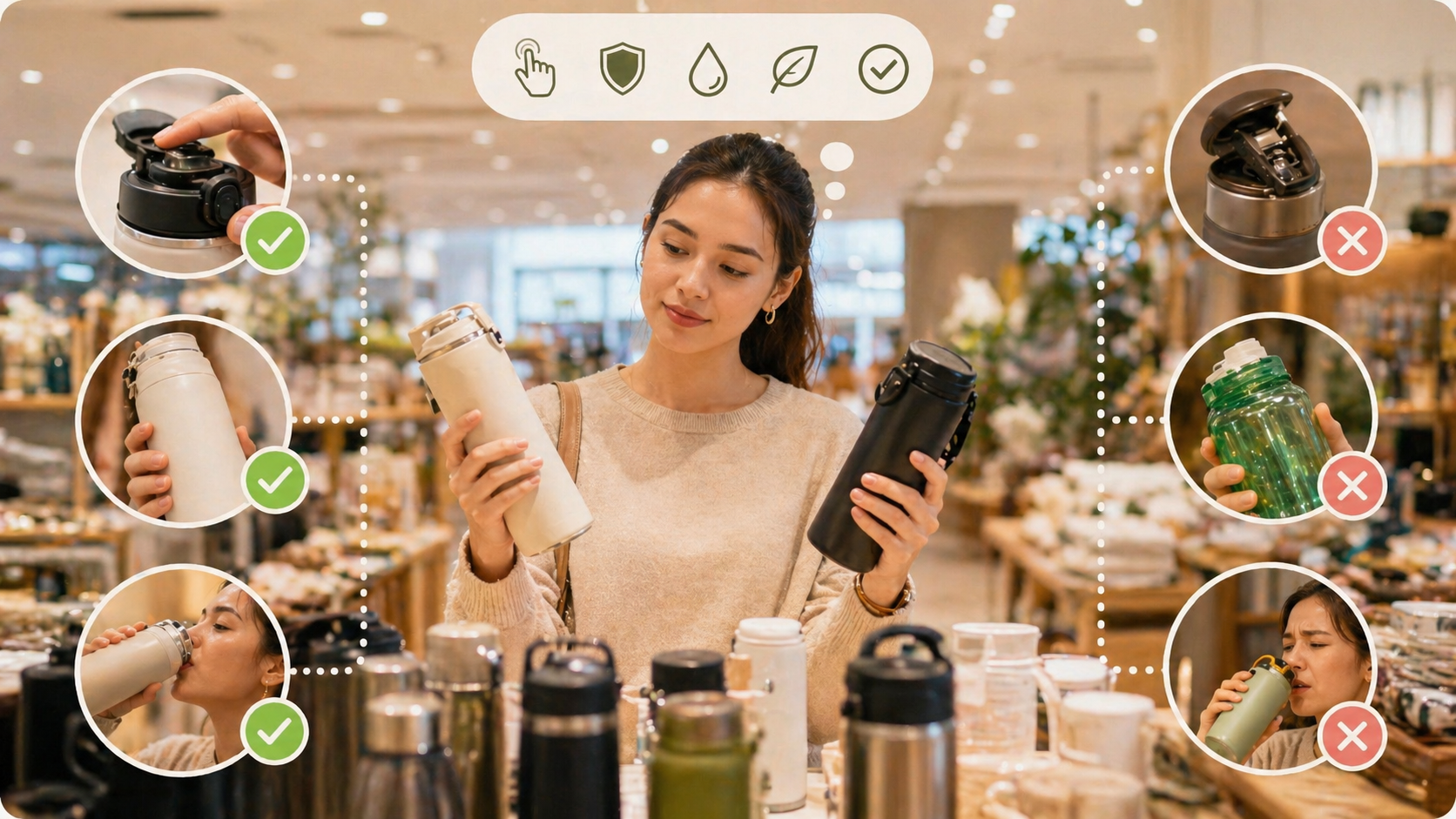
4.1 Simulate Real Use
Instead of just looking at the product, interact with it:
- Hold it
- Open it
- Imagine using it in your daily routine
This reveals practical details that are not obvious at first glance.
4.2 Compare Before Deciding
Avoid making decisions in the first store.
Compare similar products across different shops. Subtle differences become clearer when you see alternatives.
4.3 Ask Practical Questions
Focus on real usage:
- How do people typically use this?
- What problems does it solve?
- Are there common complaints?
Avoid vague questions about quality or popularity.
4.4 Use the Walk-Away Test
Step away from the store and give yourself time.
If you still feel the need to buy the product after 10–15 minutes, it is likely a better decision.
If not, it was probably impulse-driven.
5. Common Mistakes (Validated by Real Behavior)
5.1 Buying for “Future Possibilities”
“This might be useful someday.”
This is one of the most common justifications—and one of the least reliable.
If you cannot define a clear use case today, the product is unlikely to be used later.
5.2 Overvaluing Brand Names
Well-known brands can signal quality—but they do not guarantee fit.
A product from a smaller brand that matches your needs may perform better than a popular one that does not.
5.3 Choosing Aesthetic Over Practicality
A product that looks good but feels inconvenient will not last.
A product that feels natural to use will.
6. Case Study: Choosing Drinkware in a Mall
Let’s bring everything together.
You are choosing between three bottles:
- Bottle A: visually appealing, but requires twisting to open
- Bottle B: simple design, easy one-hand use
- Bottle C: low cost, but basic material
Using the framework:
- Functionality → B meets the need
- Ease of use → B is easiest
- Durability → B is more reliable
- Behavioral fit → B supports frequent use
The conclusion is clear:
The best product is not the most attractive or the cheapest—it is the one you will actually use.
7. Shopping for Families: A Different Decision Logic
When shopping for a household, priorities shift.
7.1 Shared Usage
Products should be easy for multiple people to use.
Complex designs create confusion.
7.2 Durability Becomes Critical
Higher usage leads to faster wear.
Stronger materials reduce replacement frequency.
7.3 Practicality Over Appearance
Ease of cleaning, storage, and safety become more important than aesthetics.
8. The Economics of Better Choices
8.1 Cost Per Use
A product used daily spreads its cost over time.
Even a higher upfront price becomes minimal when divided by frequent use.
8.2 Avoiding Replacement Cycles
Low-quality products often lead to repeated purchases.
This increases both cost and inconvenience.
8.3 Buying Less, But Better
Fewer, better products create more value than many average ones.
9. Turning Shopping Into a System
9.1 Plan Before You Go
Identify what you need.
Avoid browsing without purpose.
9.2 Use a Simple Checklist
- Will I use this often?
- Is it easy to use?
- Is it comfortable?
- Is it durable?
- Does it fit my routine?
9.3 Build Personal Standards
Over time, your decision-making becomes faster and more consistent.
10. The Bigger Insight: Better Choices Build Better Routines
Every product you choose affects how you behave.
- Easier tools → more frequent use
- Better fit → stronger habits
Over time, these small decisions shape your daily life.
Conclusion: Better Shopping Is a Repeatable Skill
Choosing better products is not about luck.
It is about having a system.
When you evaluate based on real use—rather than appearance or impulse—you make decisions that last.
The best products are not the ones that stand out in a store, but the ones that quietly become part of your everyday life.