
Why It Happens, How to Remove It, and How to Keep Your Bottle Fresh for Years
Part 1 — Understanding Coffee Odors and Why They Stay Behind
Introduction: Why Does Your Water Bottle Still Smell Like Coffee?
You finish your morning coffee, rinse your bottle before heading to work, and refill it with water later in the day.
Everything looks clean.
The bottle has been washed.
The lid has been rinsed.
Yet when you take the first sip of water, there's still a familiar coffee aroma.
For many reusable bottle owners, this is a surprisingly common experience.
Whether it's an insulated tumbler, a stainless steel bottle, or a travel mug, coffee seems to leave behind a scent that refuses to disappear completely.
Some people assume the bottle hasn't been cleaned properly.
Others think the material itself has permanently absorbed the smell.
The truth is more interesting—and much more manageable.
In most cases, what lingers inside your bottle isn't simply "coffee smell." Instead, it is a combination of coffee oils, aromatic compounds, and microscopic residue that remain attached to the bottle's interior surfaces and hidden components such as silicone seals, lids, and drinking spouts.
Understanding why this happens is the first step toward solving the problem.
Once you know where coffee odors come from, removing them becomes much easier—and preventing them from returning becomes even easier.
Coffee Leaves Behind More Than Just a Smell
Coffee is one of the world's most chemically complex beverages.
Scientists have identified hundreds of naturally occurring compounds that contribute to its flavor and aroma. During brewing, these compounds dissolve into water while natural oils are released from roasted coffee beans.
Every time you drink coffee from a reusable bottle, tiny amounts of these substances remain behind.
Unlike plain water, coffee contains:
- Natural coffee oils
- Aromatic volatile compounds
- Organic acids
- Fine coffee particles
- Proteins and carbohydrates
- Minerals from brewing water
Most of these compounds are completely harmless.
However, they interact differently with bottle materials than water does.
Water evaporates cleanly.
Coffee does not.
Instead, microscopic layers gradually remain on interior surfaces after every use.
Even after rinsing, a thin film can continue to coat the bottle.
Over time, this invisible layer becomes the primary reason bottles continue smelling like coffee.
Coffee Oils: The Real Cause of Lingering Odors
Many people believe coffee odors come from the liquid itself.
In reality, the biggest contributor is often coffee oil.
Roasted coffee beans naturally contain oils that carry much of coffee's distinctive aroma.
During brewing, these oils mix into the drink and eventually coat the inside of your bottle.
Unlike water, oil does not rinse away easily.
Even hot water alone struggles to remove it completely.
Instead, these oils slowly cling to:
- Stainless steel walls
- Plastic interiors
- Silicone seals
- Lid threads
- Drinking spouts
- Straw components
Once attached, the oils continue releasing aromatic compounds long after the coffee itself has been emptied.
This is why a bottle may smell like coffee even when it appears perfectly clean.
The odor is often a sign that microscopic oils remain rather than visible dirt.
Aromatic Compounds Continue Working After You Finish Drinking
Coffee's rich aroma is one of the reasons millions of people enjoy it every morning.
That pleasant smell comes from volatile aromatic compounds released during roasting and brewing.
These compounds are designed by nature to evaporate gradually.
Unfortunately, they do exactly the same thing inside reusable bottles.
Small amounts become trapped within textured surfaces, narrow lid channels, silicone gaskets, and tiny air vents.
As you open the bottle later, these compounds continue evaporating into the air.
The result is a familiar coffee scent—even after repeated rinsing.
In other words, your bottle isn't necessarily dirty.
It's simply holding onto compounds specifically created to be aromatic.
Why Rinsing with Water Usually Isn't Enough
Many people finish their coffee, give the bottle a quick rinse under the tap, and consider the job done.
For plain water bottles, that habit may be adequate for a short period.
Coffee is different.
Water removes loose liquid.
It removes crumbs.
It removes visible residue.
What it does not remove effectively is oil.
Anyone who has washed a frying pan knows this principle well.
Oil and water naturally resist mixing.
Without soap or another cleaning agent that breaks down oils, much of the coffee residue remains attached to the bottle.
This explains why bottles that receive only quick rinses often develop stronger odors over time.
Each new cup of coffee adds another microscopic layer.
Eventually those layers become noticeable through smell and taste.
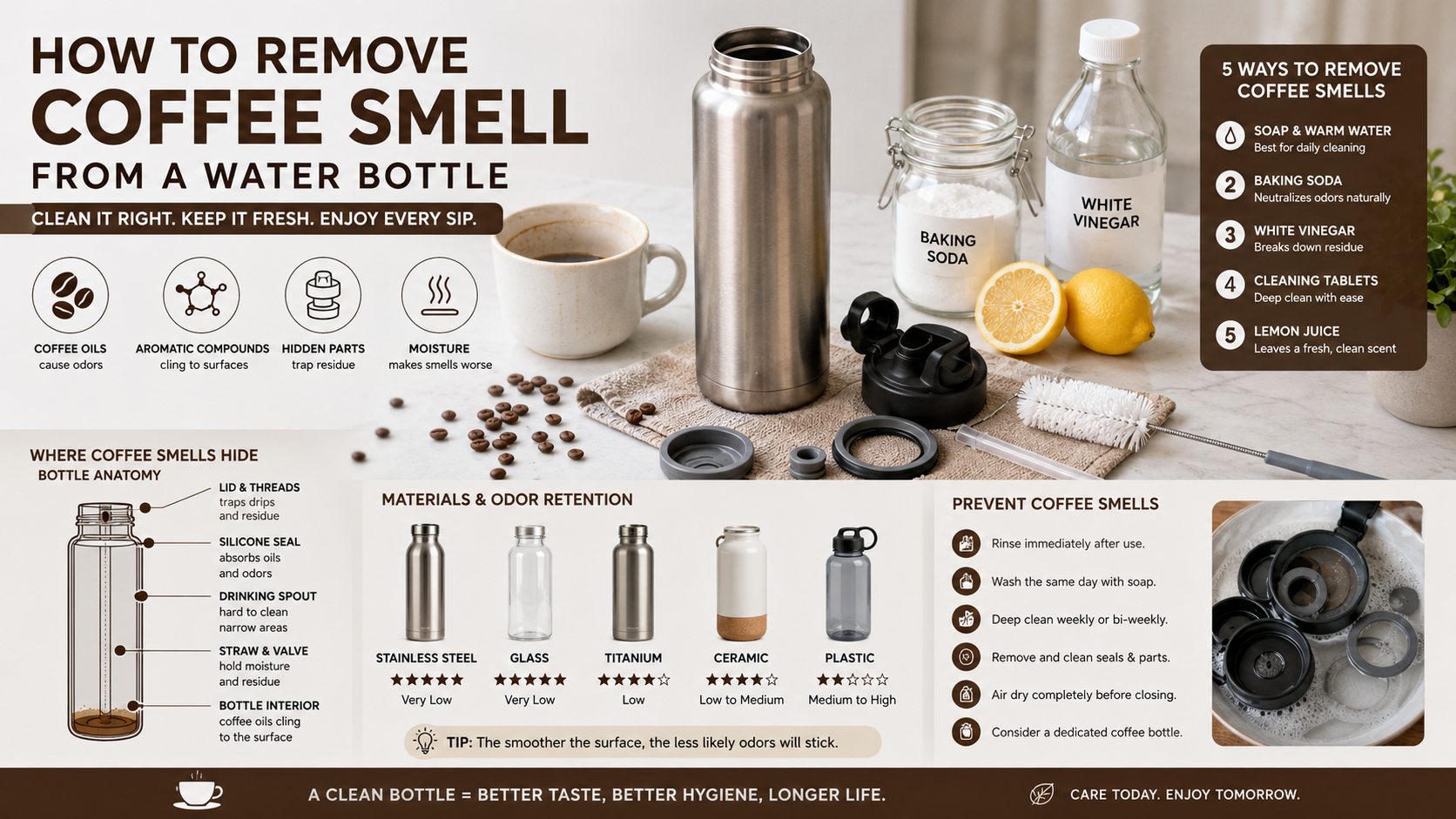
Where Coffee Smells Actually Hide
Many people focus entirely on the inside of the bottle.
Ironically, that is often not the source of the strongest odor.
Modern reusable bottles include several hidden areas where coffee residue quietly accumulates.
Understanding these locations helps explain why some bottles continue smelling despite regular washing.
Silicone Seals
Soft silicone gaskets create watertight seals.
Their slightly textured surface can hold tiny amounts of coffee oil.
Because these seals sit inside narrow grooves, they are easy to overlook during routine cleaning.
Bottle Lids
Lids contain multiple surfaces:
- Hinges
- Drinking openings
- Vent holes
- Threads
- Locking mechanisms
Each creates small spaces where residue may remain after rinsing.
Drinking Spouts
Flip-top lids and straw bottles contain narrow drinking channels.
These passages receive direct contact with coffee every time you drink.
Because brushes rarely reach them during everyday washing, residue may slowly accumulate.
Straw Systems
Reusable straws often have the smallest internal diameter of any bottle component.
Coffee travels through these narrow tubes repeatedly.
Without dedicated straw brushes, cleaning may be incomplete.
Bottle Threads
Every time the lid is screwed on, tiny amounts of liquid may collect around the threaded neck.
These areas dry slowly and deserve occasional attention during deeper cleaning.
Do Different Bottle Materials Hold Coffee Smells Differently?
The answer is yes—but perhaps not in the way many people expect.
Material affects odor retention, cleaning difficulty, and long-term maintenance.
However, proper cleaning habits often matter even more than the material itself.
Stainless Steel
High-quality stainless steel remains one of the best materials for coffee drinkers.
Its smooth, non-porous surface resists flavor absorption and is relatively easy to clean.
Most lingering coffee odors associated with stainless steel bottles actually originate from lids or silicone seals rather than the steel itself.
Plastic
Plastic bottles are lightweight and affordable but generally retain odors more easily than stainless steel or glass.
Tiny surface imperfections can gradually trap coffee oils, especially after months of heavy use.
This doesn't mean plastic bottles are poor choices—it simply means they benefit from more frequent deep cleaning.
Glass
Glass offers perhaps the purest drinking experience.
Its smooth surface rarely absorbs flavors or aromas.
Coffee smells usually disappear quickly after proper washing.
The trade-off is durability, making glass better suited to home or office environments than rugged outdoor use.
Ceramic
Ceramic-lined travel mugs combine excellent flavor preservation with attractive aesthetics.
As long as the ceramic coating remains intact, odor retention is generally minimal.
Titanium
Titanium performs similarly to stainless steel in resisting odor retention while offering exceptional durability and low weight.
It is particularly popular among outdoor enthusiasts and travelers seeking premium performance.
Should You Use the Same Bottle for Coffee and Water?
This question has become increasingly common as reusable bottles become everyday essentials.
Technically, there is nothing wrong with using one bottle for multiple beverages.
Many people do exactly that.
However, there are trade-offs.
If your bottle regularly carries coffee in the morning and water throughout the afternoon, even small amounts of remaining coffee oil may influence the taste of later drinks.
For users who are particularly sensitive to flavor, maintaining separate bottles—one dedicated to coffee and another to water—can provide a consistently fresher drinking experience.
Others may find that regular cleaning allows a single high-quality bottle to serve both purposes perfectly well.
Ultimately, the decision depends on personal preference, cleaning habits, and how frequently the bottle changes beverages.
Coffee Odors Are Preventable
Perhaps the most reassuring fact is that persistent coffee smells are rarely permanent.
Most are caused by residue rather than damage.
With appropriate cleaning methods, attention to hidden components, and consistent maintenance, even bottles used daily for coffee can remain fresh for years.
In Part 2, we'll explore the most effective cleaning techniques—including baking soda, vinegar, bottle-cleaning tablets, and specialized brushes—compare which methods work best for different materials, explain when it's time to replace silicone seals, and share simple habits that prevent coffee odors from returning in the first place.
Part 2 — Effective Cleaning Methods, Long-Term Prevention, and Choosing the Right Bottle
Five Safe and Effective Ways to Remove Coffee Smells
Once you understand that lingering coffee odors are usually caused by oils and aromatic compounds—not simply leftover liquid—choosing the right cleaning method becomes much easier.
Fortunately, most reusable bottles can be restored using simple household ingredients or purpose-made cleaning products. The key is selecting a method that removes residue without damaging the bottle's materials.
Method 1: Warm Water and Mild Dish Soap
The simplest solution is still the one most people should use most often.
A quality dish soap is specifically designed to break down oils, making it highly effective against the coffee oils that remain inside reusable bottles.
For routine cleaning:
- Empty the bottle completely.
- Fill it with warm (not boiling) water.
- Add a few drops of mild dish soap.
- Use a bottle brush to scrub the interior walls.
- Clean the lid, drinking spout, and threads separately.
- Rinse thoroughly with clean water.
- Allow every component to air dry before reassembly.
For bottles used daily, this routine alone is often enough to prevent long-term odor buildup.
Method 2: Baking Soda for Stubborn Odors
If a bottle already has a noticeable coffee smell, baking soda is one of the safest and most effective household cleaners.
Because it is mildly alkaline, baking soda helps neutralize odors while gently loosening residue from interior surfaces.
A simple deep-cleaning method is to:
- Add one or two teaspoons of baking soda to the bottle.
- Fill with warm water.
- Shake gently.
- Let the solution sit for several hours or overnight.
- Scrub with a bottle brush before rinsing thoroughly.
Baking soda is particularly useful for bottles that have been used for coffee over many months.
Method 3: White Vinegar for Deep Cleaning
White vinegar is especially effective when coffee residue combines with mineral deposits from hard water.
Its mild acidity helps dissolve buildup that ordinary soap may not remove completely.
Mix equal parts warm water and white vinegar, fill the bottle, and allow it to soak for several hours.
Afterward, wash the bottle again with mild soap to remove any remaining vinegar smell.
Because vinegar is acidic, it should not become an everyday cleaning solution. Occasional deep cleaning is generally sufficient.
Method 4: Bottle Cleaning Tablets
Dedicated bottle-cleaning tablets have become increasingly popular among travelers, commuters, and outdoor enthusiasts.
These tablets are designed to dissolve residue inside reusable bottles while reaching areas that are difficult to scrub manually.
They can be especially helpful for:
- Narrow-mouth bottles
- Travel tumblers
- Coffee thermoses
- Bottles with complex lid systems
Although they do not replace regular washing, they offer a convenient option for periodic maintenance.
Method 5: Lemon Juice for a Fresh Finish
Fresh lemon juice is often recommended as a natural deodorizer.
Its mild acidity can help reduce light coffee odors while leaving a clean citrus scent.
Lemon juice works best as a finishing treatment after the bottle has already been washed thoroughly with soap.
It is not intended to replace regular cleaning but can provide an extra level of freshness.
The Most Overlooked Part of Cleaning: The Lid
If you've washed the bottle repeatedly but the coffee smell remains, the problem is probably not inside the bottle itself.
It is inside the lid.
Modern reusable bottles often have surprisingly complex lid designs, including:
- Silicone gaskets
- Air vents
- Flip-top mechanisms
- Drinking valves
- Locking buttons
- Threaded channels
Each of these components creates tiny spaces where coffee oils can collect.
Even if the bottle body is spotless, a neglected lid can continue releasing coffee aromas every time you open it.
Whenever possible, remove all detachable components and clean them individually using a small brush or soft cloth.
Many users discover that cleaning the lid thoroughly eliminates odors almost immediately.
Don't Forget Silicone Seals
Silicone sealing rings deserve special attention.
Because silicone is flexible and slightly textured, it can retain tiny amounts of coffee oil far more easily than polished stainless steel.
Fortunately, this does not mean the seal has permanently absorbed the smell.
Instead:
- Remove the gasket carefully.
- Wash it with warm water and mild soap.
- For stronger odors, soak it briefly in a baking soda solution.
- Allow it to dry completely before reinstalling.
This simple habit often prevents the most common source of lingering coffee odors.
When Should You Replace the Seal?
Even with excellent maintenance, silicone seals are wear items.
Over time they may:
- Lose flexibility.
- Become permanently stained.
- Develop small cracks.
- Hold persistent odors despite repeated cleaning.
Rather than replacing the entire bottle, many manufacturers offer replacement sealing rings.
Replacing a worn gasket is inexpensive and can significantly improve both freshness and leak resistance.
How to Prevent Coffee Smells from Coming Back
Removing coffee odor is only half the solution.
Preventing it from returning requires a few simple habits.
Empty the Bottle Soon After Finishing
The longer coffee remains inside, the more opportunity oils have to settle onto interior surfaces.
Whenever practical, empty the bottle once you've finished drinking.
Rinse Immediately
Even if you cannot wash the bottle right away, a quick rinse removes much of the remaining liquid before residue dries.
This small habit makes later cleaning much easier.
Wash the Same Day
Try not to leave coffee inside overnight.
Fresh residue is always easier to remove than dried residue.
Dry Every Component Completely
Moisture trapped inside lids or beneath silicone seals can encourage lingering odors.
After washing, allow the bottle and every removable component to air dry separately before reassembly.
Deep Clean Regularly
Daily washing handles routine maintenance.
Monthly deep cleaning helps remove residue before it becomes noticeable.
For heavy coffee drinkers, cleaning every two to three weeks may be worthwhile.
One Bottle or Two?
Many people wonder whether they should dedicate one bottle to coffee and another to water.
There is no universal answer, but there are practical considerations.
Using One Bottle
Advantages:
-
Less to carry
-
Fewer bottles to purchase
-
Simpler daily routine
Challenges:
-
Water may occasionally carry a faint coffee aroma.
-
More frequent cleaning becomes important.
Using Separate Bottles
Advantages:
-
Water always tastes neutral.
-
Less flavor transfer.
-
Easier long-term maintenance.
Challenges:
-
Additional cost.
-
More items to clean and carry.
For people who drink coffee throughout the day, a dedicated coffee tumbler paired with a separate water bottle often provides the best overall experience.
For casual coffee drinkers, one well-maintained bottle may be perfectly adequate.
Choosing a Bottle That Is Easier to Keep Fresh
Some bottle designs naturally simplify cleaning and maintenance.
When selecting reusable drinkware for coffee, look for features such as:
- Food-grade stainless steel interior
- Wide-mouth opening for easier brushing
- Removable silicone seals
- Simple lid construction
- Smooth interior surfaces
- Minimal hidden crevices
- Replacement parts availability
- Durable powder-coated exterior for everyday use
These design choices do not eliminate cleaning, but they make regular maintenance faster and more effective.
Common Mistakes That Make Coffee Odors Worse
Many persistent odor problems are caused not by the bottle itself, but by everyday habits.
Avoid these common mistakes:
- Only rinsing with water after drinking coffee.
- Forgetting to clean the lid.
- Never removing silicone gaskets.
- Leaving coffee inside overnight.
- Storing the bottle while still damp.
- Ignoring stains for months before deep cleaning.
- Assuming stainless steel permanently absorbs odors.
- Using abrasive metal scrubbers that scratch interior surfaces.
Small improvements in routine often produce dramatic improvements in cleanliness.
Coffee Smell Doesn't Always Mean It's Time for a New Bottle
One of the biggest misconceptions about reusable drinkware is that persistent coffee odor means the bottle has reached the end of its life.
In reality, most high-quality bottles are designed to last for many years.
In many cases, replacing a worn silicone seal, performing a thorough deep cleaning, or adjusting daily maintenance habits restores the bottle to excellent condition.
Unless the bottle has structural damage such as cracks, severe corrosion, or insulation failure, lingering coffee odors are usually a maintenance issue rather than a product failure.
Conclusion: Fresh Bottles Make Every Drink Better
Coffee is one of life's great daily pleasures. Its rich aroma, complex flavors, and comforting warmth are exactly what make it enjoyable.
Ironically, those same qualities are also why coffee can leave a lasting impression inside reusable bottles.
Fortunately, persistent coffee smells are rarely permanent.
With regular washing, occasional deep cleaning, careful attention to lids and silicone seals, and a few simple daily habits, it is entirely possible to enjoy coffee in the morning and fresh-tasting water later in the day.
More importantly, maintaining your bottle protects more than just its appearance. It preserves flavor, improves hygiene, extends product lifespan, and supports a more sustainable lifestyle by reducing unnecessary replacements.
A well-designed reusable bottle is built to accompany you through countless cups of coffee, long commutes, outdoor adventures, and everyday routines. With consistent care, it can continue delivering fresh, enjoyable drinks for many years—proving that the secret to a great bottle is not simply how it's made, but how well it's maintained.