
Understanding the Different “Fingerprints” Your Favorite Drinks Leave Behind
Part 1 — Why Coffee and Tea Leave Different Residue
Introduction: Your Bottle Remembers Every Drink
Reusable water bottles have become part of modern daily life. They travel with us to work, accompany us on long commutes, sit beside us during meetings, and come along on weekend adventures. Many people use the same bottle throughout the day, switching from morning coffee to afternoon tea and eventually plain water.
At first glance, everything seems perfectly clean.
A quick rinse.
A refill with water.
Another sip.
Yet something feels different.
Sometimes the water carries a faint coffee aroma.
Sometimes the inside of the bottle slowly develops a brown tint.
Sometimes there is no visible stain at all, but the flavor of the next drink isn't quite as fresh as expected.
These experiences lead to a surprisingly common question:
Which drink leaves more residue inside a reusable bottle—coffee or tea?
The answer isn't as simple as choosing one winner.
Coffee and tea leave behind very different kinds of residue. They create different cleaning challenges, interact differently with bottle materials, and even affect taste and odor in unique ways.
Rather than asking which beverage is "dirtier," it is more useful to understand the different fingerprints each one leaves behind.
Coffee is primarily an oil and aroma challenge.
Tea is largely a tannin and stain challenge.
Once you understand this difference, choosing the right bottle, cleaning method, and maintenance routine becomes much easier.
What Does "Residue" Actually Mean?
When people notice stains inside a bottle, they often assume residue simply means visible dirt.
In reality, residue is much broader than what we can see.
After every drink, microscopic substances remain attached to the bottle's interior. Some are visible, while others can only be detected through smell or taste.
Common types of beverage residue include:
- Natural oils
- Plant pigments
- Polyphenols
- Tannins
- Organic acids
- Aromatic compounds
- Minerals
- Tiny food particles
- Sugars (in flavored drinks)
- Proteins (in milk-based beverages)
Not all residue causes problems.
Some disappears easily with normal washing.
Others gradually accumulate over weeks or months, eventually affecting the appearance, smell, or taste of your bottle.
The type of residue depends largely on what you drink.
And this is where coffee and tea begin to differ.
Coffee: An Oil-Rich Beverage That Loves to Leave Aroma Behind
Coffee appears simple—a dark liquid brewed from roasted beans.
Chemically, however, it is one of the most complex beverages people consume every day.
Researchers have identified hundreds of compounds responsible for coffee's flavor and aroma.
Among the most important are its natural oils.
These oils are released during roasting and extraction, carrying many of the rich aromas people associate with freshly brewed coffee.
Every time coffee passes through a reusable bottle, microscopic amounts of these oils remain behind.
Unlike water, oils do not rinse away easily.
Instead, they gradually cling to smooth surfaces, especially around bottle walls, drinking spouts, silicone gaskets, and lid threads.
This is why coffee drinkers often notice lingering aromas long after the bottle has been emptied.
The smell doesn't necessarily indicate poor hygiene.
More often, it reflects the remarkable ability of coffee oils to remain attached to surfaces.
Tea: A Drink That Leaves Color More Than Smell
Tea behaves very differently.
Although tea also contains hundreds of naturally occurring compounds, its most noticeable characteristic is not oil.
It is tannin.
Tannins are naturally occurring polyphenols found in tea leaves.
These compounds contribute to tea's flavor, body, and slight bitterness.
They are also responsible for the gradual brown discoloration many tea drinkers notice inside cups, teapots, and reusable bottles.
Unlike coffee oils, tannins are less likely to create strong lingering aromas.
Instead, they slowly bond with surfaces, producing visible stains over time.
This explains why a bottle used exclusively for tea may look darker inside while still smelling relatively fresh.
Coffee often affects your nose.
Tea usually affects your eyes.
Coffee Oils vs. Tea Tannins: Two Very Different Challenges
Although both beverages can leave residue, they do so in fundamentally different ways.
Imagine two artists signing their work.
Each leaves a signature.
Neither signature looks the same.
Coffee signs your bottle with invisible oils and persistent aromas.
Tea signs it with pigments and gradual discoloration.
This distinction matters because cleaning methods that work well for one beverage are not always equally effective for the other.
A bottle that smells like coffee may need oil-removing cleaners.
A bottle stained by tea may require treatments that dissolve tannins rather than grease.
Understanding this difference helps explain why some bottles continue smelling fresh but look stained, while others appear spotless yet still carry yesterday's coffee aroma.
Which Parts of Your Bottle Collect the Most Residue?
Many people assume the inside wall of the bottle is the primary problem.
Surprisingly, the hidden components often collect much more residue.
Silicone Seals
Flexible silicone gaskets are excellent at preventing leaks, but they also trap tiny amounts of coffee oil around their edges.
Because they remain slightly porous compared to polished stainless steel, they may hold aromas longer if not cleaned regularly.
Bottle Lids
Modern lids contain multiple surfaces where residue can hide:
- Hinges
- Air vents
- Drinking ports
- Threads
- Locking mechanisms
Both coffee oils and tea particles may settle in these hard-to-reach areas.
Drinking Spouts
Every sip passes directly through the drinking spout.
Narrow openings receive constant contact with beverages yet often receive only minimal cleaning.
Straw Systems
Reusable straws are convenient but challenging to clean thoroughly without dedicated brushes.
Coffee oils can coat the interior walls, while tea particles may slowly accumulate in corners and bends.
Threaded Bottle Necks
The threads connecting the bottle and lid frequently trap tiny amounts of liquid during pouring and drinking.
Because these areas dry more slowly, they deserve regular attention during cleaning.
Does Brewing Style Make a Difference?
The type of beverage matters just as much as the beverage itself.
Not every coffee leaves the same residue.
Not every tea stains equally.
Dark Roast Coffee
Dark roasts generally contain richer roasted aromas and can leave stronger lingering scents inside bottles.
Espresso-Based Drinks
Highly concentrated coffee may produce more noticeable aroma transfer, especially when consumed frequently.
Cold Brew
Cold brew often tastes smoother but still contains coffee oils capable of adhering to bottle surfaces.
Its lower acidity does not necessarily mean less residue.
Black Tea
Among common teas, black tea typically contains higher levels of tannins, making it one of the most likely to stain bottles over time.
Green Tea
Green tea generally leaves lighter stains and milder aromas, although long-term use can still produce visible discoloration.
Herbal Tea
Herbal infusions vary widely.
Fruit-based blends may contain natural pigments that behave differently from traditional tea leaves, while floral infusions often leave relatively little visible residue.
How Bottle Materials Influence Residue
The beverage is only half the story.
The material of the bottle also plays an important role.
Stainless Steel
Food-grade stainless steel remains one of the most balanced choices.
Its smooth, non-porous surface resists flavor absorption and is relatively easy to clean.
Most lingering odors actually originate from the lid rather than the steel itself.
Glass
Glass offers exceptional flavor neutrality.
Neither coffee oils nor tea tannins bond strongly to its smooth surface, making it one of the easiest materials to maintain.
Plastic
Plastic bottles are lightweight and practical but are generally more susceptible to retaining aromas over time.
Microscopic surface wear may allow coffee oils to cling more easily after prolonged use.
Ceramic-Lined Bottles
Ceramic interiors provide excellent flavor preservation while reducing odor retention.
As long as the coating remains intact, they perform well for both coffee and tea.
Titanium
Titanium combines durability with excellent corrosion resistance.
Like stainless steel, it resists flavor transfer effectively and remains popular among outdoor enthusiasts seeking lightweight drinkware.
The First Lesson: Coffee and Tea Leave Different Fingerprints
After comparing the chemistry behind both beverages, one conclusion becomes clear.
Coffee and tea do not compete to see which one is "worse."
They simply leave different fingerprints.
Coffee's fingerprint is largely invisible—an oily layer carrying rich aromas that can linger inside lids, seals, and drinking spouts.
Tea's fingerprint is easier to see—a gradual buildup of tannins that slowly stains interior surfaces while often producing very little odor.
Recognizing these differences changes the way we care for reusable bottles.
Instead of treating every stain or smell the same, we can choose cleaning methods based on the type of residue we are actually trying to remove.
In Part 2, we'll compare coffee and tea side by side, examine which beverage is harder to clean from different bottle materials, explore the most effective cleaning techniques for each type of residue, and share practical maintenance habits that keep every drink tasting as fresh as the first sip.
Part 2 — Cleaning Strategies, Material Comparisons, and Keeping Every Sip Fresh
Coffee vs. Tea: A Side-by-Side Comparison
Now that we've explored the science behind coffee oils and tea tannins, it's time to compare how these two beverages behave inside a reusable bottle.
While neither drink is inherently "harder" to clean, they create different maintenance challenges.
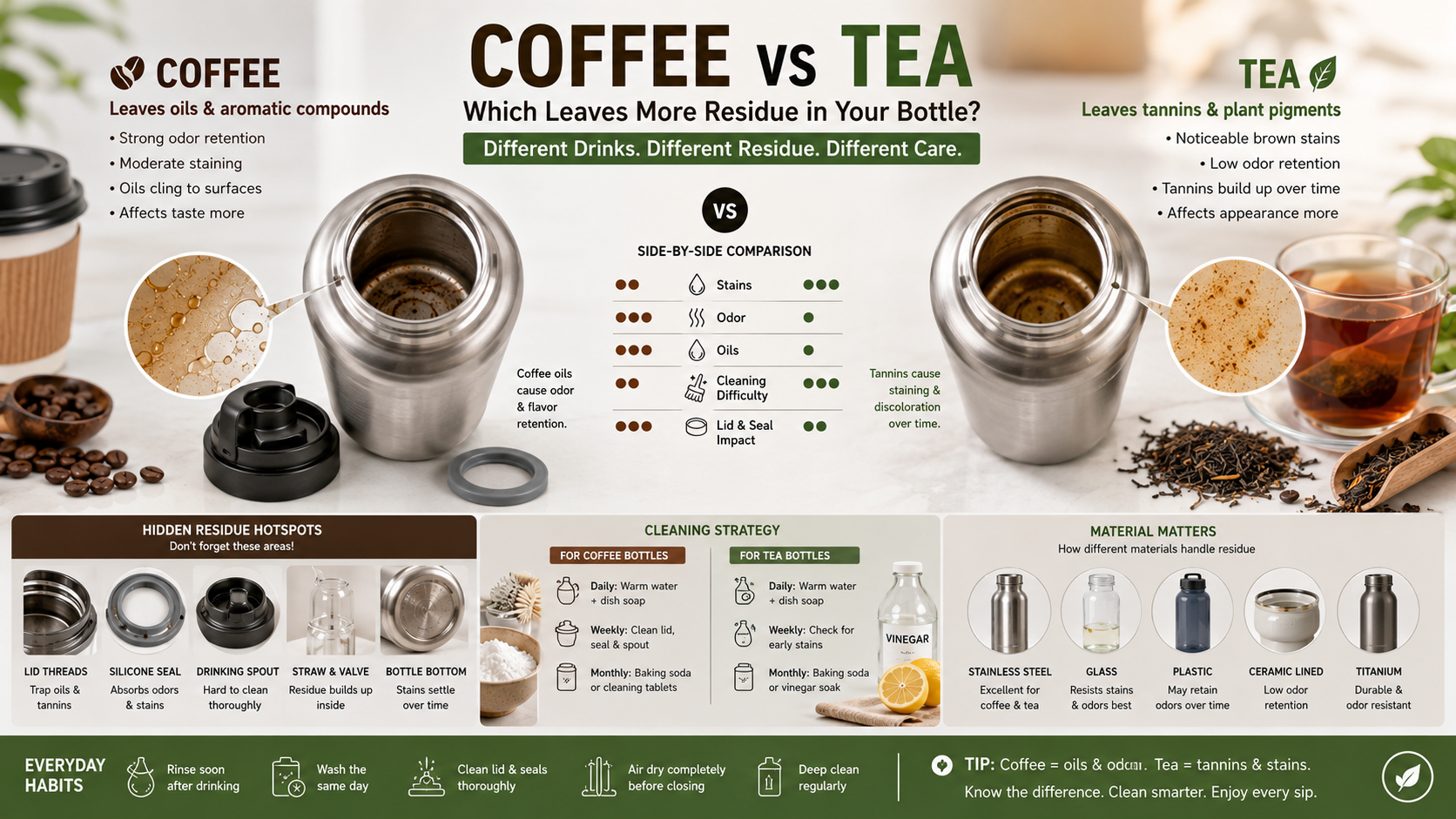
| Factor | Coffee | Tea |
|---|---|---|
| Primary Residue | Natural oils & aromatic compounds | Tannins & plant pigments |
| Most Noticeable Effect | Lingering smell | Brown staining |
| Odor Retention | High | Low to Moderate |
| Visible Staining | Moderate | High |
| Best Daily Cleaning | Warm water + dish soap | Warm water + dish soap |
| Best Deep Cleaning | Baking soda or bottle-cleaning tablets | Baking soda or diluted white vinegar |
| Most Affected Bottle Part | Lid, silicone seal, drinking spout | Interior walls and bottle bottom |
| Long-Term Maintenance | Frequent odor removal | Regular stain prevention |
This comparison highlights an important takeaway: coffee usually challenges your sense of smell, while tea challenges the appearance of your bottle.
Which Bottle Materials Handle Coffee and Tea Best?
Not every reusable bottle responds the same way to coffee or tea.
The material plays an important role in how easily residue is removed and how fresh your next drink tastes.
Stainless Steel
Food-grade stainless steel remains one of the best all-around materials.
Its smooth, non-porous surface resists both coffee oils and tea pigments well.
When odors persist, the culprit is usually the lid or silicone gasket rather than the bottle itself.
For people who regularly switch between coffee, tea, and water, stainless steel offers an excellent balance of durability, hygiene, and easy maintenance.
Glass
Glass provides the most neutral drinking experience.
Because its surface is extremely smooth, neither coffee oils nor tea tannins attach strongly.
Both stains and odors are generally easy to remove with routine washing.
The only trade-off is durability, making glass more suitable for home, office, or indoor use than rugged travel.
Plastic
Plastic bottles remain popular because they are lightweight and affordable.
However, over time, repeated exposure to coffee oils may cause faint aromas to linger longer than they would in glass or stainless steel.
Tea stains may also become more visible if the bottle develops surface scratches through years of use.
Proper cleaning remains effective, but plastic generally requires more frequent deep maintenance.
Ceramic-Lined Drinkware
Ceramic-coated interiors have become increasingly popular among coffee enthusiasts because they preserve flavor exceptionally well.
Both coffee and tea leave relatively little flavor transfer when the ceramic surface remains smooth and undamaged.
Titanium
Titanium combines premium durability with excellent resistance to corrosion and flavor retention.
Although often found in outdoor and premium drinkware, it performs similarly to stainless steel regarding everyday cleaning.
Does Temperature Affect Residue?
Surprisingly, temperature also influences how beverages interact with your bottle.
Hot Coffee
Heat allows coffee oils to spread more easily across interior surfaces.
As the bottle cools, these oils remain attached, contributing to lingering aromas.
Cold Brew
Cold brew generally contains less perceived acidity but still carries natural coffee oils.
Many people mistakenly assume cold coffee leaves less residue, yet odor buildup can still occur with repeated use.
Hot Tea
Heat encourages tannins to bond gradually with bottle walls.
This explains why daily tea drinkers often notice staining after several weeks or months.
Iced Tea
Cold tea tends to leave slightly less staining during short-term use.
However, sweetened iced tea introduces additional sugars that require prompt cleaning.
Which Beverage Is Actually Harder to Clean?
This is perhaps the question readers expect most.
The answer depends entirely on what you consider "clean."
If your priority is:
Appearance
Tea is usually more challenging because tannins create visible brown stains that become increasingly noticeable over time.
If your priority is:
Fresh-Smelling Drinkware
Coffee presents the greater challenge because aromatic oils linger in lids, seals, and drinking spouts long after the bottle appears clean.
Neither beverage wins outright.
Each simply creates a different maintenance task.
The Best Cleaning Strategy for Coffee Bottles
Since coffee's biggest challenge is oil, cleaning should focus on removing greasy residue.
A practical routine includes:
Daily
- Wash with warm water and mild dish soap.
- Clean the drinking spout thoroughly.
- Rinse immediately after finishing coffee.
Weekly
- Remove silicone seals.
- Clean hidden lid components.
- Use a bottle brush to scrub the entire interior.
Monthly
-
Perform a deep cleaning using baking soda or bottle-cleaning tablets.
These habits prevent microscopic coffee oils from accumulating over time.
The Best Cleaning Strategy for Tea Bottles
Tea requires a slightly different approach.
Because staining develops gradually, consistency matters more than aggressive cleaning.
Recommended routine:
Daily
-
Wash with warm water and dish soap.
Weekly
-
Inspect the interior for discoloration.
-
Remove any early stains before they become permanent.
Monthly
-
Deep clean using baking soda or a mild vinegar solution to dissolve tannin buildup.
Removing light stains regularly is much easier than trying to remove months of accumulated discoloration.
Should You Have Separate Bottles?
Many people eventually ask whether one bottle should be dedicated to coffee while another is reserved for water or tea.
The answer depends on personal habits.
One Bottle for Everything
Advantages:
- Convenient
- Less expensive
- Fewer items to carry
Challenges:
- Requires more consistent cleaning.
- Mild flavor transfer may occasionally occur.
Separate Bottles
Advantages:
- Neutral water taste.
- Less frequent deep cleaning.
- Easier long-term maintenance.
Challenges:
- More bottles to purchase.
- More drinkware to clean and store.
For people who drink multiple cups of coffee every day, a dedicated coffee tumbler paired with a separate water bottle often provides the best overall experience.
For occasional coffee drinkers, one well-maintained bottle is usually more than sufficient.
Everyday Habits That Keep Every Drink Fresh
No matter which beverage you enjoy, a few simple habits dramatically reduce residue buildup.
Rinse Soon After Drinking
Fresh residue is always easier to remove than dried residue.
Wash the Same Day
Avoid leaving coffee or tea inside overnight whenever possible.
Clean the Lid as Carefully as the Bottle
The lid often determines whether odors return.
Never overlook removable silicone seals or drinking valves.
Let Everything Dry Completely
Moisture trapped beneath seals or inside lids can contribute to lingering smells.
Store bottles only after every component has dried thoroughly.
Deep Clean Before Problems Develop
Waiting until stains or odors become obvious usually means more work later.
Routine maintenance is simpler, faster, and more effective.
Choosing the Best Bottle for Coffee and Tea Lovers
If you frequently alternate between beverages, certain design features make maintenance significantly easier.
Look for bottles with:
- Food-grade 18/8 or 316 stainless steel interiors
- Wide-mouth openings for easier brushing
- Removable silicone gaskets
- Minimal internal crevices
- Leakproof but easy-to-disassemble lids
- Available replacement seals and lids
- Durable powder-coated exteriors for everyday use
Good bottle design cannot eliminate residue, but it can make cleaning faster, more thorough, and far more convenient.
The Bigger Picture: It's Not About Coffee or Tea—It's About Care
The discussion of coffee versus tea often leads people to ask which beverage is "better" for reusable bottles.
In reality, the bottle itself does not prefer one drink over the other.
It responds to how it is used.
Coffee leaves aromatic oils.
Tea leaves tannins.
Both are natural.
Both are harmless when cleaned properly.
The deciding factor is not the beverage—it is the consistency of your maintenance routine.
A bottle that is rinsed promptly, washed regularly, and deep cleaned when needed will continue performing well whether it carries espresso, green tea, black tea, herbal infusions, or plain water.
Conclusion: Every Drink Leaves a Story—Good Care Keeps the Next Chapter Fresh
Reusable drinkware is designed to support everyday life, and every beverage we enjoy leaves behind a small reminder of its journey.
Coffee leaves the rich signature of roasted oils and comforting aromas.
Tea leaves the gentle mark of tannins and natural pigments.
Neither should be viewed as a problem.
Instead, they remind us that reusable bottles are meant to be cared for, not simply used.
Understanding the different fingerprints left by coffee and tea allows you to clean more effectively, choose materials more wisely, and enjoy fresher-tasting drinks every day.
Ultimately, the goal isn't to prevent every trace of yesterday's beverage.
It's to create a simple maintenance routine that keeps your bottle clean, your drinks tasting exactly as intended, and your favorite reusable companion ready for whatever comes next—whether that's a morning latte, an afternoon green tea, or a refreshing bottle of cold water.