
How Books, Journals, Coffee, and Quiet Moments Are Redefining Modern Luxury
Introduction: In a World That Never Stops, Many People Are Choosing to Slow Down
Modern life has never been more connected.
Within seconds, we can reply to messages, stream music, order dinner, book flights, and share our lives with people across the world.
Technology has made everyday tasks faster and more convenient than ever before.
Yet something unexpected is happening.
Across Europe, North America, Australia, and many other parts of the world, people are intentionally making room for experiences that can't be rushed.
They are buying paper books instead of scrolling endlessly through social media.
They are writing in notebooks rather than typing every thought into a phone.
They are spending weekends sketching in parks, visiting bookstores, brewing coffee by hand, or taking long walks without checking notifications.
This movement isn't about rejecting technology.
It's about rediscovering balance.
It's about remembering that some of life's most meaningful moments happen when nothing is competing for our attention.
Welcome to the return of analog living.
Why Analog Living Is Making a Comeback
The word "analog" once described technology from another era.
Today, it represents something much broader.
It reflects a lifestyle that values presence over speed, experiences over distractions, and intentional habits over constant stimulation.
Many people spend most of their weekdays surrounded by digital devices.
Work happens on computers.
Meetings happen online.
Entertainment arrives through streaming platforms.
Even conversations often take place through messaging apps.
As digital convenience has grown, so has the desire for activities that feel more tangible.
Holding a hardcover book.
Writing with a fountain pen.
Developing photographs.
Listening to vinyl records.
These experiences engage our senses in ways that screens simply cannot.
Rather than moving backward, analog living is becoming a thoughtful complement to modern life.
Why Real Objects Create Stronger Memories
Think about your favorite childhood book.
You probably remember more than the story itself.
You may remember the texture of its pages.
The illustration on the cover.
The place where you first read it.
Physical objects often become connected to personal memories.
The same happens with handwritten journals.
Unlike digital notes buried inside folders, a notebook records not only ideas but also moments in time.
Different handwriting.
Coffee stains.
Pressed flowers.
Travel tickets tucked between the pages.
Every mark tells part of the story.
The journal becomes an object filled with memories rather than simply a collection of information.
The Return of Paper Books
Despite the popularity of e-books, printed books continue to attract readers of every generation.
Independent bookstores are opening in many cities.
Reading cafés have become popular gathering places.
Book clubs are thriving both online and offline.
Social media communities like BookTok have introduced millions of young readers to classic novels and contemporary fiction alike.
Ironically, digital platforms have inspired people to spend more time reading physical books.
Many readers describe paper books as more immersive.
Turning pages encourages a slower rhythm.
Without notifications appearing every few minutes, it becomes easier to focus on one story.
Reading transforms from another task into a peaceful ritual.
Journaling Is Becoming an Everyday Ritual
Writing by hand has also experienced a remarkable revival.
Some people begin each morning by recording their thoughts before the day begins.
Others keep travel journals filled with sketches and observations.
Many simply write a few sentences every evening about what they noticed during the day.
There is no single way to keep a journal.
Some pages are carefully organized.
Others are messy and spontaneous.
Some contain drawings.
Others hold ticket stubs, postcards, pressed leaves, or handwritten recipes.
The value isn't in creating something perfect.
It's in creating something personal.
A journal becomes a quiet conversation with yourself—one page at a time.
Coffee, Books, and Better Weekends
Walk into a neighborhood café on a Saturday morning, and you'll often notice a familiar scene.
Someone reading beside a window.
A traveler planning the next adventure in a notebook.
Friends discussing ideas over freshly brewed coffee.
A designer sketching concepts while soft music plays in the background.
These moments reflect a growing shift in how many people spend their free time.
Weekends are becoming less about constant consumption and more about meaningful experiences.
Instead of rushing through shopping malls, people explore bookstores, local cafés, museums, botanical gardens, and farmers' markets.
Coffee becomes more than a beverage.
It becomes part of a slower rhythm that encourages conversation, creativity, and reflection.
Why Offline Moments Feel More Valuable Than Ever
One of the greatest appeals of analog living is its simplicity.
When a phone is placed aside, ordinary moments often become more noticeable.
The sound of birds during a morning walk.
The smell of coffee brewing in the kitchen.
Sunlight moving across a wooden table.
The feeling of turning another page in a favorite novel.
These experiences don't require expensive equipment or carefully planned schedules.
They simply require attention.
Offline moments aren't valuable because they are rare.
They become valuable because they allow us to fully experience where we are.
Creativity Often Begins Away from the Screen
Many writers, photographers, architects, designers, and artists have long found inspiration outside digital environments.
Ideas often appear while walking through a quiet park.
Reading beneath a tree.
Sketching buildings in an old neighborhood.
Watching people pass by from a café terrace.
Creativity grows when curiosity has room to wander.
That's why many creative hobbies are returning.
Film photography.
Watercolor painting.
Scrapbooking.
Letter writing.
Nature journaling.
Handmade crafts.
These activities invite patience.
They encourage experimentation without worrying about instant results or online approval.
Everyday Objects Become Part of the Experience
Analog living isn't about collecting more things.
It's about choosing objects that support meaningful routines.
A favorite notebook carried on every trip.
A fountain pen that improves with years of use.
A comfortable backpack packed for weekend adventures.
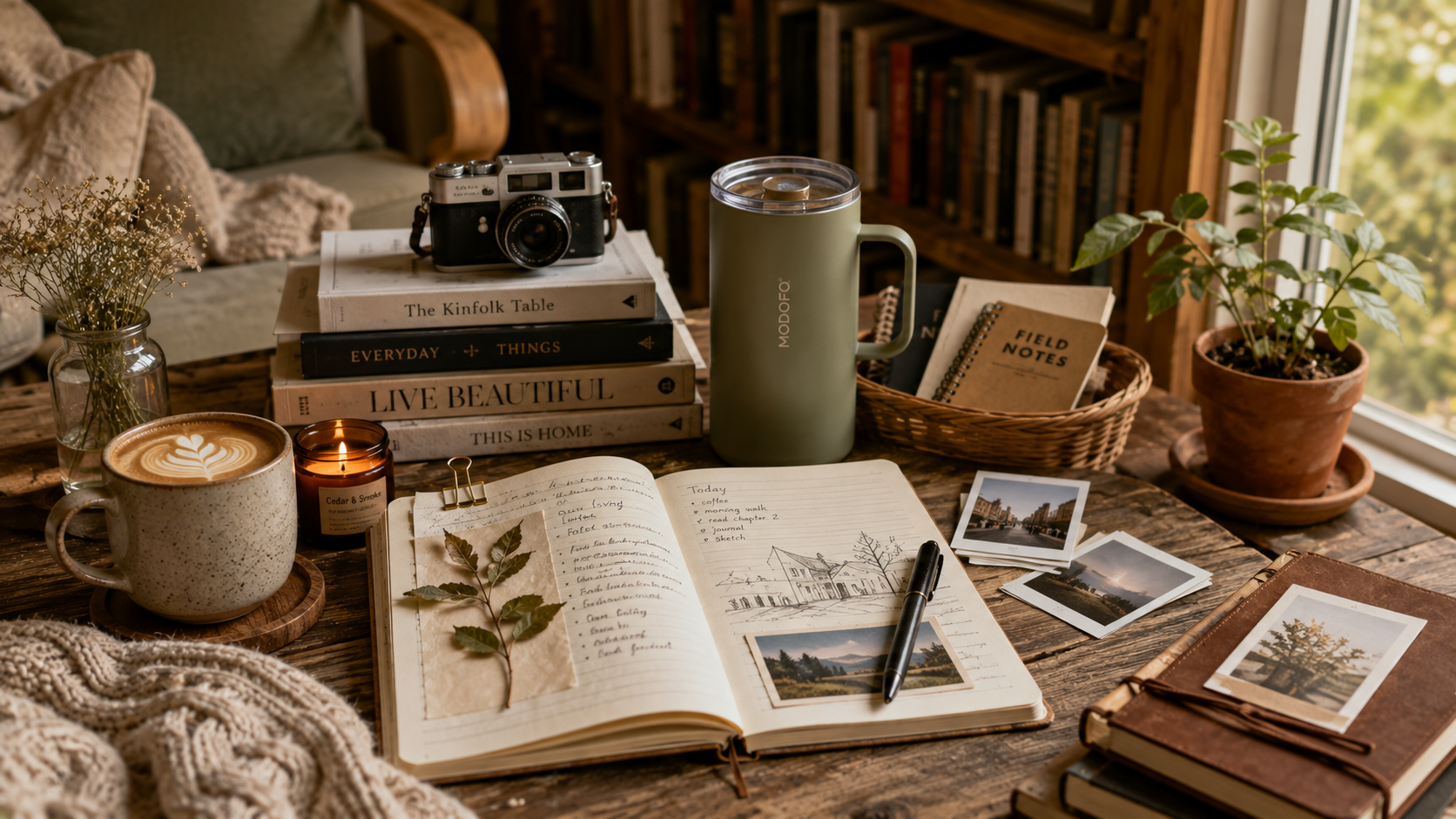
A ceramic mug enjoyed every morning.
An insulated tumbler accompanying a train commute.
A reusable water bottle taken on forest walks.
These everyday items quietly become companions in daily life.
Their value comes not from being luxurious, but from being used, appreciated, and woven into personal routines.
Building Your Own Analog Weekend
Creating more offline moments doesn't require dramatic lifestyle changes.
Often, small rituals make the biggest difference.
You might begin the morning by brewing coffee slowly instead of rushing out the door.
Visit a local bookstore instead of scrolling online.
Bring a notebook to a nearby park.
Take a walk without listening to a podcast.
Sketch a building that catches your attention.
Write a postcard to a friend.
Browse a weekend market.
Enjoy lunch outdoors.
Read a few chapters before going to bed.
None of these activities are extraordinary on their own.
Together, they create a weekend that feels calmer, richer, and easier to remember.
The MODOFO GLOBAL Philosophy
At MODOFO GLOBAL, we believe everyday life becomes more meaningful when we create space for simple rituals.
A notebook waiting to capture new ideas.
A favorite book beside the window.
Fresh coffee shared with friends on a quiet morning.
A reusable tumbler accompanying a walk through the city or a peaceful afternoon in nature.
Thoughtfully designed everyday essentials don't define the experience.
They simply make it easier to enjoy the moments that matter.
Because the most memorable parts of life rarely happen while rushing.
They happen when we slow down enough to notice them.
Conclusion: Choosing Presence Over Constant Noise
Technology will continue to shape the future.
It makes our lives more connected, more efficient, and more convenient.
But convenience alone doesn't always create lasting memories.
Sometimes the experiences we treasure most are surprisingly simple.
Reading a well-loved book.
Writing in a journal after sunset.
Brewing coffee by hand.
Walking through a quiet forest.
Watching autumn leaves fall without reaching for a phone.
Analog living isn't about escaping the modern world.
It's about making room for experiences that remind us how rewarding it can be to slow down.
In a culture that often celebrates doing more, analog living quietly suggests another idea.
Perhaps living well isn't about filling every moment.
Perhaps it's about paying closer attention to the moments we already have.
The richest experiences aren't always found on a screen—they're often waiting in the pages of a book, the warmth of a coffee mug, and the quiet moments we choose to keep for ourselves.