
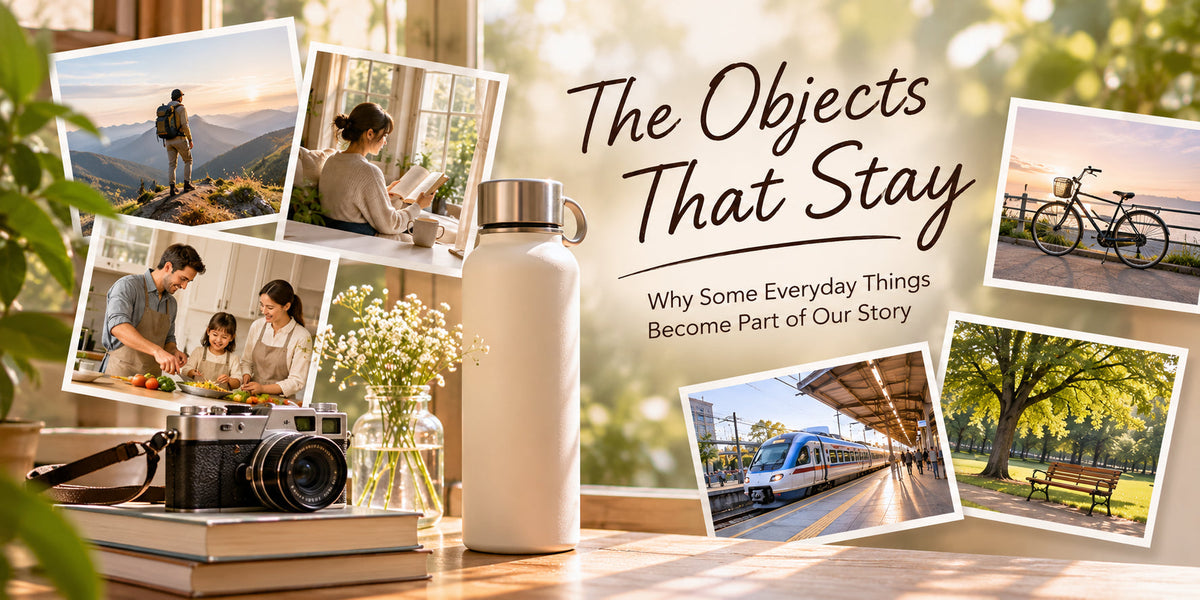
Why Some Everyday Things Become Part of Our Story
Introduction: Not Everything We Own Is Meant to Last
We live in an age of constant replacement.
New phones arrive every year.
Fashion trends change every season.
Home décor follows the latest color palette.
Even everyday products are often designed to be replaced rather than remembered.
Yet, despite living in a world that moves so quickly, most people can think of a few objects they have kept for years.
A favorite coffee mug.
A notebook filled with old ideas.
A cast-iron pan passed down through generations.
A backpack that has traveled across countries.
A watch worn every day.
A reusable bottle that has quietly accompanied countless mornings, commutes, workouts, and weekend adventures.
These objects are valuable not because they are expensive.
They become valuable because they remain.
Over time, they stop being possessions.
They become part of our story.
The Things We Use Every Day Shape Our Lives
Most memorable objects are not displayed behind glass.
They are used.
Again and again.
The mug waiting on the kitchen counter every morning.
The bottle carried to work.
The lunch box packed before school.
The blanket brought out every winter.
The camera taken on every vacation.
These ordinary companions witness thousands of small moments that are easy to overlook.
A sunrise before an early train.
A quiet afternoon reading in the park.
A long conversation with a close friend.
A family picnic.
The first day of a new job.
The last day at an old one.
They become silent witnesses to everyday life.
Good Design Ages with Us
Many products are designed to attract attention.
Great products are designed to earn trust.
As the years pass, scratches appear.
Colors soften.
Small signs of use become visible.
Rather than reducing value, these marks often make an object feel more personal.
A leather notebook becomes softer.
A wooden table gains character.
A ceramic mug carries tiny reminders of daily rituals.
Even a well-used bottle tells a story through the places it has traveled.
Objects that age gracefully remind us that beauty is not always found in perfection.
Sometimes it is found in continuity.
Everyday Rituals Give Objects Meaning
An object becomes meaningful because of what happens around it.
Coffee before sunrise.
Tea after dinner.
Water during a long walk.
A warm drink shared while talking late into the evening.
The object itself remains the same.
The moments around it continue to grow.
This is why people rarely remember every product they have owned.
They remember how those products became part of their routines.
Rituals quietly transform everyday objects into emotional companions.
Durability Is Also a Form of Sustainability
Sustainability is often discussed in terms of materials and manufacturing.
Those are important.
But another part of sustainability is simply making products people want to keep.
The longer an object stays in daily use, the fewer resources are needed to replace it.
A thoughtfully designed reusable bottle that serves someone for years has a very different impact than one replaced every few months.
Longevity encourages appreciation.
Care.
Repair.
Attachment.
The most sustainable products are often the ones that never become disposable in our minds.
Why We Form Emotional Connections with Everyday Objects
Psychologists have long observed that people naturally attach memories to physical objects.
Not because the objects themselves are extraordinary.
But because they quietly accompany meaningful experiences.
A favorite pen reminds us of university.
A travel bag recalls unforgettable journeys.
A cookbook carries handwritten notes from family dinners.
A bottle may remind us of morning walks, road trips, mountain hikes, or long workdays that eventually became meaningful chapters of life.
The object becomes a bridge between memory and the present.
The Best Products Don't Interrupt Life
Thoughtful design rarely asks for attention.
Instead, it supports what already matters.
A comfortable handle.
A lid that feels secure.
Materials that last.
A shape that fits naturally into everyday routines.
Good design disappears into the experience.
It lets people focus on conversations instead of convenience.
On landscapes instead of logistics.
On people instead of products.
The greatest compliment an everyday object can receive is not that it looks impressive.
It is that people naturally reach for it every single day.
More Than a Bottle
A bottle is often seen as something simple.
Something practical.
Something ordinary.
Yet it quietly accompanies many of life's most meaningful moments.
Morning coffee before the city wakes.
Ice water after a long hike.
Tea shared with family on a rainy afternoon.
A favorite drink beside a book on a peaceful Sunday.
A companion during commutes, creative work, travel, and everyday routines.
The value of a reusable bottle is not measured only by what it holds.
It is measured by the experiences it quietly travels through with us.
Like many well-designed everyday essentials, it becomes less noticeable over time—not because it matters less, but because it fits so naturally into life.
The MODOFO GLOBAL Philosophy
At MODOFO GLOBAL, we believe everyday products should be designed for more than a single season.
They should be created to accompany years of ordinary moments.
To travel from home to work.
From weekend adventures to family gatherings.
From quiet mornings to new beginnings.
Rather than chasing short-lived trends, we believe thoughtful design earns its place through reliability, comfort, and timeless simplicity.
Our hope is never that a product becomes the center of attention.
Our hope is that it quietly becomes part of someone's everyday life.
Because the objects people keep are often the ones that have helped them create memories.
Conclusion: The Things That Stay Become Part of Who We Are
Life is measured less by the things we own than by the moments we experience.
Some objects simply pass through our lives.
Others remain.
They witness celebrations.
Challenges.
Journeys.
Conversations.
Ordinary mornings.
Unexpected adventures.
Over time, they become woven into our routines so naturally that we hardly notice them anymore.
And perhaps that is the highest achievement of thoughtful design.
Not to stand out for a moment.
But to stay.
To be trusted.
To be used.
To quietly accompany the life unfolding around it.
Because the most meaningful everyday objects are never remembered only for how they looked.
They are remembered for where they were, who they were with, and the life they helped us live.
The best everyday essentials don't simply last for years. They become part of the stories worth remembering.